Economy
Demand for Dangote Cement, Others Lifts Stock Exchange by 2.10%
By Dipo Olowookere
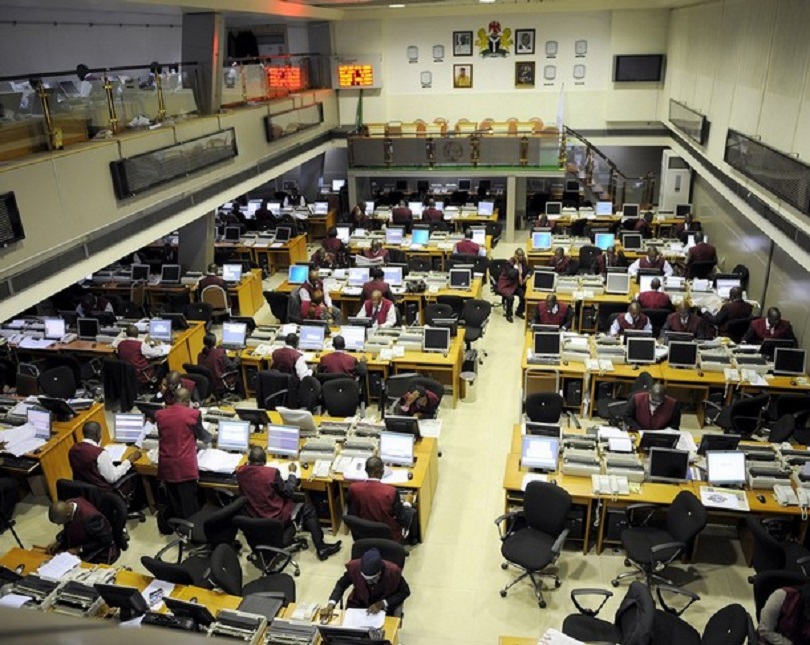
The local stock exchange reversed the previous day’s loss, with a 2.10 per cent surge on Friday as a result of demand for large-cap equities like Dangote Cement, First Holdco and others.
It was observed that apart from the insurance counter, which shed 0.37 per cent, every other sector closed higher yesterday.
The industrial goods index expanded by 7.26 per cent, the banking segment increased by 3.35 per cent, the consumer goods industry rose by 0.21 per cent, and the energy sector soared by 0.14 per cent.
Consequently, the All-Share Index (ASI) of the Nigerian Exchange (NGX) Limited improved by 5,041.22 points to 244,775.83 points from 239,734.61 points, and the market capitalisation added N3.235 trillion to settle at N157.094 trillion compared with the preceding session’s N153.859 trillion.
The quintet of Neimeth, Cadbury Nigeria, LivingTrust Mortgage Bank, Mecure, and Dangote Cement led the advancers’ table on Friday, with 10.00 per cent growth each to quote at N9.90, N72.60, N3.52, N72.60, and N1,088.00, respectively.
On the flip side, the duo of UAC Nigeria and Industrial and Medical Gases lost 10.00 per cent each to sell for N171.00 and N42.30, respectively, as Eterna declined by 9.93 per cent to N33.55, Learn Africa slipped by 9.89 per cent to N8.20, and Deap Capital tripped by 9.69 per cent to N5.50.
The most active stock for the day was VFD Group, with a turnover of 102.9 million units valued at N1.1 billion. FCMB transacted 99.4 million units worth N1.1 billion, UBA traded 94.5 million units for N3.8 billion, Access Holdings exchanged 85.4 million units worth N2.0 billion, and Zenith Bank sold 46.5 million units valued at N5.8 billion.
At the close of trades, market participants traded 1.1 billion units worth N55.0 billion in 69,996 deals, in contrast to the 1.8 billion units valued at N72.2 billion transacted in 81,131 deals a day earlier, showing a crash in the trading volume, value, and number of deals by 38.89 per cent, 23.82 per cent, and 13.73 per cent, respectively.
Economy
Why Nigeria’s $46.7 Billion War Chest Is a Game Changer for Forex Traders
Nigeria’s foreign reserves rising to the $46.7 billion area has changed the mood around the naira. For a country that has spent years fighting dollar shortages, parallel market pressure, and nervous investor sentiment, that number feels like more than a headline. It feels like a cushion the market can finally see. Channels Television reported that Nigeria’s external reserves reached the $46.7 billion mark, helped by Eurobond proceeds and stronger foreign exchange inflows.
For traders in Lagos, Abuja, Port Harcourt, and Kano, reserves are not just central bank language. They affect liquidity, confidence, pricing, and the way buyers and sellers behave when dollar demand starts rising. A bigger reserve buffer is like extra fuel in the tank during a long trip. You still need good driving, but at least the fear of running empty is lower.
For anyone watching forex in Nigeria, this reserve build up matters because it can change how the market reads the naira. It does not mean the currency suddenly becomes risk free. It means the Central Bank of Nigeria has more room to manage pressure, support orderly trading, and calm panic when the market gets noisy.
Why Bigger Reserves Matter to the Naira
A strong reserve position tells traders that Nigeria has more external firepower. It can help the central bank meet foreign currency needs, manage short term shocks, and give investors more confidence that the country can handle external obligations.
Confidence Can Shift Market Behaviour
Currency markets run on confidence as much as numbers. When reserves are weak, importers may rush to buy dollars early because they fear scarcity. When reserves look stronger, that panic can reduce. You might see calmer pricing, narrower spreads, and fewer wild reactions to every rumour.
That is important in Nigeria, where the official and parallel markets have often moved with different moods. Stronger reserves can help traders believe that the market is less vulnerable to sudden stress.
The Central Bank Has More Room to Act
Reuters reported that Nigeria’s net foreign exchange reserves jumped to $34.8 billion by the end of 2025, while gross reserves also improved sharply. The Central Bank of Nigeria linked that improvement to stronger inflows, better reserves management, and reforms aimed at restoring confidence in the currency market.
That gives the central bank more room to guide the market. Not unlimited room, of course. But enough to make speculators think twice before betting too aggressively against the naira.
What This Means for Nigerian Traders
For traders, the biggest change is not just the reserve number itself. It is what the number may do to expectations. In forex, expectation can move price before policy does.
Naira Volatility May Become More Manageable
When reserves are healthier, the naira may still move, but the moves can become less disorderly. Traders may find that sudden panic spikes become less frequent if the market believes dollar supply is improving.
This matters for short term traders who watch intraday movement. It also matters for businesses that need to plan import payments. A trader in Lagos tracking USDNGN knows that confidence can change fast, but a stronger reserve position can make the market feel less like a guessing game.
Liquidity Is Still the Real Test
A reserve buffer only becomes meaningful when it improves actual access to dollars. Reuters reported that the CBN approved weekly foreign currency sales of up to $150,000 to licensed bureau de change operators as part of efforts to improve liquidity and broaden access to foreign exchange.
That is where traders should stay alert. If reserves rise but market access stays tight, pressure can return. The real question is simple: are dollars reaching the market smoothly?
Why This Is Bigger Than One Currency Pair
Nigeria’s reserve strength does not only affect USDNGN. It can shape inflation expectations, import costs, investor flows, and even sentiment toward local assets.
Importers May Feel Less Pressure
Many Nigerian businesses rely on imported goods, machinery, fuel, medicine, electronics, and raw materials. When dollar supply improves, pricing pressure can ease. It may not happen overnight, but it can reduce the sense of panic that often filters into consumer prices.
Think of a spare parts dealer in Ladipo or a medicine importer in Lagos. If dollar access becomes more predictable, pricing decisions become easier. That can slowly help business planning.
Investors Watch the Same Signal
Foreign investors also watch reserves closely. Stronger reserves suggest better external stability, and that can make Nigerian assets look less risky. It does not erase concerns about inflation, policy consistency, or oil production, but it helps the story.
For traders, this means reserves can influence more than the chart. They can affect the entire mood around Nigerian markets.
Conclusion
Nigeria’s $46.7 billion reserve war chest is a game changer because it gives the naira something markets always respect: backing. It can improve confidence, reduce panic demand, support liquidity efforts, and make traders rethink one way bets against the currency.
Still, reserves are not a magic shield. Oil earnings, dollar demand, inflation, policy discipline, and investor trust still matter. The smartest Nigerian traders will not treat this as a reason to relax. They will treat it as a signal to watch the market more closely, because when confidence returns, currency behaviour can change quickly.
Economy
Champion Breweries Better Positioned to Capitalise on Emerging Opportunities
By Aduragbemi Omiyale
Shareholders of Champion Breweries Plc have been given the assurance to enjoy more value for investment in the brewery giant because of the strategies put in place by the board and management.
The chairman of Champion Breweries, Mr Imo-Abasi Jacob, while speaking at the recently-concluded landmark 50th Annual General Meeting (AGM) of the organisation in Uyo, Akwa-Ibom State, stressed that the firm was now “better positioned to navigate future uncertainties and capitalise on emerging opportunities.”
He further said, “Champion Breweries Plc now operates from a more stable and resilient platform, characterised by improved profitability, a strengthened capital base, and a clearer strategic direction.”
According to him, the performance of the company in the first quarter of 2026 attests to this fact, as it sustained its growth momentum, with a 69 per cent year-on-year increase in revenue to N14.36 billion, while operating profit rose to approximately N3.02 billion, driven by improved efficiency and disciplined cost management.
Despite softer consumer demand and lower domestic volumes, Champion Breweries maintained a strong gross profit margin of 48 per cent, while profit after tax stood at approximately N881 million.
In the 2025 fiscal year, the organisation grew its revenue by 43 per cent to N29.80 billion, while post-tax profit rose by 119 per cent to N1.79 billion, reflecting the success of its margin-led growth strategy.
This sterling performance inspired the board to declare a dividend of 7 Kobo per share, which was approved by shareholders at the AGM.
Mr Jacob described the financial year as a defining phase in the company’s evolution, noting that it successfully transitioned from recovery into a stronger growth phase, driven by improved profitability, disciplined operations, strategic capital raising, and expansion initiatives.
“The year under review represents a defining phase in the company’s evolution, one in which Champion Breweries Plc transitioned from a position of recovery to one of measurable growth, strengthened profitability, and strategic repositioning,” he said.
He noted that the firm’s successful rights issue strengthened its capital structure, broadened shareholder participation, and reinforced investor confidence in its long-term strategy.
“Our successful engagement with the capital market during the year was not only a strategic financing milestone, but also a strong vote of confidence from shareholders and stakeholders in the future of Champion Breweries Plc,” he stated.
Economy
Sunu Assurances Extends Closure of N9.3bn Rights Issue to June 3
By Aduragbemi Omiyale
The deadline for the N9.34 billion rights issue of Sunu Assurances Nigeria Plc has been extended to Wednesday, June 3, 2026.
This followed the approval granted by the Securities and Exchange Commission (SEC) for the company to shift the closure date by two weeks.
Business Post reports that the exercise was initially scheduled to end on Wednesday, May 20, 2026, but the apex regulatory agency in the Nigerian capital market has allowed the rights issue to now close next Wednesday.
The Sunu Assurances rights issue opened on Monday, April 13, 2026, and the organisation is offering 2,075,285,714 ordinary shares of 50 Kobo each at N4.50 per share on the basis of five new ordinary shares for every existing 14 ordinary shares held as of the close of business on Thursday, February 12, 2026.
Funds from the rights issue will be used by the non-life insurer to meet the N15 billion minimum capital requirement introduced under the Nigerian Insurance Industry Reform Act (NIIRA) 2025.
The National Insurance Commission (NAICOM) has directed operators in the country’s underwriting sector to shore up their capital base on or before July 31, 2026.
“We are positioning early to meet the new benchmark and enhance our capacity to underwrite larger and more complex risks,” the company’s chairman, Mr Kyari Abba Bukar, stated.
-
Feature/OPED6 years agoDavos was Different this year
-
Travel/Tourism10 years ago
Lagos Seals Western Lodge Hotel In Ikorodu
-
Showbiz3 years agoEstranged Lover Releases Videos of Empress Njamah Bathing
-
Banking8 years agoSort Codes of GTBank Branches in Nigeria
-
Economy3 years agoSubsidy Removal: CNG at N130 Per Litre Cheaper Than Petrol—IPMAN
-
Banking3 years agoSort Codes of UBA Branches in Nigeria
-
Banking3 years agoFirst Bank Announces Planned Downtime
-
Sports3 years agoHighest Paid Nigerian Footballer – How Much Do Nigerian Footballers Earn