Connect with us

Economy

Ecobank, NIRSAL Give Farmers Single Digit Interest Loans

Published

on

By Dipo Olowookere

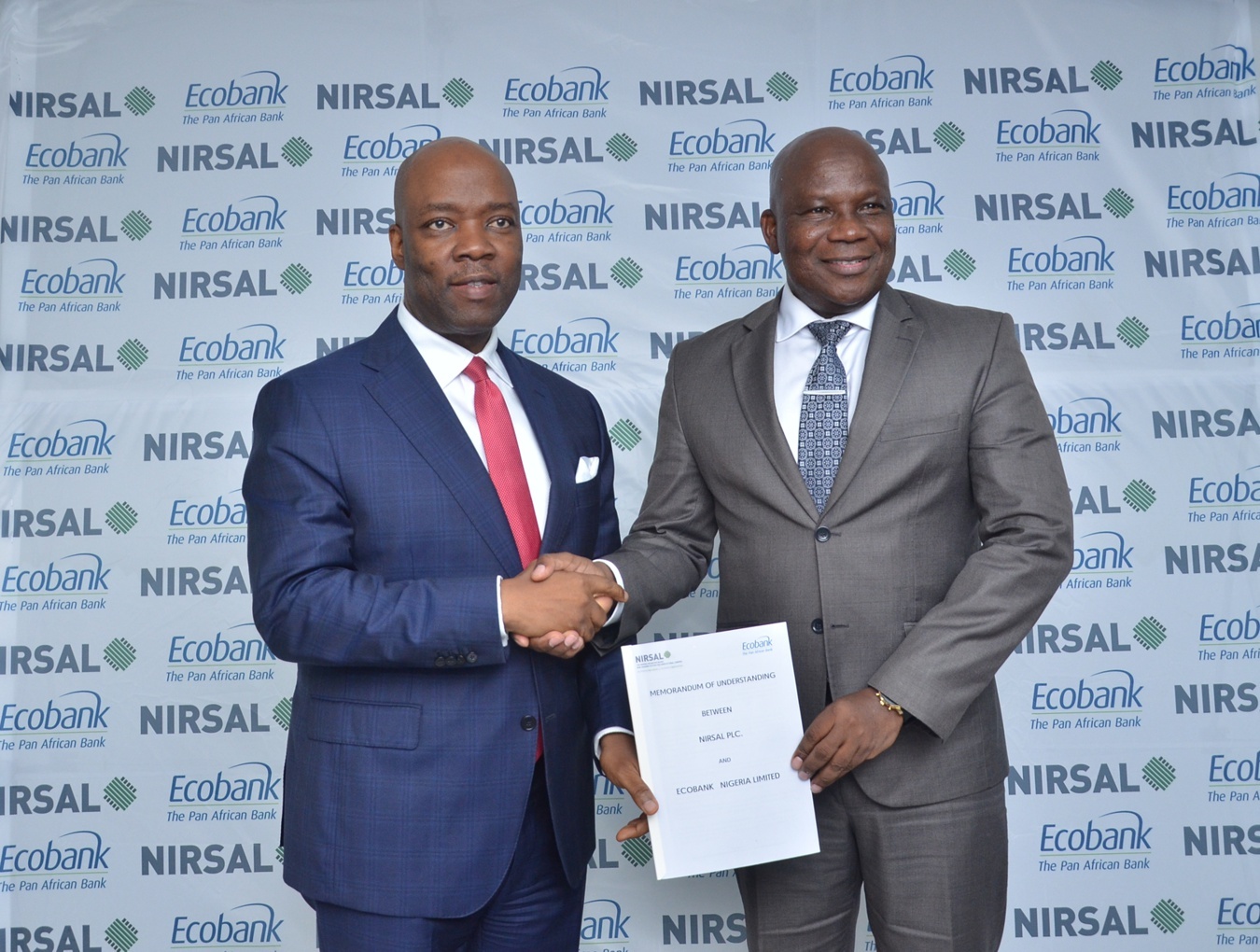
A Memorandum of Understanding (MoU) has been signed between Ecobank Nigeria Limited and Nigeria Incentive-Based Risk-Sharing System for Agricultural Lending (NIRSAL).

This signals the beginning of a collaboration between both institutions on agri-business financing and the development of products that will support lending to actors in the agricultural value chain in conformity with Ecobank’s risk acceptance criteria and credit process.

Under the arrangement, Ecobank has committed a portfolio of N70 billion in series that has the bank immediately releasing a lump sum of N15 billion take off funding.

Ecobank and NIRSAL would jointly select and develop projects that will meet the financing needs of actors in NIRSAL’s focal commodity value chains. These include maize, soybean, wheat, cassava and cotton for industrial commodities.

The list also includes consumer commodities such as hibiscus, sesame, ginger and shea, rice; controlled environment agriculture commodities including sweet potato and beans, fresh fruits and vegetables and agriculture and integrated livestock commodity. The intent of the partnership is to ensure farmers get single digit interest rates to make agriculture attractive to both the elderly and the young population.

In his comment at the MoU signing ceremony in Lagos, Managing Director of Ecobank Nigeria Limited, Mr Patrick Akinwuntan, said the bank was actively promoting agriculture as a strategic initiative to support national development which is critical to the wellbeing of Nigerians.

According to Mr Akinwuntan, Ecobank is committed to working with NIRSAL to open up the vast opportunities that abound in agriculture and to ensure citizens benefit ultimately.

“This is a collaboration and the federal government had made it clear that investing in the agriculture sector is very critical for Nigeria to succeed, especially taking into consideration the natural endowment God granted us in terms of population, land and weather.

“We have the opportunity to make agriculture the economic spinner for Nigeria. What we are doing is to fulfil this policy direction of the Federal Government and the Central Bank of Nigeria (CBN),” he noted.

Further, Mr Akinwuntan reiterated that “in Nigeria, Ecobank hopes to contribute positively to move the economy forward, creating employment for the teeming population through agriculture. We found a natural partner in NIRSAL, as they have the requisite intellectual and technical capacity to act as meeting point for the stakeholders in the sector.

“The de-risking participation of NIRSAL gives us the will to provide these facilities at single digit rates at a maximum of 9 percent to ensure that the users are able to make profit. When our customers make profit, we are also able to make profit. So it is a win – win business for everyone”.

Also speaking, Managing Director of NIRSAL, Mr Aliyu Abdulhameed, revealed that under the agreement, and in line with its Mapping to Markets (M2M) strategy, NIRSAL will identify and refer structured projects to Ecobank to support the bank’s deal origination and financing operations in agribusiness.

On its part, Ecobank will finance the projects leveraging NIRSAL’s Credit Risk Guarantee (CRG) which is a further comfort for lenders to agriculture and agribusiness.

Shedding more light on the M2M, Mr Abdulhameed noted that the strategy is “a closed loop financing system that mandatorily operates via one bank or a consortium of banks.

He added that NIRSAL will refer input and service providers under the M2M to Ecobank for account opening, hence, driving the growth of the bank’s business.

In addition to growing the bank’s business, Abdulhameed said that NIRSAL will develop a program for training Ecobank staff on Agribusiness Finance, with emphasis on how to channel customer applications and requests for effective and streamlined agribusiness lending.

The MoU ceremony had in attendance top executives of both institutions including Akintayo Dada, Executive Director, Corporate & Investment Banking, Biyi Olagbami, Executive Director / Chief Risk Officer and  Carol Oyedeji, Executive Director, Commercial Bank, all of  Ecobank Nigeria and  Babajide Arowosafe, Executive Director, Technical, Eze Nwakanma, Assistant General Manager, Agricultural Value Chain Finance & Investment Services,  Ernest Ihedigbo, Head, Balance Sheet Financing & Portfolio Management and  Michael Adeoye, Head, Credit Risk Guarantee Operations and Portfolio Management, from NIRSAL Plc

Dipo Olowookere is a journalist based in Nigeria that has passion for reporting business news stories. At his leisure time, he watches football and supports 3SC of Ibadan. Mr Olowookere can be reached via [email protected]

Click to comment

Leave a Reply

Your email address will not be published. Required fields are marked *

Economy

Nigerians Pay More to Buy Eggs, Beans, Garri

Published

on

garri beans eggs

By Adedapo Adesanya

Nigerians paid more to buy staple foods, including eggs, beans, and garri, in March 2026 compared with what they paid in the preceding month, according to the National Bureau of Statistics (NBS).

The agency, in its Selected Food Prices Watch report for March 2026, released on Wednesday, said that the average price of eggs (a crate of 30 pieces) on a month-on-month basis went up by 2.00 per cent from N6,007.35 in February 2026.

However, the price of the proteinous meal decreased by 20.12 per cent on a year-on-year basis from N7,670.56 recorded in March 2025 to N6,127.63 in March 2026.

Similarly, the report said that the average price of 1kg of brown beans decreased by 49.39 per cent on a year-on-year basis from N2,616.26 in March 2025 to N1,325.85 in March 2026, but on a month-on-month basis, the price increased by 1.41 per cent from the N1,307.44 recorded in February 2026. It also showed the average price of 1kg of white garri decreased by 41.19 per cent on a year-on-year basis from N1,362.96 in March 2025 to N801.4 in March 2026, and on a month-on-month basis, it rose by 1.38 per cent from the N790.62 recorded in February 2026.

The report said that the average price of 1kg of onion decreased by 19.63 per cent from N1,434.85 recorded in March 2025 to N1,153.14 in March 2026. On a month-on-month basis, 1kg of onions increased by 1,59 per cent in March from the N1,135.12 recorded in February 2026.

The report said the average price of 1kg of fresh ginger increased by 20.46 per cent from the N4,600.23 recorded in March 2025 to N5,541.25 in March 2026. On a month-on-month basis, 1kg of ginger increased by 0.61 per cent in March from the N5,507.43 recorded in February 2026.

However, it said the average price of one litre of palm oil decreased by 4.71 per cent on a year-on-year basis from N2,511.77 recorded in March 2025 to N2,393.38 in March 2026.

Continue Reading

Economy

NASD Exchange Rises 1%

Published

on

NASD Exchange bullish

By Adedapo Adesanya

Four securities buoyed the NASD Over-the-Counter (OTC) Securities Exchange by 1.00 per cent on Wednesday, May 6.

During the session, 11 Plc soared by N19.10 to sell at N210.10 per unit compared with the previous day’s N191.00 per unit, FrieslandCampina Wamco Nigeria Plc gained N9.90 to close at N116.80 per share versus N106.90 per share, Food Concepts Plc rose by 23 Kobo to N2.59 per unit from N2.36 per unit, and IPWA Plc increased by 3 Kobo to trade at N7.3o per share compared with the preceding day’s N7.27 per share.

As a result, the market capitalisation went up by N24.32 billion to N2.454 trillion from N2.429 trillion, and the NASD Unlisted Security Index (NSI) grew by 40.64 points to 4,101.58 points from 4,060.94 points.

It was observed that at midweek, there were two price decliners led by Okitipupa Plc, which shrank by N5.00 to finish at N300.00 per unit compared with the previous day’s N305.00 per unit, and Central Securities Clearing System (CSCS) Plc dipped by N1.14 to N76.00 per share from N77.14 per share.

The volume of securities traded by investors fell by 9.5 per cent to 506,651 units from the 679,768 units recorded a day earlier, and the number of deals slid by 15.9 per cent to 37 deals from 44 deals, while the value of securities went up by 25.5 per cent to N44.8 million from the N30.9 million recorded on Tuesday.

At the close of business, Great Nigeria Insurance (GNI) Plc remained the most traded stock by value on a year-to-date basis, with 3.4 billion units valued at N8.4 billion, followed by CSCS Plc with 60.3 million units exchanged for N4.1 billion, and Okitipupa Plc with 27.8 million units traded for N1.9 billion.

GNI Plc also ended the session as the most traded stock by volume on a year-to-date basis, with 3.4 billion units worth N8.4 billion, trailed by Resourcery Plc with 1.1 billion units sold for N415.7 million, and Infrastructure Guarantee Credit Plc with 400 million units transacted for N1.2 billion.

Continue Reading

Economy

Naira Rallies to N1,357/$1 at NAFEX, Remains N1,380/$1 at Parallel Market

Published

on

yuan-naira $10bn

By Adedapo Adesanya

The Naira maintained stability against the United States Dollar in the parallel market segment of the foreign exchange (FX) market on Wednesday at N1,380/$1, according to data obtained by Business Post.

However, at the Nigerian Autonomous Foreign Exchange Market (NAFEX), it appreciated against the greenback by N9.22 or 0.67 per cent to quote at N1,357.34/$1 versus Tuesday’s closing value of N1,366.56/$1.

Equally, the local currency gained N5.58 against the Pound Sterling in the same market window at midweek to close at N1,847.20/£1 compared with the previous day’s N1,852.78/£1, and against the Euro, it was strengthened by N3.74 to N1,595.00/€1 from N1,598.74/€1.

In the same vein, the Nigerian Naira improved its rate against the US Dollar at the GTBank forex counter yesterday by N9 to sell at N1,375/$1, in contrast to the preceding session’s N1,384/$1.

Market activity improved notably, with total deals rising to 287 on Wednesday, a 25 per cent increase from 262 recorded on Tuesday. FX turnover climbed by 59.22 per cent or $157.88 million to $424.46 million from $266.58 million posted the previous day.

Activity in the interbank segment also strengthened. The number of deals rose by 62.6 per cent to 161 on Wednesday from 99 on Tuesday, while turnover surged by 120.95 per cent to $158.18 million from $71.59 million.

The improved liquidity conditions saw Nigeria’s external reserves continue their downward trend, declining to $48.33 billion as of May 5, 2026, according to data from the apex bank.

The Naira could face mild pressure from maturing securities, particularly the large volume of Open Market Operations (OMO) maturities exceeding N7 trillion. However, inflows from autonomous sources are expected to provide some cushion against potential volatility, analysts at the FMDA said.

Meanwhile, the cryptocurrency market was mixed as global stock markets ripped to fresh records on US-Iran ceasefire hopes, with reports indicating the two countries are working on a proposal to end the nearly 10-week conflict.

Binance Coin (BNB) gained 1.9 per cent to sell for $646.39, Solana (SOL) appreciated by 1.4 per cent to $88.55, Cardano (ADA) rose by 1.0 per cent to $0.2661, and TRON (TRX) increased by 0.3 per cent to $0.3447.

On the flip side, Dogecoin (DOGE) fell by 4.1 per cent to $0.1108, Ethereum (ETH) declined by 1.4 per cent to $2,329.51, Ripple (XRP) slipped by 1.7 per cent to $1.41, and Bitcoin (BTC) decreased by 0.3 per cent to $81,025.93, while the US Dollar Tether (USDT) and the US Dollar Coin (USDC) closed flat at $1.00 apiece.

Continue Reading

Trending