Economy
Edo Modular Refinery to Increase Capacity by 900%
By Adedapo Adesanya
The handlers of the Edo Modular Refinery have disclosed plans to increase its refining capacity target by 900 per cent to 60,000 barrels per day of crude oil against the initially planned 6,000 barrels per day.
The modular refinery is a project being developed by two Chinese firms, AIPCC Energy Limited and the Peiyang Chemical Equipment Company Limited in the state.
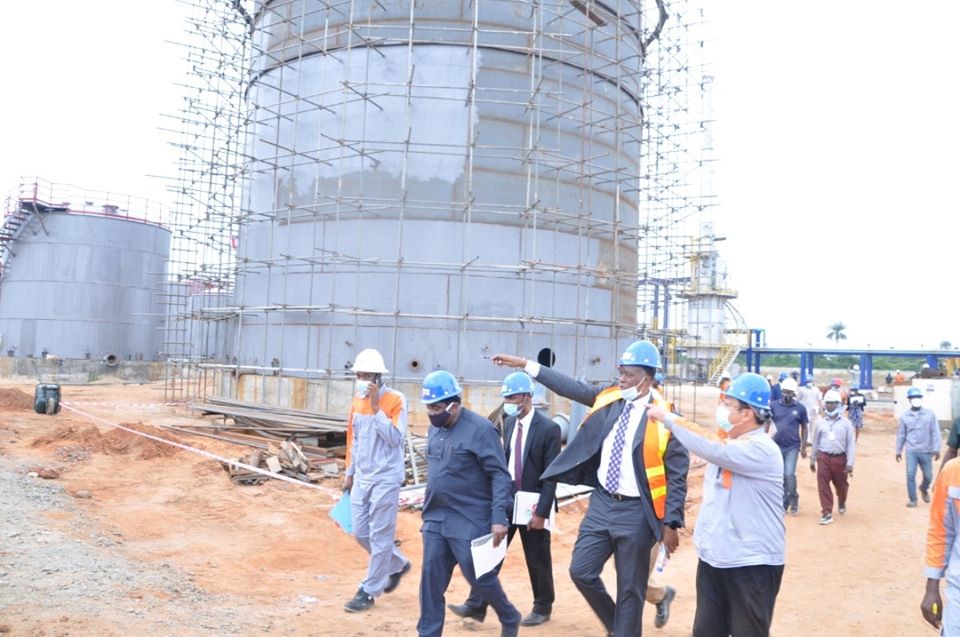
The Head Quality, Health and Safety/ Community Relations of the AIPCC, Mr Segun Okeni, disclosed this on Tuesday during an inspection tour of the site at Ologbo in Ikpoba-okha Local Government Area by a seven-man factional members the Edo State House of Assembly loyal to Governor Godwin Obaseki.
Mr Okeni said that the modular refinery would commence operation between the end of September and mid-October.
He said the first phase of the project would target 1,000 barrels per day and 6,000 barrels per day for the second phase while the 60,000 barrels daily would be achievable in the long run.
He noted that the first phase of the refinery, which is 99 per cent completed, would target four products at the ratio of 55 per cent for diesel, 38 per cent for fuel oil and less than 10 per cent for naphtha while the rest would be gas to power the processing of the equipment.
In his words, “Some of the products will be exported to boost foreign exchange earnings and by the time of we extend it to different phases, we would be able to take care of more than 80 per cent of diesel requirement in Nigeria. That is the vision we have in the next five years.
“We have directly employed more than 300 people and the majority is from the host communities in Edo. The environment has been friendly, the host community and the government have been cooperative and that is why we are able to deliver to this stage.
“We are almost rounding off. It is just left with less than one per cent. We are going to work with the government and people around the community will benefit from this project.”
He further disclosed that there are plans in progress to source crude from the Nigerian Petroleum Development Company (NPDC) facility located a few kilometres away from the project site.
The factional Speaker of Edo State House of Assembly, Mr Francis Okiye, commended the executive arm of government and noted that the investment is for the benefit of Edo people.
Mr Okiye expressed optimism that the project would create more revenue, jobs, wealth and ease the pressure on other refineries.
“We satisfied that there is judicious use of the money appropriated by the executive. We are here on an oversight function and inspection for proper justification of our funds.”
The project will also help boost the status of Edo which alongside Delta, Akwa-Ibom, Bayelsa, Rivers, Ondo, Imo, Abia and Lagos are the oil-producing states in the country.
Economy
Nigeria’s External Reserves Hit $52.5bn, Cover Nine Months of Imports
By Adedapo Adesanya
The Governor of the Central Bank of Nigeria (CBN), Mr Yemi Cardoso, disclosed that Nigeria’s external reserves had risen to $52.5 billion, enough to finance about nine months of imports.
He disclosed this on Tuesday at the end of the 306th meeting of the Monetary Policy Committee (MPC) held in Abuja, where the Monetary Policy Committee (MPC) retained the benchmark interest rate at 26.50 per cent as well as the standing facilities corridor at +50/-450 basis points around the MPR.
Similarly, the Cash Reserve Requirement (CRR) was maintained at 45 per cent for Deposit Money Banks, 16 per cent for Merchant Banks, and 75 per cent for non-Treasury Single Account (TSA) public sector deposits.
Speaking on FX developments, the central banker said at the $52 billion level, the country’s external reserves were significantly above the internationally recommended threshold of three months of import cover.
On the Naira exchange rate, Mr Cardoso said the foreign exchange market had deepened and was now operating on a transparent willing-buyer, willing-seller basis.
He said the apex bank remained committed to maintaining a liquid and functional foreign exchange market, adding that daily market turnover sometimes exceeded $1 billion.
According to him, the long-term stability of the naira would depend on key economic fundamentals, including increased oil exports, foreign direct investment, and improved domestic productivity to reduce dependence on imports.
He also added that the MPC welcomed the federal government’s renewed commitment to stronger policy coordination, particularly collaboration between fiscal and monetary authorities, which he said had helped reduce the impact of the Middle East crisis on the Nigerian economy.
Mr Cardoso said members of the committee also commended efforts to improve crude oil production and urged relevant agencies to intensify reforms in other sectors, including solid minerals, to boost government revenue.
On the regulatory forbearance granted to banks during the COVID-19 period, he reiterated that this had been discontinued because it had served its purpose.
According to him, the policy had “outlived its time” and was no longer necessary in assessing the health of the banking sector.
“Forbearance, we felt, had outlived its time. Many of you will recall this is something that came as a result of COVID. And now we are in 2026; we did not see the reason why that should continue to form part of the analysis of the banking system,” he said.
Mr Cardoso explained that banks had begun recalibrating their portfolios following the end of the policy, leading to a temporary reduction in outstanding risk assets.
He, however, assured that the development was part of a transition towards a stronger and more sustainable credit environment.
“It reflects a transition to a more sustainable and better quality credit environment, which is what we all want. We don’t want unanticipated shocks that come in a boom-and-bust fashion,” he said.
Economy
FrieslandCampina Leads to NASD OTC Exchange to 1.17% Growth
By Adedapo Adesanya
The NASD Over-the-Counter (OTC) Securities Exchange extended its recent positive run by 1.17 per cent on Tuesday, July 21, triggered by appreciation seen in four bellwethers.
Leading the pack was FrieslandCampina Wamco Nigeria Plc, which added N12.00 to its value to close at N153.15 per share compared with the previous day’s N141.15 per share. NASD Plc appreciated by N1.90 to N36.00 per unit from N34.10 per unit, Food Concepts Plc improved by 23 Kobo to N2.48 per share from N2.25 per share, and Afriland Properties Plc grew by a marginal 1 Kobo to N15.01 per unit from N15.00 per unit.
As a result, the market capitalisation of the bourse increased by N30.40 billion to N2.637 trillion from Monday’s N2.606 trillion, and the NASD Security Index (NSI) gained 50.70 points to finish at 4,393.97 points, in contrast to the 4,343.27 points it ended a day earlier.
The unlisted securities exchange recorded a price loser yesterday, and it was Geo-Fluids Plc, which shed 1 Kobo to settle at N2.30 per share versus N2.31 per share.
During the trading day, the volume of securities traded by market participants on Tuesday dropped 99.4 per cent to 322,147 units from the previous day’s 52.6 million units, the value of securities dipped by 89.8 per cent to N19.4 million from the preceding session’s N191.2 million, and the number of deals contracted by 3.6 per cent to 27 deals from 28 deals.
Great Nigeria Insurance (GNI) Plc ended the day as the most traded stock by value on a year-to-date basis, with 3.4 billion units traded for N8.4 billion, followed by Infrastructure Credit Guarantee (Infracredit) Plc with 2.3 billion units transacted for N6.5 billion, and Central Securities Clearing System (CSCS) Plc with 75.4 million units exchanged for N5.3 billion.
GNI Plc also closed the day as the most traded stock by volume on a year-to-date basis, with 3.4 billion units worth N8.4 billion, followed by Infracredit Plc with 2.3 billion units valued at N6.5 billion, and Resourcery Plc with 1.1 billion units sold for N415.7 million.
Economy
Naira Strengthens to N1,375/$ as Dollar Slides in Official Market
By Adedapo Adesanya
The Naira gained N4.80 or 0.35 per cent against the US Dollar in the Nigerian Autonomous Foreign Exchange Market (NAFEX) on Tuesday, July 21, to trade at N1,375.31/$1, in contrast to the previous day’s N1,380.11/$1.
Also, the local currency appreciated against the Pound Sterling in the official market yesterday by N16.22 to quote at N1,857.35/£1 versus Monday’s closing price of N1,854.42/£1, and improved against the Euro by N8.17 to settle at N1,567.78/€1 compared with the previous day’s rate of N1,575.95/€1.
In the same vein, the Nigerian currency strengthened against the US Dollar by N1 at the GTBank FX counter during the session to exchange at N1,388/$1 compared with the preceding day’s rate of N1,389/$1, and maintained stability in the parallel market at N1,405/$1.
Data from the Central Bank of Nigeria (CBN) showed that interbank FX turnover increased sharply by more than 21 per cent to $322.644 million from $266.227 million the previous day.
Interbank FX deal count also climbed to 110, from 66, as banks bid for international payments on behalf of their corporate clients increased.
Latest data from the CBN revealed external reserves topped $52 billion due to sustained FX inflows across multiple sources, including hydrocarbon sales receipts. Gross external reserves surged to $52.024 billion from $51.942 billion.
Also, the central bank retained the Monetary Policy Rate (MPR), the country’s benchmark interest rate, at 26.5 per cent as it seeks to sustain the gradual decline in inflation while shielding the economy from growing global uncertainties.
In the crypto market, benchmarked tokens fell after traders took profit, following rallies driven by a semiconductor boon which has driven crypto all month while the Japanese yen sank to its weakest level in four decades.
Bitcoin (BTC) came in flat at $65,885.77, but Cardano (ADA) slumped by 3.1 per cent to $0.1706, Solana (SOL) dropped 1.8 per cent to sell at $77.12, Binance Coin (BNB) lost 1.5 per cent to trade at $567.38, Dogecoin (DOGE) declined by 1.1 per cent to $0.0723, Ethereum (ETH) depreciated by 0.9 per cent to $1,916.21, and Ripple (XRP) dipped by 0.3 per cent to $1.13, while TRON (TRX) gained 0.7 per cent to close at $0.3286, with the US Dollar Tether (USDT) and the US Dollar Coin (USDC) flat at $1.00 each.