Economy
Edo’s 6,000 Barrels/Day Modular Refinery 95% Ready
By Modupe Gbadeyanka
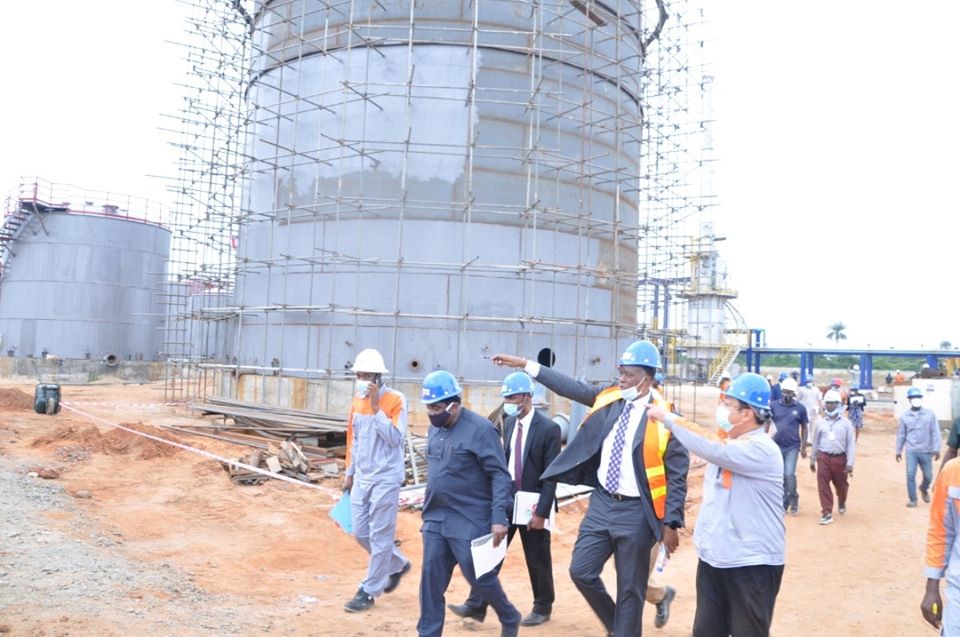
The 6,000 barrels per day modular refinery being built in Ologbo, Ikpoba Okha Local Government Area of Edo State is almost completed.
On Thursday, a delegation of the federal government was at the site of the facility, which is 95 per cent (mechanical works) completed.
According to the Chairman of Edo Refinery and Petrochemical Company, Mr Michael Osime, represented by the company’s Global Advisor, Mr Frans Ojielu, the company is being supported by Edo State Government with a N700 million project support fund.
He said the refinery also has a fabrication yard to boost local capacity to produce materials and provide robust support for the establishment of more modular refineries.
Mr Osime added that discussions were ongoing with the Ambrose Alli University to assist in training Nigerians for the oil and gas industries.
“In 2016, the Vice President, Prof. Yemi Osibanjo, embarked on the tour of the region where he met with key stakeholders to deliberate on issues on improving the social-economic wellbeing of the people of Niger Delta region, which is in line with the six-point agenda of Mr President. This is one of the products of that tour,” he told the delegation.
Leader of the inspection team, Mr Edobor Iyamu, who is the Senior Special Assistant to the President on Niger Delta Affairs, expressed confidence that when completed, the project will attract more investment in modular refineries in Nigeria, generate employment and reduce youth restiveness in the Niger Delta.
He commended the Edo State government for ensuring that the modular refinery comes on stream, stating that its establishment was in line with the new vision for the Niger Delta, ensuring that the people benefit maximally from the wealth in the region.
Mr Iyamu added that the project is aimed at promoting the establishment of modular refinery projects in the area to attract investment into the oil and gas sector.
Economy
Naira Opens Week Weaker at N1,364/$ at NAFEX After N5.80 Loss
By Adedapo Adesanya
The first trading day of the week in the currency market was bearish for the Naira in the Nigerian Autonomous Foreign Exchange Market (NAFEX) on Monday, April 27.
Yesterday, it lost N5.80 or 0.43 per cent against the United States Dollar to trade at N1,364.24/$1, in contrast to the N1,358.44/$1 it was traded last Friday.
In the same vein, the Nigerian currency depreciated against the Pound Sterling in the official market by N13.70 to close at N1,847.72/£1 versus the preceding session’s N1,834.02/£1, and slumped against the Euro by N11.56 to sell at N1,602.29/€1 versus N1,590.73/€1.
Also, the Nigerian Naira tumbled against the greenback during the trading day by N5 to quote at N1,385/$1 compared with the previous rate of N1,380/$1, and at the GTBank FX desk, it traded flat at N1,370/$1.
The poor performance of the domestic currency could be attributed to liquidity shortage at the official currency market on Monday, which came amid surging demand for international payments. At $76.50 million, interbank liquidity printed higher across 79 deals, up from the $43.572 million reported on Friday.
Nigeria’s gross external reserves declined to $48.45 billion amid a month-long decline in inflows, amid uncertainties in the global commodity market. The depletion of foreign reserves could be partly attributed to the Central Bank of Nigeria’s intervention in the FX market.
The market remains perturbed by persistent concerns over liquidity constraints, policy transparency, and weakening confidence in Nigeria’s FX market, while boosters, including oil prices, continue to look rocky due to stalled discussions and unclear ceasefire negotiations between the US and Iran.
A look at the cryptocurrency market, Bitcoin (BTC) has been rejected near $79,000 three times in eight sessions, leaving the level as the de facto ceiling of its current trading range even as major cryptocurrencies trade lower over the past day. It lost 0.9 per cent to sell at $77,003.61.
Analysts say that upcoming US Federal Reserve policy decisions and top tech firms’ earnings this week could provide the catalyst to push bitcoin decisively above $80,000.
The market also continued to weigh Iran’s interim deal proposal to reopen the Strait of Hormuz, which failed to advance over the weekend. The White House said US officials were discussing the latest Iranian proposal but maintained “red lines” on any deal to end the eight-week war.
Solana (SOL) dropped 1.8 per cent to $84.25, Ripple (XRP) went down by 1.6 per cent to $1.39, Ethereum (ETH) depreciated by 1.3 per cent to $2,290.00, Binance Coin (BNB) declined by 0.5 per cent to $625.18, and Cardano (ADA) fell by 0.2 per cent to $0.2480.
However, Dogecoin (DOGE) rose by 2.0 per cent to $0.1002, and TRON (TRX) appreciated by 0.2 per cent to $0.3242, while the US Dollar Tether (USDT) and the US Dollar Coin (USDC) remained unchanged at $1.00 apiece.
Economy
NASCON Targets Deeper Cost Optimisation, Accelerated Digital Transformation, Others
By Aduragbemi Omiyale
One of the leading salt makers in Nigeria, NASCON Allied Industries Plc, has set its eyes on some strategies aimed to deliver more value to shareholders.
The chief executive of the company, Mrs Aderemi Saka, said efforts are being made to surpass the performance of last year.
In the 2025 financial year, the organisation recorded a 27 per cent growth in revenue, while post-tax profit grew by over 100 per cent to N33.5 billion, with the earnings per share (EPS) expanding by 115 per cent to N12.41 from N5.77 Kobo in the previous year.
The impressive performance, attributed to a clear strategic vision, disciplined execution and sustained focus on cost-saving initiatives across production, logistics and fleet management, resulted in a 200 per cent increase in dividend payout to shareholders to N6 per share.
Mrs Saka, at the firm’s Annual General Meeting (AGM) in Lagos, said the strategic priorities for the coming year include deeper cost optimisation, expanded market penetration, strengthened energy diversification and sustainability initiatives, as well as accelerated digital transformation and process automation.
Earlier, the chairman of NASCON, Mr Olakunle Alake, informed shareholders that the achievements for last year were due to improved operational efficiency, strict cost management and the dedication of the company’s workforce.
“The operating environment in 2025 was characterised by economic volatility, persistent inflation and structural changes across key sectors. Yet, NASCON remained resilient and strategically focused, delivering outstanding value to shareholders,” Mr Alake said.
He noted that operational sustainability remains a core pillar of the organisation’s strategy, stressing that during the year, NASCON introduced Compressed Natural Gas (CNG) trucks into its logistics fleet to reduce fuel costs and minimise exposure to diesel price volatility.
In addition, the company’s state-of-the-art salt refinery, its largest production facility, now runs entirely on natural gas, significantly boosting efficiency while reinforcing NASCON’s commitment to environmental sustainability.
A director in the organisation, Mrs Tonya Lawani, emphasised that the firm remains firmly committed to the principles that have driven its excellent performance, noting that NASCON approaches the new financial year from a position of strength, with further opportunities for growth and improvement.
Speaking on behalf of shareholders, Mr Faruk Umar expressed strong confidence in the company’s trajectory, citing NASCON’s rising share price, which recently crossed the N100 mark, and projecting further appreciation.
He commended the quality of the Board and management team, noting that strong leadership and recent executive appointments have positioned the entity to deliver even greater value to all stakeholders.
Economy
Brent Nears $110 on Stalled Diplomacy, Tight Global Supply
By Adedapo Adesanya
Brent futures gained $2.90 or 2.8 per cent to trade at $108.23 a barrel on Monday as peace talks between the United States and Iran stalled and shipments through the Strait of Hormuz remained limited, keeping global oil supplies tight.
Also, the US West Texas Intermediate crude rose by $1.97 or 2.1 per cent to $96.37 per barrel after Iran reportedly offered to reopen the Strait of Hormuz, but insisted US nuclear talks be postponed, a condition the Americans are unlikely to accept.
Iran presented the proposal through regional mediators to reopen the waterway and move toward ending the war first, while postponing nuclear negotiations. The proposal would separate shipping security from the dispute over uranium enrichment, where negotiations have deadlocked.
The stalled negotiations are leading to fears for the global economy as both nations are no closer to a lasting truce after US President Donald Trump cancelled American participation in talks with Iran.
President Trump discussed a new Iranian proposal on resolving the war with Iran with his top national security aides, with the conflict currently in a stalemate and energy supplies from the Middle East region reduced.
The market is also beginning to price the supply story beyond crude. Higher petrol and heating oil prices are feeding concern that the conflict is moving into transport, manufacturing, and consumer costs.
At least seven ships – mainly dry bulk vessels – have crossed the Strait of Hormuz in the past 24 hours, in line with muted activity in recent days. That represents a fraction of the average 140 daily passages before the Iran war began on February 28, when around 20 per cent of global oil supplies passed through the strait.
In addition, six tankers loaded with Iranian oil have been forced back to Iran by the US blockade in recent days.
Also, Russian President Vladimir Putin praised the Iranian people for battling to stay independent in the face of US and Israeli pressure and said Russia would do all it could to help Iran.
Major global central banks are set to hold interest rates steady this week.
The European Central Bank (ECB) will meet on Thursday, with a ceasefire easing the pressure on it for an immediate interest rate hike. Higher interest rates increase consumer borrowing costs, which can reduce economic growth and oil demand.
Traders are betting that the US Federal Reserve, ECB, Bank of Japan, and Bank of England will all maintain rates at current levels.
-
Feature/OPED6 years agoDavos was Different this year
-
Travel/Tourism10 years ago
Lagos Seals Western Lodge Hotel In Ikorodu
-
Showbiz3 years agoEstranged Lover Releases Videos of Empress Njamah Bathing
-
Banking8 years agoSort Codes of GTBank Branches in Nigeria
-
Economy3 years agoSubsidy Removal: CNG at N130 Per Litre Cheaper Than Petrol—IPMAN
-
Banking3 years agoSort Codes of UBA Branches in Nigeria
-
Banking3 years agoFirst Bank Announces Planned Downtime
-
Sports3 years agoHighest Paid Nigerian Footballer – How Much Do Nigerian Footballers Earn