Connect with us

Economy

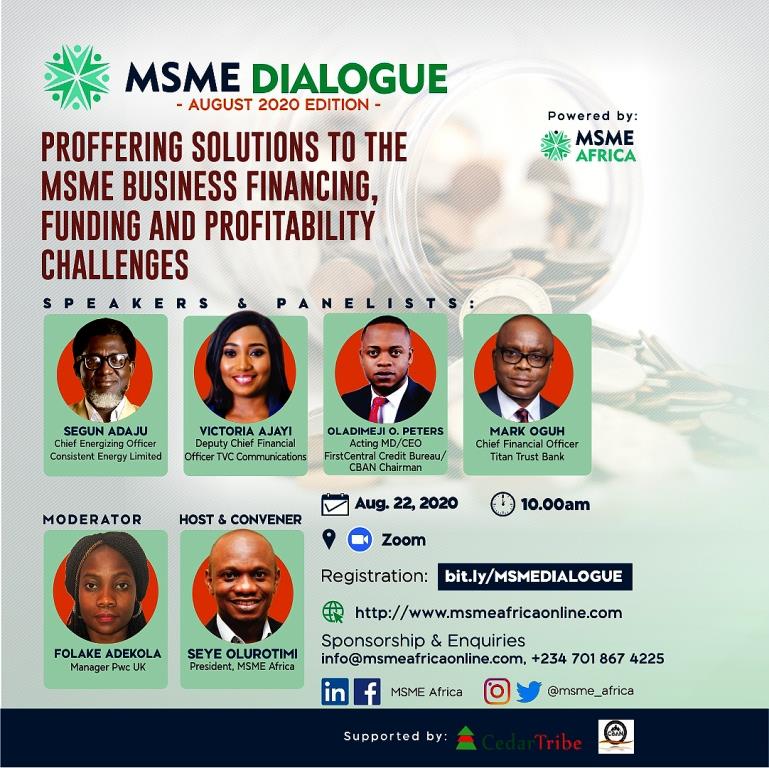
Experts to Discuss Business Funding, Others at MSME Dialogue

Published

on

MSME Dialogue

By Dipo Olowookere

Come Saturday, August 22, 2020, by 10 am, key stakeholders in the Micro, Small and Medium Enterprises (MSME) will share their views on issues affecting the sector of the economy.

It is believed that the industry is a major contributor to the Gross Domestic Product (GDP) of Nigeria, but despite this, the sector has largely been given lesser attention.

But next Saturday, issues concerning funding and others would be discussed at a programme put together by one of the major forces in the space, MSME Africa.

At the event tagged MSME Dialogue and requires registration via http://bit.ly/MSMEDIALOGUE, experts in the field will proffer solutions to the issues of raising capital, accessing credits, funding types, business profitability and other related issues.

According to the organisers of the maiden virtual programme, business owners from different sectors will be in attendance and will have the Chief Energising Officer of Consistent Energy Limited, Mr Segun Adaju, as one of the speakers.

Others are the Deputy Chief Financial Officer of TVC Communications, Ms Victoria Ajayi; the Acting CEO of FirstCentral Credit Bureau Limited & Chairman, Credit Bureau Association of Nigeria (CBAN), Mr Oladimeji Peters; and the Chief Financial Officer of Titan Trust Bank, Mr Mark Oguh, with Ms Folake Adekola of PwC UK moderating the session.

Speaker on the forthcoming event, the convener and President of MSME Africa, Mr Seye Olurotimi, noted that, “Funding, financing and profitability and big deals to business owners; they pose major challenges to the growth and survival of MSMEs and that is why we have decided to address and proffer solutions to them at the very first edition of the MSME Dialogue.”

The MSME expert and champion further said, “From my interactions with MSME operators over the years, I have realised that there is a lot of gap with regards to information on the various financing types and the requirements for accessing them and this must be addressed.

“If we really want to grow the equally; we must pay attention to the over 41 million businesses who fall into the MSME category.”

According to a recent report by PricewaterhouseCoopers (PwC) from its PwC’s MSME Survey 2020- Building to last, Small and Medium Enterprises (SMEs) in the country face an estimated N617.3 billion financing gap annually which accounts for less than one per cent of banks’ credit in 2018.

The report further stated that besides obtaining finance, finding customers and infrastructure deficits also accounted for the top of the most pressing problems for small businesses, while generating electricity constituted the biggest cost to the MSMEs.

According to the PwC report, “Access to finance, in particular credit, is a critical enabler for the growth and development of small and medium enterprises.”

MSME Africa is a multi-faceted resource platform for MSME in Africa providing news, opportunities, articles and resources for stakeholders. The platform is poised to build the biggest network and community of MSMEs in Africa in years to come.


Dipo Olowookere is a journalist based in Nigeria that has passion for reporting business news stories. At his leisure time, he watches football and supports 3SC of Ibadan. Mr Olowookere can be reached via [email protected]

Economy

Why We Did Not Pay Dividend for FY 2025—Nigerian Breweries

Published

on

Nigerian Breweries

By Aduragbemi Omiyale

When shareholders of Nigerian Breweries Plc gathered at the company’s 80th Annual General Meeting (AGM) in Lagos, on Wednesday, April 22, 2026, one thing they were sure was not on the agenda was the approval of a dividend for the 2025 financial year.

This was because the board did not propose the payment of a cash reward to investors for the fiscal year for some reasons, which were explained at the meeting.

The chairman of the organisation, Ms Juliet Anammah, told shareholders that the dividend payout was skipped to rebuild retained earnings impacted by prior macroeconomic shocks, particularly foreign exchange-related losses.

“We recognise the importance of dividend payments to our shareholders and sincerely appreciate your continued understanding.

“While we are not declaring a dividend at this time due to negative retained earnings, we are working diligently to restore the company’s financial position and return to dividend payments as soon as it is sustainable to do so,” she explained.

Ms Anammah noted that the board remains vigilant to external risks, including the Middle East crisis and broader macroeconomic challenges, which may impact the pace of improvement in the 2026 financial year.

She thanked shareholders for their continued support and reaffirmed that the company will build on its 2025 performance as it accelerates growth ambitions.

“We have a solid foundation built over eight decades, anchored on a strong portfolio of brands, an extensive nationwide sales and supply chain network, ongoing digital transformation, and most importantly, our people. These strengths remain critical to sustaining our leadership position,” she said.

Despite the non-payment of cash reward for the year, shareholders applauded Nigerian Breweries for strong recovery and improved profitability in the 2025 financial year, driven by disciplined cost management and a significant reduction in finance expenses.

One of them, Mr Eke Emmanuel, who is the immediate past Secretary of the Independent Shareholders Association of Nigeria, praised the board and management for steering the company through a volatile macroeconomic environment while strengthening its financial position, noting that the company’s resilience, at a time when several businesses exited the country, reflects strong leadership and a sound strategic direction.

“It is good news that we have been here for 80 years. There is no reason why we will not be here for the next 80 years with what we have achieved. To return to this level of profitability and cash position shows the Board has done an enormous amount of work,” he said.

Another shareholder, Mr Owolabi Opeyemi of the Noble Shareholders Association, confessed that, “We are proud of how the company has withstood the ups and downs of a challenging environment. The return to profitability and the reversal of the negative cash position recorded in the previous two financial years is commendable.”

Continue Reading

Economy

Waltersmith Plans 30,000bpd Condensate Refinery, Industry Park

Published

on

Waltersmith Refinery

By Adedapo Adesanya

Waltersmith Refining and Petrochemical Company Limited has announced plans to commence two further phases of expansion, which will include the construction of a 30,000-barrel-per-day condensate refinery and an industry park that will accommodate other gas-based firms.

The chairman of Waltersmith Petroman, Mr Abdulrazak Isa, revealed this during a visit of the Executive Secretary of the Nigerian Content Development and Monitoring Board (NCDMB), Mr Felix Omatsola Ogbe, and the chief executive of the Nigerian Midstream and Downstream Petroleum Regulatory Authority (NMDPRA), Mr Saidu Mohammed, to the Waltersmith modular refinery at Ohaji- Egbema, Imo State.

Mr Isa said the firm would develop a gas line that would deliver 100 million standard cubic feet of gas per day, and provide an embedded captive power, to attract industries to co-locate in the industrial park.

Plans are afoot to conclude the partnership agreement for the condensate refinery by the 4th quarter of 2026, he said, adding that feedstock for the integrated expansions will come from the Ibigwe and Assa fields, as well as from nearby fields.

The chairman underlined the company’s determination to invest in the petrochemical sector, leveraging its access to gas and Naphtha, noting that the petrochemical industry is a key enabler of the economy.

He sought approvals from the NMDRA for the various stages of the upcoming developments.

The visit was to inspect the newly completed expansion of the firm’s refining capacity, from 5,000 barrels per day to 10,000 barrels per day.

NCDMB invested equity in Waltersmith Refining and Petrochemical Company Limited’s modular refinery in 2018 and helped catalyse the investment, leading to the commissioning of the first phase of the plant in November 2020.

NCDMB also participated in the expansion, which is now completed and operational, producing AGO (diesel), Household kerosine (HHK), HFO (Heavy Fuel Oil) and Naphtha.

The refinery has to date supplied over 1.1 billion litres of refined products to local and regional markets, helping to strengthen Nigeria’s and West Africa’s energy security and contributing immensely to the national economy. The refinery supplies most of its products to the South-East and South-South parts of the country, while the HFO gets to the West African sub-region.

On his part, Mr Mohammed expressed his delight at the success of the facility and promised the agency’s support to the company’s expansion plans, saying the midstream sector of the petroleum industry holds the key to the nation’s economic development, adding that the establishment of such projects is the dream of every administration.

He described Waltersmith as an octopus in the midstream sector and challenged the company to hasten the development of the condensate refinery. Mohammed also commended NCDMB for partnering with Waltersmith to develop the project, which had become a runaway success.

The Director of Legal Services at NCDMB, Mr Naboth Onyesoh, who represented the organisation’s scribe, conveyed the board’s delight at the success of Waltersmith modular refinery, describing the company as a model in local content implementation, especially in direct and indirect job creation, capital retention, industrialisation, import substitution and value addition to crude oil and gas resources.

Continue Reading

Economy

46 Stocks Gain Weight, 53 Equities Lose on NGX in One Week

Published

on

NGX investors

By Dipo Olowookere

The Nigerian Exchange (NGX) Limited was bullish last week despite investors’ mood swing, triggered by happenings in the country and across the globe, especially the Middle East crisis.

The All-Share Index (ASI) and the market capitalisation appreciated week-on-week by 3.94 per cent to 225,722.49 points and N145.335 trillion, respectively.

Similarly, all other indices finished higher with the exception of the growth and commodity indices, which depreciated by 0.02 per cent and 0.41 per cent, respectively, while the sovereign bond index closed flat.

A look at the price changes of shares in the five-day trading week showed that

46 stocks gained weight versus 61 stocks of the previous week, 53 equities shed weight compared with 36 equities a week earlier, and 47 shares closed flat, in contrast to 49 shares of the preceding week.

UAC Nigeria led the gainers’ chart after it chalked up 42.00 per cent to trade at N142.00, Union Dicon appreciated by 32.73 per cent to N21.90, NASCON expanded by 32.63 per cent to N206.90, Trans-Nationwide Express rose by 30.58 per cent to N7.90, and Zichis improved by 25.71 per cent to N15.60.

On the flip side, Infinity Trust Mortgage Bank led the losers’ group after it gave up 50.79 per cent to close at N9.35, Abbey Mortgage Bank declined by 33.33 per cent to N5.40, Guinea Insurance slipped by 15.20 per cent to N1.06, Stanbic IBTC lost 13.82 per cent to settle at N162.50, and Living Trust Mortgage Bank slumped by 10.98 per cent to N3.65.

As for the activity log, Customs Street recorded a turnover of 3.805 billion shares worth N213.955 billion in 297,202 deals in the week compared with 3.588 billion shares valued at N195.313 billion transacted in 254,553 deals in the previous week.

Financial stocks led the activity chart with 2.739 billion units sold for N106.269 billion in 135,101 deals, contributing 71.99 per cent and 49.67 per cent to the total trading volume and value, respectively.

Services equities traded 212.324 million units worth N4.024 billion in 17,042 deals, and consumer goods shares exchanged 180.076 million units valued at N13.269 billion in 32,457 deals.

Access Holdings, UBA, and First Holdco were the busiest with 814.060 million units traded for N39.032 billion in 37,195 deals, contributing 21.40 per cent and 18.24 per cent to the total equity turnover volume and value, respectively.

Continue Reading

Trending