Economy
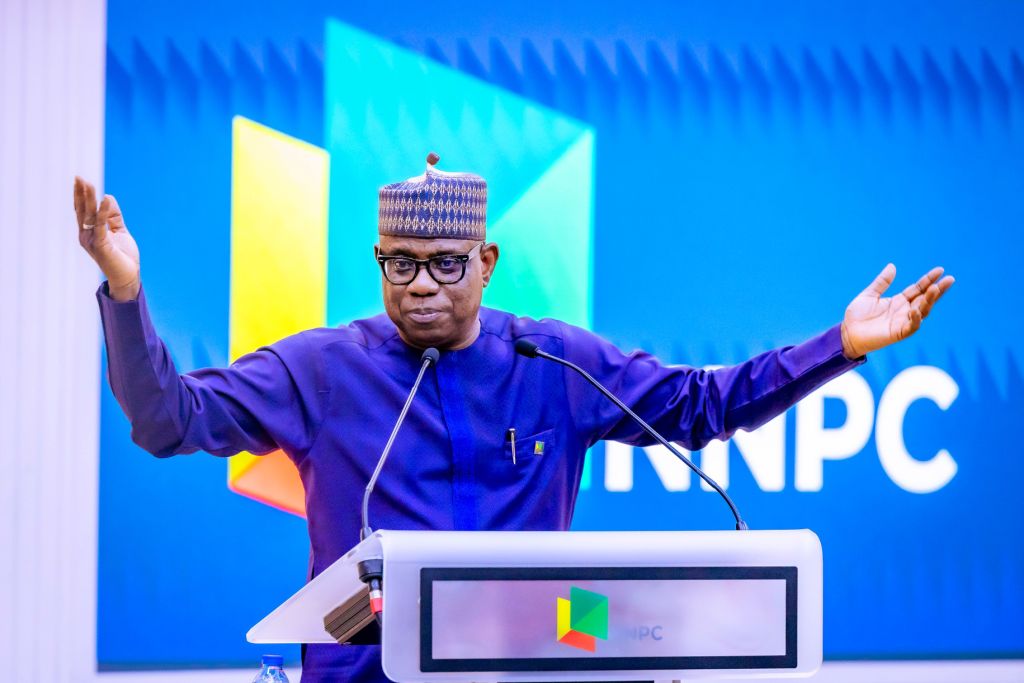
FG Backs NNPC’s Move to Revamp Refineries
By Adedapo Adesanya
The federal government has expressed support and commitment to the new efforts by the Nigerian National Petroleum Company (NNPC) Limited to rehabilitate the nation’s refineries.
The state oil company recently signed a Memorandum of Understanding (MoU) with two Chinese companies, Sanjiang Chemical Company Limited and Xinganchen (Fuzhou) Industrial Park Operation and Management Co. Limited, for collaboration through a potential Technical Equity Partnership in support of the completion and operation of the Port Harcourt and Warri Refineries.
The Minister of State for Petroleum Resources (Oil), Mr Heineken Lokpobiri, spoke at the official opening of the 2026 Nigeria Oil and Gas (NOG) Energy Week on Tuesday in Abuja.
“I was excited recently when I saw NNPC Bayo going to Warri with partners who are coming to help Nigeria rehabilitate the refineries in Warri and Port Harcourt.
“That is the right way to go. As for me, as Minister who is the chairman of the steering committee of refineries rehabilitation, I told Bayo you have my fullest support. You may not see me going to those refineries, but I am with you in spirit,” he said.
The minister also disclosed ongoing efforts to address one of the biggest complaints of investors in Nigeria’s oil and gas industry, announcing plans to streamline over 270 taxes, levies and regulatory charges blamed for driving up the cost of doing business and undermining investments.
The move came as indigenous oil producers warned that the multiplicity of charges has become a major threat to project viability and could force operators to abandon assets if left unchecked.
Mr Lokpobiri stated that the government had commissioned PricewaterhouseCoopers (PwC), in collaboration with the Nigerian Upstream Petroleum Regulatory Commission (NUPRC), to undertake a global benchmarking of Nigeria’s fiscal charges against those of competing oil-producing countries.
According to him, the exercise was part of efforts by the Tinubu administration to make Nigeria’s petroleum industry globally competitive and attract fresh investments.
“We have commissioned PwC to do a global benchmarking. Nigeria is committed to being globally competitive, so let us benchmark our fees and rates against other jurisdictions,” he said.
Mr Lokpobiri explained that operators currently contend with about 270 different taxes, fees and regulatory charges, many of which yield little revenue but create huge administrative bottlenecks.
“Sometimes when you hear that we have about 270 taxes, some of them are just a few cents. Instead of making companies process about 270 invoices, why don’t we aggregate them? The report will soon be ready, and I believe it will solve that problem once and for all.”
The minister said the initiative forms part of broader reforms aimed at improving the ease of doing business, noting that the government had consistently responded to concerns raised by industry stakeholders.
Also speaking at the event, the Minister of State, Petroleum Resources (Gas), Mr Ekperikpe Ekpo, reiterated that Nigeria was open for business, saying sweeping reforms, fiscal incentives and major infrastructure projects were positioning the country as a globally competitive destination for gas investment.
Mr Ekpo said the federal government was transforming Nigeria from a nation that merely possesses vast gas reserves into one powered by gas to drive industrialisation, energy security and economic growth.
“Our message to the global investment community is unified and resolute: Nigeria is open for business, and we have established a stable, competitive and highly predictable investment environment.”
Mr Ekpo noted that Nigeria’s 215 trillion cubic feet of proven gas reserves, the largest in Africa, would be leveraged not only for exports but also to power domestic industries, fertiliser and petrochemical plants, transportation and clean cooking initiatives under the government’s Decade of Gas programme.
He highlighted ongoing strategic infrastructure projects, including the Ajaokuta-Kaduna-Kano (AKK) and OB3 gas pipelines, as well as new gas processing facilities aimed at expanding domestic supply, reducing gas flaring and increasing the availability of liquefied petroleum gas (LPG).
The minister also reaffirmed the government’s commitment to expanding Nigeria’s liquefied natural gas export capacity through the NLNG Train 7 project, which will increase production capacity from 22 million tonnes per annum to 30 million tonnes annually upon completion.
He added that the government was accelerating the National Clean Cooking Programme, which targets five million households by 2030, and the Presidential Compressed Natural Gas (CNG) Initiative aimed at reducing transportation costs and expanding domestic gas utilisation.
Reinforcing the reform agenda, the Special Adviser to the President on Energy, Mrs Olu Verheijen, said Nigeria was now competing for investments on the strength of policy credibility rather than the size of its hydrocarbon reserves.
“The competition is no longer geology against geology. It is government against government. It is rules against rules. It is delivery against delivery,” she said.
Mrs Verheijen disclosed that reforms introduced by the Tinubu administration had already attracted more than $10 billion in Final Investment Decisions (FIDs), while investment projects worth over $50 billion were currently in the pipeline.
She added that Nigeria’s crude oil and condensate production had increased by more than 400,000 barrels per day, while external reserves had exceeded $50 billion.
“Capital is no longer sentimental. It asks one question: Can this country turn resources into bankable projects, and bankable projects into reliable returns?” she asked.
Economy
Financial Stocks Account for 79.48% of Total Weekly Trading Volume on NGX
By Dipo Olowookere
On the Nigerian Exchange (NGX) Limited last week, investors transacted 3.648 billion shares worth N220.568 billion in 251,861 deals compared with the 3.821 billion shares valued at N154.393 billion traded in 258,567 deals a week earlier.
Analysis showed that financial stocks led the activity chart with 2.899 billion units sold for N147.360 billion in 106,603 deals, accounting for 79.48 per cent and 66.81 per cent of the total trading volume and value, respectively.
Services equities recorded a turnover of 164.914 million units valued at N3.615 billion in 16,375 deals, and the consumer goods shares exchanged 157.451 million units worth N7.777 billion in 27,950 deals.
First Holdco, Zenith Bank, and Fidelity Bank were the busiest stocks for the five-day trading week, trading 1.745 billion units valued at N121.828 billion in 31,053 deals, contributing 47.85 per cent and 55.23 per cent to the total trading volume and value, respectively.
Business Post reports that 60 equities appreciated during the week versus 22 equities in the previous week, 28 shares depreciated versus 57 shares of the preceding week, and 58 stocks closed flat versus 67 stocks of the previous week.
International Breweries gained 40.00 per cent to trade at N13.30, RT Briscoe expanded by 32.02 per cent to N13.40, Livestock Feeds improved by 28.47 per cent to N9.25, First Holdco chalked up 25.82 per cent to close at N69.20, and Abbey Bank rose by 23.65 per cent to N9.15.
On the flip side, McNichols lost 28.57 per cent to finish at N5.00, Thomas Wyatt gave up 11.64 per cent to quote at N2.43, Geregu Power declined by 10.00 per cent to N825.70, CAP shed 9.99 per cent to settle at N157.60, and Guinness Nigeria also slipped by 9.99 per cent to N329.00.
Customs Street was under buying pressure last week, making the All-Share Index (ASI) and the market capitalisation close higher by 6.35 per cent to 243,798.76 points and N156.445 trillion, respectively.
In the same vein, all other indices finished higher apart from the growth and sovereign bond indices, which depreciated by 7.43 per cent and 0.02 per cent, respectively.
Economy
NASD OTC Market Gains 2.3%, Adds N58bn to Investors’ Wealth
By Adedapo Adesanya
The NASD Over-the-Counter (OTC) Securities Exchange rose by 2.30 per cent, spurring the NASD Security Index (NSI) to close higher by 96.61 points to 4,296.34 points from 4,199.73 points, and raising the market capitalisation by N57.99 billion to N2.578 trillion from N2.521 trillion.
The market was up yesterday despite a lower activity level, as the volume of securities traded slumped by 94.7 per cent to 1.3 million units from the previous 23.9 million units. The value of securities slipped by 57.2 per cent to N29.2 million from the preceding session’s N68.2 million, while the number of deals executed by market participants increased by 6.7 per cent to 32 deals from the 30 deals carried out on Thursday.
At the close of transactions, Great Nigeria Insurance (GNI) Plc remained the most traded stock by value on a year-to-date basis, with a turnover of 3.4 billion units worth N8.4 billion, trailed by Infrastructure Credit Guarantee (Infracredit) Plc with 2.3 billion units valued at N6.5 billion in trades, and Central Securities Clearing System (CSCS) Plc with 70.8 million units traded for N4.9 billion.
GNI Plc was also the most traded stock by volume on a year-to-date basis, with 3.4 billion units sold for N8.4 billion, followed by Infracredit Plc with 2.3 billion units exchanged for N6.5 billion, and Resourcery Plc with 1.1 billion units transacted for N415.7 million.
During the trading day, there were three price gainers and two price losers, led by Afriland Properties Plc, which shed N1.48 to sell at N15.17 per share compared with the previous session’s N16.65 per share, and Food Concepts Plc, which slid by 7 Kobo to close at N2.69 per unit versus N2.76 per unit.
Conversely, FrieslandCampina Wamco Nigeria Plc improved its value by N9.50 to trade at N150.00 per share compared with Thursday’s closing price of N140.50 per share, CSCS Plc went up by N7.95 to N89.65 per unit from N81.70 per unit, and 11 Plc soared by N6.94 to N206.95 per share from N200.01 per share.
Economy
Guinness Nigeria, Others Drown Stock Exchange by 0.07%
By Dipo Olowookere
The Nigerian Exchange (NGX) Limited lost its footing by 0.07 per cent on Friday as a result of renewed profit-taking by investors.
The fall happened after Thomas Wyatt and Guinness Nigeria led other price losers group comprising 27 stocks at the market yesterday due to selling pressure.
Thomas Wyatt Nigeria shed 10.00 per cent to quote at N2.70, Guinness Nigeria drowned by 9.99 per cent to close at N329.00, Ikeja Hotel slipped by 9.96 per cent to N42.50, Zichis shed 9.94 per cent to trade at N26.37, and McNichols depreciated by 9.91 per cent to N5.00.
On the flip side, International Breweries gained 9.92 per cent to finish at N13.30, NEM Insurance appreciated by 9.61 per cent to N27.95, Jaiz Bank grew by 6.36 per cent to N9.20, UPDC expanded by 6.33 per cent to N4.20, and Livestock Feeds increased by 6.32 per cent to N9.25.
Business Post reports that investor sentiment remained bullish despite the loss recorded during the session, as there were 27 price decliners and 30 price advancers, representing a positive market breadth index.
Yesterday, market participants transacted 441.3 million equities for N19.4 billion in 44,938 deals compared with the 1.7 billion equities worth N112.0 billion traded in 44,780 deals a day earlier. This showed that the trading volume contracted by 74.04 per cent, the trading value declined by 82.68 per cent, and an uptick in the number of deals by 0.35 per cent.
Access Holdings led the activity chart on Friday after selling 40.2 million shares valued at N1.0 billion, Sterling Holdco traded 30.3 million stocks worth N228.8 million, Fidelity Bank sold 26.3 million equities for N505.6 million, Zenith Bank transacted 22.3 million shares valued at N2.5 billion, and First Holdco exchanged 19.0 million stocks worth N1.3 billion.
During the last trading session of the week, the consumer goods sector rose by 0.49 per cent, the insurance counter increased by 0.06 per cent, and the industrial goods index closed flat, while the banking and energy indices lost 0.78 per cent and 0.52 per cent, respectively.
As a result, the All-Share Index (ASI) shrank by 159.97 points to 243,798.76 points from 243,958.73 points, and the market capitalisation moderated by N103 billion to N156.445 trillion from N156.548 trillion.