Connect with us

Economy

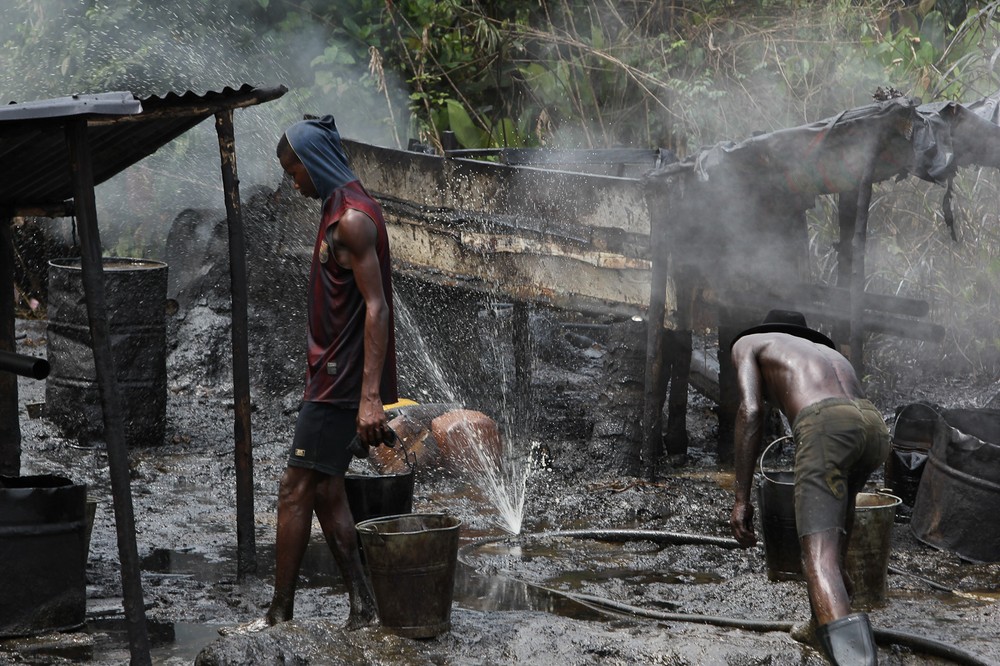
FG Eyes 100% Nigerian Content in 2027, Trains Illegal Refiners

Published

on

oil theft

By Modupe Gbadeyanka

Minister of State for Petroleum Resources, Mr Ibe Kachikwu has directed the Nigerian Content Development and Monitoring Board (NCDMB) to ensure that the Nigerian oil and gas industry is able to produce all its needs by year 2027.

The Minister set the target in Owerri, Imo State at the just concluded Nigerian Content Workshop organised by New Planets Projects in conjunction with the Senate Committee on Petroleum Resources Upstream.

He said the Federal Government expects that over the next 10 years, the Nigeria oil and gas industry, in collaboration with foreign investors would have developed in-country capacities and capabilities to produce all its offshore platforms locally.

“I would like to see the Japanese coming; I would like to see the Koreans come here; I would like to see collaborative efforts that will make our oil industry produce everything that we need,” he said at the event.

However, the Minister acknowledged the giant strides made by the board in seven years, commending particularly the excellent achievements of the current Executive Secretary, Engr. Simbi Wabote, whom he credited for working with energy and passion and meeting several targets set for the Board in the past one year.

Noting that Nigerian Content achievement in engineering services had hit 80 percent, the Minister insisted that performance in offshore aspects of the industry was still substantially low and charged international and local operating oil companies to collaborate with the NCDMB to achieve the new target.

Mr Kachikwu described Nigerian Content as the future of the industry.

According to him, “It doesn’t matter how much money we make, how much gas we produce or alternative fossils we produce; if we do not ensure that a lot of that is captured locally in terms of benefits, we have no stake.”

Commenting on NCDMB’s strategies for addressing noncompliance with provisions of the Nigerian Content Act by some companies, the Minister said the focus should not be on identifying defaulters and penalizing them.

According to him, NCDMB should develop corrective measures and understand why some companies fail to comply.

“The Board needs to develop corrective visitation programmes to institutions that have not complied. Sit down with them and do an audit of the issues and jointly develop models, giving specific timelines for delivery and create incentives for those who comply and  penalties for those who blatantly refuse to comply,” he said.

On industry’s capacity building initiatives, the Minister directed NCDMB, the Petroleum Technology Development Fund (PTDF) and the Petroleum Training Institute (PTI) to collaborate and develop a plan for training youths who are involved in pipeline vandalism, illegal refining and other illicit activities in the oil and gas industry.

The training programme will focus on improving their skillsets and getting them to embrace productive activities.

He said, “We need to find a middle-level specialized system of training people in the oil industry, a system that is not necessarily tied to degrees. We need to capture a lot of those in the hinterlands who have finished WAEC or their first diploma and don’t know where to go to but have some unique skillsets. We need to bring them to finishing schools.”

Mr Kachikwu also directed the NCDMB, PTDF and PTI to use existing industry facilities in Port Harcourt and Kaduna to carry out the planned trainings and other bespoke capacity building programmes for industry stakeholders. “We have to provide local competency trainings, relying on support from oil companies in terms of investment and overseas faculty.”


Modupe Gbadeyanka is a fast-rising journalist with Business Post Nigeria. Her passion for journalism is amazing. She is willing to learn more with a view to becoming one of the best pen-pushers in Nigeria. Her role models are the duo of CNN's Richard Quest and Christiane Amanpour.

Economy

UAE to Leave OPEC May 1

Published

on

Nigeria OPEC

By Adedapo Adesanya

The United ‌Arab Emirates has announced its decision to quit the Organisation of the Petroleum Exporting Countries (OPEC) to focus on national interests.

This dealt ⁠a heavy ⁠blow to the oil-exporting group at a time when the US-Israel war on Iran had caused ⁠a historic energy shock and rattled the global economy.

The move, which will take effect on May 1, 2026, reflects “the UAE’s long-term strategic and economic vision and evolving energy profile”, a statement carried by state media said on Tuesday.

“During our time in the organisation, we made significant contributions and even greater sacrifices for the benefit of all,” it added. “However, the time has come to focus our efforts on what our national interest dictates.”

The loss of the UAE, a longstanding OPEC member, could create disarray and weaken the oil cartel, which has usually sought to show a united ⁠front despite internal disagreements over a range of issues from geopolitics to production quotas.

UAE Energy Minister Suhail Mohamed al-Mazrouei said the decision was taken after a careful look at the regional power’s energy strategies.

“This is a policy decision. It has been done after a careful look at current and future policies related to the level of production,” the minister said.

OPEC’s Gulf producers have already been struggling to ship exports through the Strait of Hormuz, a ‌narrow chokepoint between Iran and Oman through which a fifth of the world’s crude oil and liquefied natural gas supplies normally pass, because of threats and attacks against vessels during the war.

The UAE had been a member of OPEC first through its emirate of Abu Dhabi in 1967 and later when it became its own country in 1971.

The oil cartel, based in Vienna, has seen some of its market power wane as the US has increased its production of crude oil in recent years.

Additionally, the UAE and Saudi Arabia have increasingly competed over economic issues and regional politics, particularly in the Red Sea area.

The two countries had joined a coalition to fight against Yemen’s Iran-backed Houthis in 2015. However, that coalition broke down into recriminations in late December when Saudi Arabia bombed what it described as a weapons shipment bound for Yemeni separatists backed by the UAE.

Continue Reading

Economy

NASD OTC Exchange Inches Up 0.03% as CSCS Outshines Four Price Decliners

Published

on

Nigerian OTC securities exchange

By Adedapo Adesanya

Central Securities Clearing System (CSCS) Plc bested four price decliners on the NASD Over-the-Counter (OTC) Securities Exchange on Monday, April 27. The alternative stock market opened the week bullish during the session with a 0.03 per cent uptick.

According to data, the security depository company added N2.61 to its share price to close at N76.26 per unit compared with the preceding session’s N78.87 per unit.

As a result, the market capitalisation of the platform increased by N820 million to N2.425 trillion from N2.424 trillion, and the NASD Unlisted Security Index (NSI) gained 1.38 points to finish at 4,053.97 points compared with the 4,052.58 points it ended last Friday.

The four price losers were led by NASD Plc, which slumped by N3.80 to sell at N34.70 per share versus N38.50 per share. FrieslandCampina Wamco Nigeria Plc fell by N1.45 to N98.10 per unit from N99.55 per unit, Food Concepts Plc slid by 27 Kobo to N2.43 per share from N2.70 per share, and Geo-Fluids Plc dipped by 9 Kobo to N2.91 per unit from N3.00 per unit.

The value of securities transacted by market participants went down by 82.0 per cent to N7.4 million from N41.3 million units, the volume of securities declined by 28.5 per cent to 319,831 units from 447,403 units, and the number of deals dropped by 34.1 per cent to 29 deals from 44 deals.

Great Nigeria Insurance (GNI) Plc was the most active stock by value on a year-to-date basis with 3.4 billion units worth N8.4 billion, followed by CSCS Plc with 59.6 million units sold for N4.0 billion, and Okitipupa Plc with 27.8 million units exchanged for N1.9 billion.

Also, GNI Plc was the most traded stock by volume on a year-to-date basis with 3.4 billion units valued at N8.4 billion, followed by Resourcery Plc with 1.1 billion units traded for N415.7 million, and Infrastructure Guarantee Credit Plc with a turnover of 400 million units worth N1.2 billion.

Continue Reading

Economy

Naira Opens Week Weaker at N1,364/$ at NAFEX After N5.80 Loss

Published

on

NAFEX Rate

By Adedapo Adesanya

The first trading day of the week in the currency market was bearish for the Naira in the Nigerian Autonomous Foreign Exchange Market (NAFEX) on Monday, April 27.

Yesterday, it lost N5.80 or 0.43 per cent against the United States Dollar to trade at N1,364.24/$1, in contrast to the N1,358.44/$1 it was traded last Friday.

In the same vein, the Nigerian currency depreciated against the Pound Sterling in the official market by N13.70 to close at N1,847.72/£1 versus the preceding session’s N1,834.02/£1, and slumped against the Euro by N11.56 to sell at N1,602.29/€1 versus N1,590.73/€1.

Also, the Nigerian Naira tumbled against the greenback during the trading day by N5 to quote at N1,385/$1 compared with the previous rate of N1,380/$1, and at the GTBank FX desk, it traded flat at N1,370/$1.

The poor performance of the domestic currency could be attributed to liquidity shortage at the official currency market on Monday, which came amid surging demand for international payments. At $76.50 million, interbank liquidity printed higher across 79 deals, up from the $43.572 million reported on Friday.

Nigeria’s gross external reserves declined to $48.45 billion amid a month-long decline in inflows, amid uncertainties in the global commodity market. The depletion of foreign reserves could be partly attributed to the Central Bank of Nigeria’s intervention in the FX market.

The market remains perturbed by persistent concerns over liquidity constraints, policy transparency, and weakening confidence in Nigeria’s FX market, while boosters, including oil prices, continue to look rocky due to stalled discussions and unclear ceasefire negotiations between the US and Iran.

A look at the cryptocurrency market, Bitcoin (BTC) has been rejected near $79,000 three times in eight sessions, leaving the level as the de facto ceiling of its current trading range even as major cryptocurrencies trade lower over the past day. It lost 0.9 per cent to sell at $77,003.61.

Analysts say that upcoming US Federal Reserve policy decisions and top tech firms’ earnings this week could provide the catalyst to push bitcoin decisively above $80,000.

The market also continued to weigh Iran’s interim deal proposal to reopen the Strait of Hormuz, which failed to advance over the weekend. The White House said US officials were discussing the latest Iranian proposal but maintained “red lines” on any deal to end the eight-week war.

Solana (SOL) dropped 1.8 per cent to $84.25, Ripple (XRP) went down by 1.6 per cent to $1.39, Ethereum (ETH) depreciated by 1.3 per cent to $2,290.00, Binance Coin (BNB) declined by 0.5 per cent to $625.18, and Cardano (ADA) fell by 0.2 per cent to $0.2480.

However, Dogecoin (DOGE) rose by 2.0 per cent to $0.1002, and TRON (TRX) appreciated by 0.2 per cent to $0.3242, while the US Dollar Tether (USDT) and the US Dollar Coin (USDC) remained unchanged at $1.00 apiece.

Continue Reading

Trending