Economy
FG Gazettes New Tax Reform Laws
By Adedapo Adesanya
The federal government has officially published Nigeria’s new tax reform laws in the government gazette, marking a historic overhaul of the country’s fiscal framework.
This was revealed in a statement signed by the Personal Assistant to the President on Special Duties, Mr Kamorudeen Yusuf, on Wednesday.
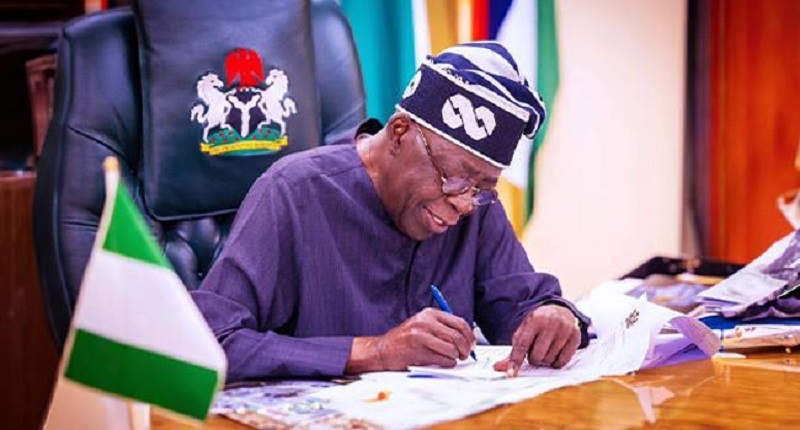
Signed into law by President Bola Tinubu on June 26, 2025, the reforms establish a new foundation for taxation, administration, and revenue collection based on four keenly contested bills.
The four legislations are: Nigeria Tax Act (NTA), 2025, Nigeria Tax Administration Act (NTAA), 2025, Nigeria Revenue Service (Establishment) Act (NRSEA), 2025, and the Joint Revenue Board (Establishment) Act (JRBEA), 2025.
By officially publishing these laws, Nigeria has confirmed the legitimacy of these legislations, notifying citizens, institutions, and businesses of these laws, and therefore, they have come into effect.
He noted that key features includes small businesses with turnover under N100 million and assets below N250 million are exempted from corporate tax while corporate tax rate for large firms may be cut from 30 per cent to 25 per cent at the President’s discretion.
“Top-up tax thresholds: N50 billion (local firms) and €750 million (multinationals).
“5 per cent annual tax credit introduced for eligible priority-sector projects.
“Companies transacting in foreign currency may now pay taxes in Naira at official exchange rates,” Mr Yusuf stated.
The statement noted that while the implementation timeline for the Nigeria Tax Act and Nigeria Tax Administration Act takes effect on January 1, 2026, the Nigeria Revenue Service (Establishment) Act and Joint Revenue Board (Establishment) Act have become effective since June 26, 2025.
“These reforms aim to simplify Nigeria’s tax system, support small businesses, attract investment, and strengthen fiscal stability, aligning with President Tinubu’s Renewed Hope Agenda to diversify revenue away from oil,” the statement added.
Economy
Agama Calls for Greater Collaboration Among African Capital Markets
By Adedapo Adesanya
The Director-General of the Securities and Exchange Commission (SEC), Mr Emomotimi Agama, has called for stronger collaboration among African capital markets to enhance regional integration, promote cross-border investments, and drive economic growth across the continent.
Mr Agama made the call in Abuja on Monday during the signing of a Memorandum of Understanding (MoU) between Nigeria’s Securities and Exchange Commission and the Capital Markets Authority (CMA) of Rwanda.
The agreement is aimed at strengthening cooperation between the two regulatory bodies in areas including investor education, capital market development, information exchange on regulatory and market developments, capacity building, technical assistance, and cooperation on enforcement and supervisory matters.
According to the MoU, both parties recognise the importance of collaboration in fostering confidence, innovation, market development, and sound practices within their respective capital markets, while also supporting regional and international engagement.
Speaking at the signing ceremony, Mr Agama emphasised the need for African countries to deepen cooperation and invest in one another’s markets to build a more interconnected and prosperous continent.
“We are excited about this opportunity to help develop your capital market. We need to cooperate in Africa, invest in each other’s markets and grow our continent. In so doing, we will build collaboration so that, as Africans, we can have a common focus and create a strong interconnection. The time is now for us to look inwards,” he said.
The SEC Director-General commended Rwanda’s economic progress and acknowledged the country’s achievements in attracting investment and promoting commerce.
“We appreciate the strength of the Rwandan economy and the efforts made to rekindle the real value of the African race. On our part, we have a very strong capital market structure, and we want to see what role the capital market can play in advancing Africa’s development agenda,” Agama stated.
He described the capital market as the nerve centre of the economy, stressing the need for citizens to understand and utilise it as a tool for wealth creation and improved living standards.
“The capital market is an enabler of economic development, and we believe there is much Rwanda can learn from Nigeria’s experience to strengthen its market. We are willing to contribute to the success of other nations because our relationship and integration will help build both markets and improve the lives of our citizens,” he said.
Mr Agama further urged African governments to leverage long-term capital from the market to finance infrastructure projects, describing the capital market as a critical solution for mobilising sustainable development financing.
“We see the capital market as a solution provider for moving economies forward. We want to make Africa better and a destination of choice for investors. We are committed to working jointly with other regulators to achieve this objective,” he added.
In his remarks, Chief Executive Officer of the Capital Markets Authority of Rwanda, Mr Romeo Ngarambe, welcomed the partnership and expressed confidence that the collaboration would support the growth of Rwanda’s capital market.
“We are here to learn from Nigeria, which has a more advanced capital market. We are confident that the lessons and experiences shared will contribute significantly to the development of our market. Whatever knowledge you provide, we will make good use of it, and we look forward to a fruitful partnership,” Mr Ngarambe said.
The MoU is expected to strengthen regulatory cooperation between both countries and support broader efforts toward the integration and development of African capital markets.
Economy
Lafarge Africa Rebrands to HBM Nigeria
By Aduragbemi Omiyale
To reinforce its commitment to Nigeria’s industrial growth, one of the leading cement manufacturers in the country, Lafarge Africa Plc, has unveiled a new corporate identity, rebranding to HBM Nigeria Plc.
According to the chief executive of the organisation, Mr Lolu Alade-Akinyemi, the new identity signals a forward-looking phase for the company, driven by operational excellence, innovation, sustainability, and long-term value creation.
He noted that the transition marks a significant milestone in the company’s transformation journey and strategic alignment with its new shareholder structure, reflecting the company’s continued evolution as one of Nigeria’s leading building solutions providers, combining strong local roots with enhanced global industrial collaboration.
He reaffirmed that the name change will not affect its operations, workforce, customers, shareholders, or its unwavering commitment to Nigeria’s economic growth and infrastructure development.
“HBM Nigeria Plc represents an exciting new chapter in our journey as a leading building solutions company. While our corporate identity is evolving, our commitment to Nigeria remains unwavering.
“We remain focused on delivering quality cement, concrete, aggregates, and innovative building solutions that support infrastructure development, housing growth, and industrialisation.
“This transition positions us for the future while reinforcing the values of excellence, sustainability, customer satisfaction, and responsible business practices that have defined our legacy for decades,” he stated.
Mr Alade-Akinyemi explained that the transition to HBM Nigeria Plc will be implemented through a structured, phased process across the company’s nationwide operations, adding that employees, customers, shareholders, investors, host communities, and other stakeholders should expect seamless business continuity, sustained investments across the country, and an even stronger focus on creating long-term economic and social value.
In his remarks, the Chairman of HBM Nigeria Plc, Mr Gbenga Oyebode, said the transition is designed to position the company for enduring success while remaining true to the values and principles that have shaped its legacy over the decades.
“I would like to express my sincere appreciation to our shareholders for their continued trust, to the Board and Management for their leadership, and to our employees whose dedication and commitment continue to drive the company forward.
“We are confident that HBM Nigeria Plc will continue to create sustainable value for shareholders, strengthen stakeholder trust, and deliver on its long-term ambitions,” Mr Oyebode said.
Also speaking at the event, the Minister of Works, Mr David Umahi, commended HBM Nigeria Plc for its significant contributions to Nigeria’s infrastructure development by delivering landmark projects across the country.
Highlighting the company’s role in supporting the federal government’s infrastructure agenda, he said, “I can talk about Lafarge for a whole day because we have come a long way. Though the company is very strict and of high integrity, I can say that their products are impeccable.”
Economy
MRS Oil, Three Others Lift NASD Exchange by 0.70%
By Adedapo Adesanya
The NASD Over-the-Counter (OTC) Securities Exchange rose by 0.70 per cent on Monday, June 22, buoyed by four price gainers led by MRS Oil Plc, which gained N7.77 to sell at N150.00 per share compared with the previous session’s N142.33 per share.
Further, Central Securities Clearing System (CSCS) Plc appreciated by N2.05 to trade at N79.82 per unit versus last Friday’s N77.77 per unit, FrieslandCampina Wamco Nigeria Plc added N2.14 to close at N172.14 per share compared with the previous N170.00 per share, and First Trust Mortgage Bank Plc grew by 22 Kobo to N2.49 per unit from N2.27 per unit.
As a result of the gains by these four securities, the market capitalisation of the platform increased by 17.87 billion to N2.570 trillion from N2.552 trillion, and the NASD Unlisted Security Index (NSI) improved by 27.98 points to 4,282.51 points from 4,252.73 points.
The volume of securities transacted by market participants during the session decreased by 65.4 per cent to 330,034 units from the previous 954,106 units, the value of securities depleted by 23.4 per cent to N32.7 million from the preceding session’s N42.7 million, and the number of deals retreated by 45.7 per cent to 19 deals from the 35 deals recorded in the previous trading session.
At the close of business, Great Nigeria Insurance (GNI) Plc was the most traded stock by value on a year-to-date basis, with 3.4 billion units worth N8.4 billion, followed by Infrastructure Credit Guarantee (Infracredit) Plc with 2.3 billion units sold for N6.5 billion, and CSCS Plc with 68.1 million units exchanged for N4.7 billion.
GNI Plc also ended the trading day as the most traded stock by volume on a year-to-date basis, with the sale of 3.4 billion units worth N8.4 billion, the second spot was taken by Infracredit Plc with 2.3 billion units valued at N6.5 billion, and the third spot was occupied by Resourcery Plc with a turnover of 1.1 billion units worth N415.7 million.
-
Feature/OPED6 years agoDavos was Different this year
-
Travel/Tourism10 years ago
Lagos Seals Western Lodge Hotel In Ikorodu
-
Showbiz3 years agoEstranged Lover Releases Videos of Empress Njamah Bathing
-
Banking8 years agoSort Codes of GTBank Branches in Nigeria
-
Economy3 years agoSubsidy Removal: CNG at N130 Per Litre Cheaper Than Petrol—IPMAN
-
Banking3 years agoSort Codes of UBA Branches in Nigeria
-
Banking3 years agoFirst Bank Announces Planned Downtime
-
Sports3 years agoHighest Paid Nigerian Footballer – How Much Do Nigerian Footballers Earn


Pingback: Lawmaker Alleges Alterations in Gazetted Tax Laws | Business Post Nigeria