Connect with us

Economy

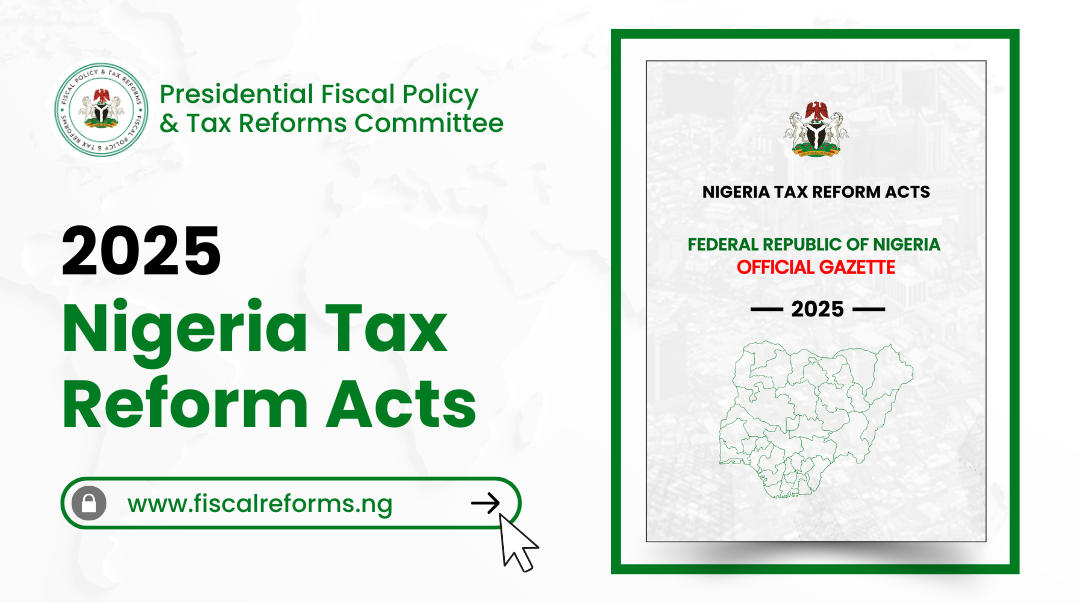
FG Releases Transition Guidelines for Tax Acts 2025

Published

on

Tax Acts 2025

By Modupe Gbadeyanka

The transition guidelines on the Tax Acts 2025 to provide direction to taxpayers, tax practitioners, revenue authorities and other stakeholders on how to address various issues arising from the old regime to the new framework have been released by the federal government.

The framework was issued on Thursday via a statement signed by the Director of Press Relations in the Federal Ministry of Finance, Efe Ovuakporie.

The guidelines set out the process for transition from the repealed tax laws to the new tax framework effective January 1, 2026.

Under the guidelines, the Tax Acts 2025, comprising the Nigeria Revenue Service (Establishment) Act, the Nigeria Tax Act, the Nigeria Tax Administration Act, and the Joint Revenue Board (Establishment) Act, apply from the respective commencement dates as enacted in each law. In particular, January 1, 2026, for the Nigeria Tax Act, 2025.

Tax liabilities, assessments, audits, investigations, disputes and enforcement actions relating to periods before that date will be treated under the repealed tax laws, the notice stated.

Tax returns relating to accounting periods ending before January 1, 2026, will be filed under the previous tax laws, while returns relating to accounting periods ending from January 1, 2026, onward will be administered under the new tax framework.

The document also covers the treatment of income taxes, transaction taxes, development levies, tax incentives, exemptions, record-keeping obligations and transactions that span both the old and new tax regimes.

Existing tax incentives and exemptions granted under the repealed laws will remain in place until their expiration dates. New applications and pending requests, however, will be considered under the provisions of the Tax Acts 2025.

The Minister of Finance and Coordinating Minister of the Economy, Mr Taiwo Oyedele, described the Tax Acts 2025 as a significant milestone in Nigeria’s tax reform programme, noting that the Guidelines set out how existing obligations, ongoing matters and future transactions will be treated under the new regime.

According to the Minister, the guidelines are anchored on three key principles – clarity, fairness and administrative certainty, adding that they are intended to promote uniform implementation and support effective administration across the Nigeria Revenue Service, State Internal Revenue Services, the FCT Internal Revenue Service, Local Government Revenue Committees, tax practitioners and taxpayers nationwide.


Modupe Gbadeyanka is a fast-rising journalist with Business Post Nigeria. Her passion for journalism is amazing. She is willing to learn more with a view to becoming one of the best pen-pushers in Nigeria. Her role models are the duo of CNN's Richard Quest and Christiane Amanpour.

Click to comment

Leave a Reply

Your email address will not be published. Required fields are marked *

Economy

Federal, State, LG Councils Share N2.3trn FAAC Allocation

Published

on

faac allocation

By Adedapo Adesanya

The Federation Account Allocation Committee (FAAC) has shared a total of N2.300 trillion among the federal government, state governments, and Local Government Councils from the revenue generated in May 2026.

The amount is slightly higher than the N2.257 trillion distributed last month, according to a statement issued by the Head of Information at the Federal Ministry of Finance, Mrs Efe Ovuakporie.

The FAAC allocation was confirmed at its June 2026 meeting following consideration of revenue receipts for the month of May.

The total distributable revenue of N2.300 trillion comprised N1.611 trillion from statutory revenue and N688.785 billion from Value Added Tax (VAT).

From the distributable amount, the federal government received N818.680 billion, while state governments got N759.141 billion. Local Government Councils were given N534.277 billion, and oil-producing states received N188.132 billion as 13 per cent derivation revenue.

The gross statutory revenue for the month stood at N2.652 trillion, representing an increase of N273.623 billion compared to the N2.378 trillion recorded in April 2026.

FAAC reported significant increases in collections from Companies Income Tax (CIT), Capital Gains Tax (CGT), Stamp Duties, Petroleum Profit Tax (PPT), Hydrocarbon Tax (HT), and oil royalties during the period under review.

However, collections from Import Duty, Value Added Tax (VAT), Excise Duty, and Common External Tariff (CET) levies recorded declines compared to the previous month.

Gross VAT revenue for May 2026 stood at N743.668 billion, lower than the N806.617 billion collected in April 2026.

The committee noted that despite the decline in VAT collections, overall revenue performance for the month was strengthened by improved receipts from petroleum-related taxes and Companies Income Tax.

Continue Reading

Economy

NGX Suspends Trading in Fortis Global Insurance Equities

Published

on

Fortis Global Insurance

By Aduragbemi Omiyale

Trading in the equities of Fortis Global Insurance Plc on the floor of the Nigerian Exchange (NGX) Limited has been suspended.

The action was taken on Wednesday, June 17, 2026, by the regulatory subsidiary of the NGX Group Plc, NGX Regulation (NGX RegCo) Limited.

It was to prevent investors from buying and selling the company’s securities on the stock market ahead of its share reconstruction.

According to a circular signed by the Head of Issuer Regulation Department of NGX RegCo, Mr Godstime Iwenekhai, the suspension is also to determine the shareholders who are entitled to receive the reconstructed shares.

“Trading license holders and the investing public are hereby notified that trading in the shares of Fortis Global Insurance Plc was suspended on Wednesday, June 17, 2026.

“The suspension is necessary to prevent trading in the shares of Fortis Global Insurance Plc to enable the Company’s Registrars and the Central Securities Clearing System Plc (CSCS) to reconcile their books for the listing of the reconstructed shares on Nigerian Exchange Limited (NGX).

“The suspension is also required for the purpose of determining the shareholders who are entitled to receive the reconstructed shares,” the notice stated.

Continue Reading

Economy

NUPRC, NRS to Strengthen Oil Revenue Collection

Published

on

NUPRC NRS

By Modupe Gbadeyanka

Efforts are being made to deepen collaboration to promote transparency and accountability in the collection of oil and gas revenue in Nigeria.

Two key organisations involved in this, the Nigerian Upstream Petroleum Regulatory Commission (NUPRC) and the Nigeria Revenue Service (NRS), recently held a strategic meeting to further work on ways to achieve this goal.

The chief executive of NUPRC, Mrs Oritsemeyiwa Eyesan, was at the headquarters of the tax-collecting agency in Abuja on Wednesday.

In discussions with the chairman of NRS, Mr Zacch Adedeji, she praised him for driving reforms that culminated in the enactment of the NRS Act.

Speaking on the transfer of revenue collection responsibilities, Mrs Eyesan said the process had been seamless, highlighting her organisation’s efforts to create an enabling environment for operators in the oil and gas industry.

She further revealed that Nigeria had the potential to produce 1.9 million barrels per day, having hit a peak production of 1.86 million barrels per day in May.

In his response, the NRS chairman praised NUPRC for its dynamism, professionalism and transparency, promising continued collaboration with the commission, particularly on matters relating to the transfer of revenue collection functions under the new Act.

“I collect revenue. I don’t generate revenue. Wherever revenue is, I work on it and keep an account for you. So, I’m helping you to collect your royalties,” Mr Adedeji said.

He pledged that the NRS would continue to support the commission to achieve its shared objective of increasing government revenues in a fair, transparent and sustainable manner.

Continue Reading

Trending