Economy
FGN Savings Bond for July 2026 Closes Today
By Dipo Olowookere
Subscription for the July 2026 edition of the FGN savings bond is closing today, Friday, July 10.
The exercise started on Monday, July 6, with two tenures of two years and three years on offer to retail investors.
The retail bonds are sold by the federal government through the Debt Management Office (DMO) to raise funds for the country’s budget deficits.
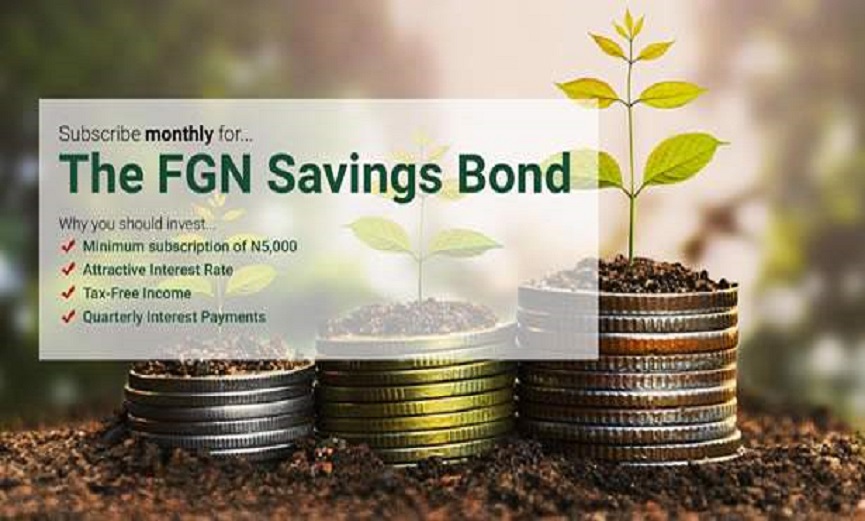
The savings bond offers investors steady tax-free income. It is risk-free, backed by the Nigerian government, and listed on the Nigerian Exchange (NGX) Limited, allowing for secondary market trading and easy exit before maturity.
For the two-year FGN savings bond maturing on July 15, 2028, the debt office is offering it at a 14.716 per cent per annum interest rate, while the three-year FGN savings bond due July 15, 2029, is at 15.716 per cent per annum, with the interest on the investment being paid by the government every quarter.
Intending investors can purchase the debt instrument at a unit price of N1,000, subject to a minimum subscription of N5,000 and in multiples of N1,000 thereafter, subject to a maximum subscription of N50.0 million.
Economy
NGX Maintains Upward Trend Despite Profit-taking in Energy Stocks
By Dipo Olowookere
The upward trend on the Nigerian Exchange (NGX) Limited continued on Thursday despite profit-taking in energy stocks by investors.
The local exchange further appreciated by 0.62 per cent yesterday, as market participants mopped up equities in the other key sectors, especially in the financial services.
The banking space rose by 1.33 per cent, the consumer goods counter expanded by 1.21 per cent, and the insurance index grew by 0.26 per cent, while the industrial goods segment closed flat, with the energy sector down by 0.19 per cent.
At the close of business, the All-Share Index (ASI) gained 1,498.75 points to finish at 243,958.73 points compared with the previous day’s 242,459.98 points, and the market capitalisation advanced by N962 billion to N156.548 trillion from N155.586 trillion.
The market breadth index remained positive, though the bears are giving the bulls a close marking. Customs Street ended the session with 28 price gainers and 26 price losers, representing strong investor sentiment.
International Breweries improved by 10.00 per cent to N12.10, First Holdco appreciated by 9.96 per cent to N69.55, Abbey Bank grew by 9.88 per cent to N8.90, Trans-Nationwide Express rose by 9.76 per cent to N3.26, and Honeywell Flour increased by 9.68 per cent to N17.00.
Conversely, Thomas Wyatt declined by 10.00 per cent to N2.70, Geregu Power shrank by 10.00 per cent to N825.70, McNichols moderated by 9.76 per cent to N5.55, UPDC slipped by 9.20 per cent to N3.95, and Neimeth contracted by 8.16 per cent to N9.00.
A total of 1.7 billion stocks valued at N112.0 billion were traded in 44,780 deals yesterday, in contrast to the 518.4 million stocks worth N22.8 billion traded in 48,495 deals on Wednesday, indicating a slip in the number of deals by 7.66 per cent, and a surge in the trading volume and value by 227.93 per cent and 391.23 per cent, respectively.
First Holdco was the busiest equity for the day, with a turnover of 1.3 billion units worth N85.6 billion. Zenith Bank exchanged 43.8 million units for N4.7 billion, Access Holdings transacted 41.0 million units valued at N1.0 billion, FCMB traded 17.7 million units worth N188.3 million, and Fidelity Bank sold 16.0 million units valued at N315.2 million.
Economy
Crude Oil Down 2% as Inflation Fears Eclipse Middle East Risks
By Adedapo Adesanya
Crude oil slid about 2 per cent on Thursday amid worries that rising inflation and other economic concerns could weigh on global oil demand despite fresh Middle East tensions.
Brent futures fell by $1.72 or 2.2 per cent to settle at $76.30 a barrel, while the US West Texas Intermediate (WTI) crude went down by $1.44 or 2.0 per cent to $72.08 per barrel.
Iranian armed forces launched attacks on US military infrastructure in Gulf states on Thursday following America’s strikes on its southern coastal and eastern provinces, further straining a three-week-old ceasefire agreement.
This adds to continued supply constraints as the US-Iran conflict has delayed the full reopening of the Strait of Hormuz, where about 20 per cent of global oil supplies passed through the strait before the war.
On Thursday, only one tanker reportedly moved along the waterway, and it was a sanctioned Very Large Crude Carrier (VLCC) that passed along the Iran-controlled route along with an Iranian container ship.
According to Bloomberg, around 14 commodity-carrying vessels had traversed the Strait of Hormuz on Wednesday. In the past three weeks, following the ceasefire deal, the strait saw an average of 34 tanker crossings per day, peaking at 59 on June 24, data from Kpler showed.
Axios reported that the US Administration believes it has more room for escalation as millions of barrels of oil have managed to exit the Strait of Hormuz in recent weeks, easing concerns about oil price spikes.
Qatar, which has often mediated between the US and its adversaries, including Iran, condemned attacks on commercial shipping and called for a return to diplomacy. The foreign ministers of Turkey and Oman also stressed the need to avoid further military escalation in calls with their Iranian counterpart, Mr Abbas Araqchi.
Minutes of the US Federal Reserve’s June 16 to 17 meeting showed policymakers’ concerns about inflation mounted last month. When the US central bank boosts interest rates to keep inflation in check, it can reduce economic growth and cut oil demand.
In China, the world’s second-biggest economy behind the US, producer price inflation surged in June to its highest level in four years, piling pressure on manufacturers’ profit margins as weak domestic demand limited pricing power.
Economy
ExxonMobil Plans $1bn Investment to Boost Nigeria’s Oil Output by 40,000bpd
By Adedapo Adesanya
The Nigerian Upstream Petroleum Regulatory Commission (NUPRC) has disclosed that ExxonMobil and its partners have committed $1 billion to on-block activities for the Usan Infill project in oil mining lease (OML) 138, a development expected to add 40,000 barrels per day of oil production.
According to a statement by NUPRC spokesperson, Mr Eniola Akinkuotu, the managing director of ExxonMobil affiliates in Nigeria, Mr Jagir Baxir, announced the investment commitment at the ongoing 2026 NOG Energy Week Conference on Tuesday.
Mr Akinkuotu said the investment is expected to add 40,000 barrels per day as Nigeria seeks to attract new upstream investment and raise crude oil production through the development of offshore and onshore assets.
“Esso Exploration and Production is the operator of OML 138, which contains the Usan field. The block is operated under a Production Sharing Contract with NNPC Limited,” he said.
“Co-venture partners in OML 138 include Chevron, TotalEnergies, and Nexen, a wholly owned subsidiary of CNOOC.
“As a short-cycle investment, the project is expected to sustain and increase production from the Usan field, with first production within 18 months after the seismic data identified the investment opportunity.”
Also, the chief executive of NUPRC, Mrs Oritsemyiwa Eyesan, said the announcement was particularly important because Esso Exploration and Production Nigeria – ExxonMobil’s affiliate – had not undertaken any drilling operation since 2016.
“With Esso’s last drilling operation dating back to 2016, the resumption of drilling signals renewed potential and value in our deep water acreage,” she said, noting that her organisation remains steadfast in advancing Nigeria’s portfolio of deep water projects.
She noted that the projects are critical to meeting the country’s production targets, boosting oil and gas reserves, sustaining government revenue, and strengthening investor confidence.
According to the statement, the NUPRC presented petroleum prospecting licences (PPLs) from the successful conclusion of the 2022/2023 mini bid round and the Nigeria 2024 licensing round.
“Some of the companies that were presented with their awards at the venue include: Broron Energy Limited (PPL 2009), Petroli Energy Marketing and Supply Limited (PPL 269), Sahara Deepwater Resources Limited (PPL 270 and PPL 271) and Tulcan Energy E&P Co (PPL 2008),” NUPRC said.
The commission said execution ceremonies for companies whose representatives were absent would be held at later dates agreed upon by both parties.
According to the NUPRC, the exercise covers 12 successful awardees across 19 PPLs, spanning a balanced mix of deep offshore, shallow water and continental shelf acreages.
The commission said the portfolio reflects the wide range of investment opportunities offered through the licensing rounds.
NUPRC described the awards as another major milestone in Nigeria’s ongoing drive to attract investment into the upstream petroleum sector.
The commission added that the awards would help accelerate exploration activities, expand the country’s hydrocarbon reserves, and generate long-term value for the Nigerian economy.