Connect with us

Economy

FIRS Adds Self-Registration Feature to TaxPro-Max

Published

on

TaxPro Max acceptance

By Adedapo Adesanya

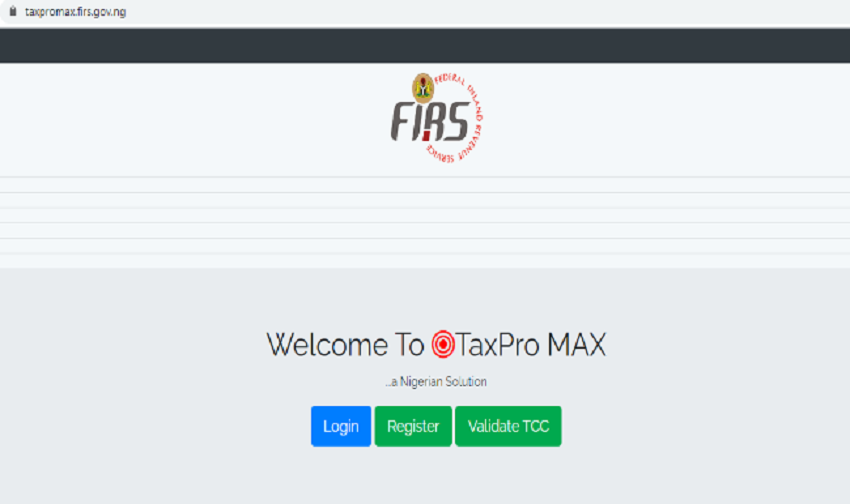
The Federal Inland Revenue Service (FIRS) has introduced the Self-Registration Module on Nigeria’s tax administration solution platform popularly called TaxPro-Max.

In a notice on Monday seen by Business Post, the tax authority said this was introduced as part of ongoing reforms aimed at ease of doing business and matching our new customer-centric posture with tangible action.

In the new development facilitated under the Executive Chairman of the agency, Mr Zacch Adedeji, with the innovation, taxpayers will be able to complete all registration processes with FIRS independently in the comfort of their offices or homes, thus saving them time and resources.

Recall that in June 2021, the FIRS introduced a new tax administration solution called TaxPro-Max to ease tax compliance in the country.

Then under the leadership of Mr Muhammadu Nami, the initiative was part of efforts at modernising tax administration in Nigeria, a crucial goal to boost Nigeria’s tax base.

“TaxPro-Max enables seamless registration, filling, payment of taxes and automatic credit of withholding tax as well as other credits to the taxpayer’s accounts, among other features.

“The TaxPro-Max also provides a single-view to taxpayers for all transactions with the service,” a disclosure revealed then.

Now, every newly registered corporate/business entity assigned a Tax Identification Number (TIN) automatically at the point of registration with the Corporate Affairs Commission (CAC) can now complete their registration with FIRS on TaxPro-Max via www.taxpromax.firs.gov.ng and follow the prompt for self-registration.

“We believe that this innovative approach to taxpayers’ registration will contribute to a more efficient and transparent tax system, ultimately benefiting both taxpayers and the country as a whole.

“FIRS, by this notice, advises taxpayers to take advantage of this new feature, while reiterating its commitment to continuous improvement in taxpayers’ experience,” it said on Monday.

Nigeria’s poor ranking in global ease of paying taxes and its low Tax-to-GDP ratio, which is significantly below the African average, has been a core focus in the current administration of President Bola Tinubu.

The Tinubu administration has said it will break the hold of heavy reliance on borrowing to finance public spending, thereby limiting fiscal space and hindering socio-economic development; one of the ways is to reform taxation in Africa’s largest economy.


Adedapo Adesanya is a journalist, polymath, and connoisseur of everything art. When he is not writing, he has his nose buried in one of the many books or articles he has bookmarked or simply listening to good music with a bottle of beer or wine. He supports the greatest club in the world, Manchester United F.C.

Economy

Crude Oil Slightly Rises as Iran Allows Safe Passage for Ships

Published

on

Brazilian Crude Oil

By Adedapo Adesanya

Crude oil marginally appreciated on Thursday after it was reported that about 30 vessels had crossed the Strait of Hormuz, with Brent crude oil futures gaining 9 cents or 0.09 per cent to trade at $105.72 a barrel, and the US West Texas Intermediate (WTI) futures expanding by 15 cents or 0.15 per cent to $101.17 a barrel.

Iranian state media reported that about 30 Chinese vessels were allowed safe passage by Iran through the Strait, which has been largely shut since the Iran war broke out at the end ​of February.

Before the report, a Chinese supertanker carrying 2 million barrels of Iraqi crude sailed through the contested waterway on Wednesday after being stranded in the Gulf for more than two months, while a Panama-flagged crude oil tanker managed by Japanese refining group Eneos had also passed.

Bloomberg also reported that the vessels were allowed to pass the Strait of Hormuz with the coordination of the Iranian authorities and Islamic Revolutionary Guard Corps’ navy, however, it added that it is yet unknown or unclear whether the US Navy side of the de facto blockade will also let them pass.

The move also follows formal requests by China’s foreign minister as well as its ambassador to Iran, with Iran reportedly agreeing based on safeguarding the two allies’ strategic partnership.

It also comes as President Donald Trump’s ongoing state visit to China, where he and President Xi Jinping agreed that the ‌Strait of ‌Hormuz must be open for ‌the free flow of energy.

President Xi expressed interest in purchasing more US oil to reduce China’s dependence on the Strait of Hormuz, according to the White House. China, the world’s largest oil importer, is not a big buyer of US crude and has not imported any since May 2025 due to a 20 per cent import tariff imposed during the trade war.

Iran, a member of the Organisation of the Petroleum Exporting Countries (OPEC), ​also appears to have tightened control over the strait, cutting deals with Iraq and Pakistan to ship oil and liquefied natural gas from the region.

The International Monetary Fund (IMF) said the global economy is clearly moving into a middle “adverse scenario,” which would see global real GDP growth falling to 2.5 per cent this year from 3.4 per cent growth in 2025, citing the Iran war as the cause.

Continue Reading

Economy

Run From Any Unregistered Online Investment Platform—SEC Warns Nigerians

Published

on

SEC Nigeria

By Aduragbemi Omiyale

For the umpteenth time, the Securities and Exchange Commission (SEC) has run to the rooftop to warn Nigerians against putting their hard-earned money in online investment platforms not authorised to operate in the nation’s capital market.

SEC is the apex regulatory agency in the Nigerian capital market. It issues licences to companies operating in the ecosystem.

In a statement on Thursday, the organisation expressed concerns over the rising “promotion of unregistered online investment schemes on social media applications and websites, including WhatsApp, Instagram, Telegram, Facebook, TikTok and other digital platforms.

In the notice, the SEC emphasised that, “Many of these investment schemes exhibit characteristics of Ponzi or Prohibited investment schemes, while some operators of such schemes also provide unauthorised investment services to members of the public.”

In view of these, the commission advised members of the public “to refrain from investing or participating in any unregistered online investment platform or scheme promising unrealistic or guaranteed returns.”

“Members of the public are further advised not to rely on investment advisories circulated through online platforms by persons or entities not registered by the commission, as reliance on such advisories may expose investors to significant financial losses and fraudulent schemes,” it noted.

“The public is reminded that, under the provisions of the Investments and Securities Act, 2025, only entities registered by the commission are authorised to promote investment services, provide investment advisory services or solicit funds from the public in the Nigerian capital market,” another part of the circular signed by the management noted.

The regulator urged the investing public to verify the registration status of any platform, company, or entity offering investment opportunities on its dedicated portal: https://sec.gov.ng/fintech-and-innovation- hub-finport/registered-fintech-operators/ or https://www.sec.gov.ng/cmos before transacting or investing with them.

Continue Reading

Economy

Dangote Rejects NNPC Bid to Raise Stake in Soon-to-Be Listed Refinery

Published

on

NNPC vs Dangote refinery

By Adedapo Adesanya

Nigerian businessman, Mr Aliko Dangote, has disclosed that he rejected requests by the Nigerian National Petroleum Company (NNPC) Limited to increase its 7.25 per cent stake in the Dangote Petroleum Refinery.

Mr Dangote stated this in a podcast with the Chief Executive Officer of the Norwegian Sovereign Wealth Fund, Mr Nicolai Tangen.

In the podcast interview, the billionaire revealed that the state oil company offered to increase its current 7.25 per cent stake in the 650,000 barrels per day plant.

However, this was rejected because the company is planning to go public and give other Nigerians the opportunity to own shares in the plant.

Recall that the refinery is planning a multi-exchange listing and targeting a valuation of $50 billion. It has appointed a consortium of three financial advisers to manage the offering. Stanbic IBTC Capital to handle international book-building process and lead engagement with foreign portfolio investors; Vetiva Capital Management to manage retail investor distribution within Nigeria; and FirstCap to focus on placements with Nigerian institutional investors, particularly pension funds.

It was reported in 2021 that the NNPC acquired the 7.25 per cent stake in the refinery for $1 billion, with an option to acquire the remaining 12.75 per cent stake by June 2024.

However, the national oil firm reneged on its decision.

During the interview with the Norwegian Sovereign Wealth Fund CEO, Mr Dangote revealed that the state oil company had made attempts to acquire more stakes in the refinery, but this was turned down.

The revelation came while he was responding to questions about what could be the biggest risks to his businesses.

“Actually, if there are civil wars, which is not in the offing at all.

“The other biggest risk is government inconsistencies in policies, and we are addressing that one because if you look at our refinery, the national oil company already owns 7.25 per cent, and they are trying to buy more. We are the ones that said no; we want to now spread it and have everybody be part of it.”

In 2024, Mr Dangote revealed that under the former Group Chief Executive Officer, Mr Mele Kyari, the NNPC reduced its stake in the refinery from 20 per cent to 7.25 per cent. He disclosed that the NNPC had only a 7.2 per cent stake in the refinery and not 20 per cent as many Nigerians believed.

“The agreement was actually 20 per cent, which we had with NNPC, and they did not pay the balance of the money up until last year; then we gave them another extension up until June (2024), and they said that they would remain where they had already paid, which is 7.2 per cent. So NNPC owns only 7.2 per cent, not 20 per cent,” Mr Dangote stated at the time.

Continue Reading

Trending