
Economy
How to Protect Your Crypto From Scams, Hacks

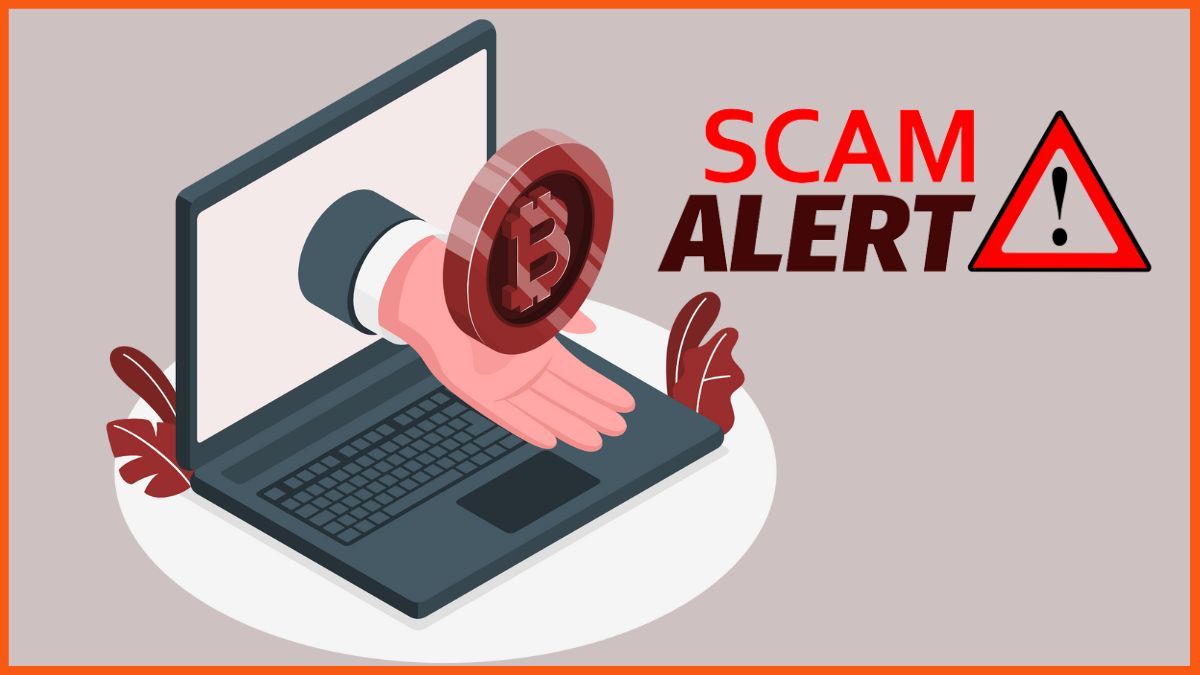
In 2023, it is estimated around $2 billion was lost by investors to scams, rug pulls and hacks. Although the technology is becoming more secure and stable and many users are more aware of the tricks used to steal assets, there are still ways for thieves to extract your crypto if you aren’t careful.
Experts at Smart Betting Guide have provided a guide on the best ways to keep your crypto safe in 2024.
1. Do not store your password and seed phrase on the Cloud
For many people, the best and most convenient way to access crypto is through an exchange or a crypto wallet. Cryptocurrency wallets store users’ public and private keys while providing an easy-to-use interface to manage crypto balances. These exchanges require you to create an account with a password, and wallets give you extra security through the use of a seed phrase. Seed phrases are a sequence of random words that store the data required to access or recover cryptocurrency on blockchains or crypto wallets. Hackers will often attempt to steal these in order to gain access to your crypto and steal it.
It is vital that these passwords and phrases are not stored in the cloud or on a device that could potentially be hacked. Instead, write these down, or get them engraved on a metal card (to protect against water damage or fire) and store them somewhere secure within your property.
Finally, no crypto protocols or their customer support staff will ever ask for this information from you, so if someone asks for it they are trying to steal your crypto.
2. Use a hardware wallet instead of an exchange
If you want to ensure your crypto is completely protected, a hard wallet is the best choice. This is a device such as a USB thumb drive that securely guards a crypto user’s private cryptographic keys in offline or “cold” storage, ready to be used online to complete a crypto transaction whenever you are ready. These are much safer than keeping crypto on an exchange; like with the FTX collapse, users lost billions of dollars of crypto stored in their wallets. Hardware wallets ensure that your crypto is safe from hackers and exchange collapses alike.
Pros: Cannot be accessed by anyone online and is completely secure from online attacks, also prevents loss of crypto from exchanges collapsing
Cons: Could be lost or damaged physically, rendering the crypto useless (although some come with backup features now)
3. DYOR – Do your own research
A rug pull is a scam where a cryptocurrency or NFT developer hypes a project to attract investor money, only to suddenly shut down or disappear, taking investor assets with them. These scams can often be well disguised, which makes them very difficult to spot. Many may be advertised across social media and entice investors through the promise of making lots of money. This is why it’s important to do your research before investing your money in any cryptocurrency or NFT.
Here are the things to look out for when thinking of investing in a new or unknown crypto:
-
– Developers
Investors should consider how credible the team behind the project are. Are they known in the crypto community, and do they have a good or bad track record? Be sure to check the legitimacy of social media accounts. Have they just been created, or is there a clear history that the person is who they say they are? Anonymous developers are a red flag, and any projects are approached with caution. Anonymous developers are a red flag and any projects are approached with caution.
-
– Whitepaper
It is important to check the quality of the white paper, this is a document that explains the purpose of a project and how it works. For a cryptocurrency, the whitepaper is a guide to its technology, features, and goals. If the whitepaper seems vague or doesn’t offer a valued use case or tokenomics then it could be a potentially risky investment.
-
– No liquidity locked
One of the easiest ways to distinguish a scam coin from a legitimate cryptocurrency is to check if the currency is liquidity-locked. With no liquidity lock on the token supply in place, nothing stops the project creators from running off with the entirety of the liquidity.
Investors should also check the percentage of the liquidity pool that has been locked. A lock is only helpful in proportion to the amount of the liquidity pool it secures. Known as total value locked (TVL), this figure should be between 80% and 100%.
-
– No external audit
It is now standard practice for new cryptocurrencies to undergo a formal code audit process conducted by a reputable third party. One notorious example is Tether, a centralised stablecoin whose team had failed to disclose that it held non-fiat-backed assets. An audit is especially applicable for decentralised currencies, where default auditing for DeFi projects is a must. However, potential investors shouldn’t simply take a development team’s word that an audit has taken place. The audit should be verifiable by a third party and show that nothing malicious was found in the code.
4. Verify fake apps and fake crypto exchanges
These are a very popular type of scam and target many investors, however, new investors are more likely to be impacted by these as they may be unsure of what to download. These fake apps can be used to steal money, cryptocurrencies or seed phrases and passwords. The best way to avoid these scams are:
- Never search for crypto apps directly from an app store. Always find the direct download link or redirect link to the app store from the company’s official website or whitepaper.
- Check for the number of app downloads and number of reviews – if these are low this is a red flag
- Check the developer of the app, this should be verifiable and come from the official company. Check for spelling mistakes and also other apps made by the developer.
5. Extra security measures
Finally, there are some basics that should be adhered to which can protect your day-to-day data and accounts as well as your crypto.
- Never click links on emails you are unsure of where they originate from.
- Set up Two Factor Authentication (2FA), this means hackers would need your phone to hack you even if they have all your other account details.
- Don’t click popups or links that come up on the internet or social media
- Be cautious of any messages you receive from people who say they can ‘make you money fast’. These have become popular across social media and utilize fake accounts to try and get your money.
A spokesperson from Smart Betting Guide commented: “Hacks, scams and rug pulls not only pose a threat to individual investors but cast a shadow on the broader narrative of cryptocurrency as a revolutionary force in finance. They erode trust, stifle innovation, and impede the progress towards a more inclusive and decentralized financial future. Therefore, the task at hand goes beyond personal security; it is a shared responsibility to fortify the foundations upon which the future of finance stands.”











By Aduragbemi Omiyale
Five stockbroking firms operating in the Nigerian capital market have been sanctioned for engaging in market infractions.
The affected companies, Meristem Stockbrokers Limited, CSL Stockbrokers Limited, Cowry Securities Limited, Associated Asset Managers Limited, and SMADAC Securities Limited, were fined a total of N291 million.
The Nigerian Exchange Regulation (NGX RegCo) Limited, which imposed the penalties on the stockbrokers, accused them of being involved in wash trades and self-matching transactions.
It was gathered that the culprits were investigated by the exchange’s panel, which uncovered repeated instances of improper trading practices such as artificial price formation and misleading market activity.
They have all been directed to undergo mandatory compliance and market conduct training.
Business Post learned from a notice to the Securities and Exchange Commission (SEC) that CSL Stockbrokers Limited was fined over N91 million, while the other four firms were each fined N50 million in line with provisions of the Investment and Securities Act 2025.
NGX RegCo noted that the penalties reflect the gravity of the breaches and were aimed at strengthening market discipline, deterring misconduct and preserving the integrity of the Nigerian capital market.
It further stated that the action reinforces its drive to ensure a fair, orderly and transparent trading environment, while bolstering investor confidence through stricter enforcement of market rules.
In accordance with the Memorandum and Articles of Association (MemArt) of the Exchange, the board of NGX Regco held a meeting on March 27, 2026, wherein it confirmed the decision of the RNBC to sanction the five trading license holder firms. These sanctions are commensurate to infractions and to serve as a deterrence to these violations,” a part of the notice read.
The action of RegCo came a few weeks after the price movement of a company on the NGX platform, Zichis Agro-Allied Industries Plc, was probed after gaining almost 900 per cent in one month.
Trading in the shares of the company was suspended for about a month and was only lifted on March 23, 2026, with its share price adjusted downward to N8.58 from N17.36.
By Aduragbemi Omiyale
Over 200 secondary school students from Covenant Child Academy, Testimony College, and Green Pastures High School were recently introduced to the fundamentals of financial literacy, capital markets, and responsible investing, offering early exposure to wealth-building principles by the Nigerian Exchange (NGX) Limited.
It was part of Customs Street’s week-long programme to commemorate Global Money Week 2026, themed Smart Money Talks.
The bourse joined the global community to celebrate the week as part of its commitment to advancing financial literacy and equipping the next generation of investors.
The students, who underwent the seminar under the NGX’s flagship X-Tour initiative, were guided by representatives from NGX and NGX Regulation on key considerations before investing, as well as common warning signs to watch for when evaluating investment opportunities.
The session reinforced the importance of cultivating positive money habits to support sound financial decisions in the future.
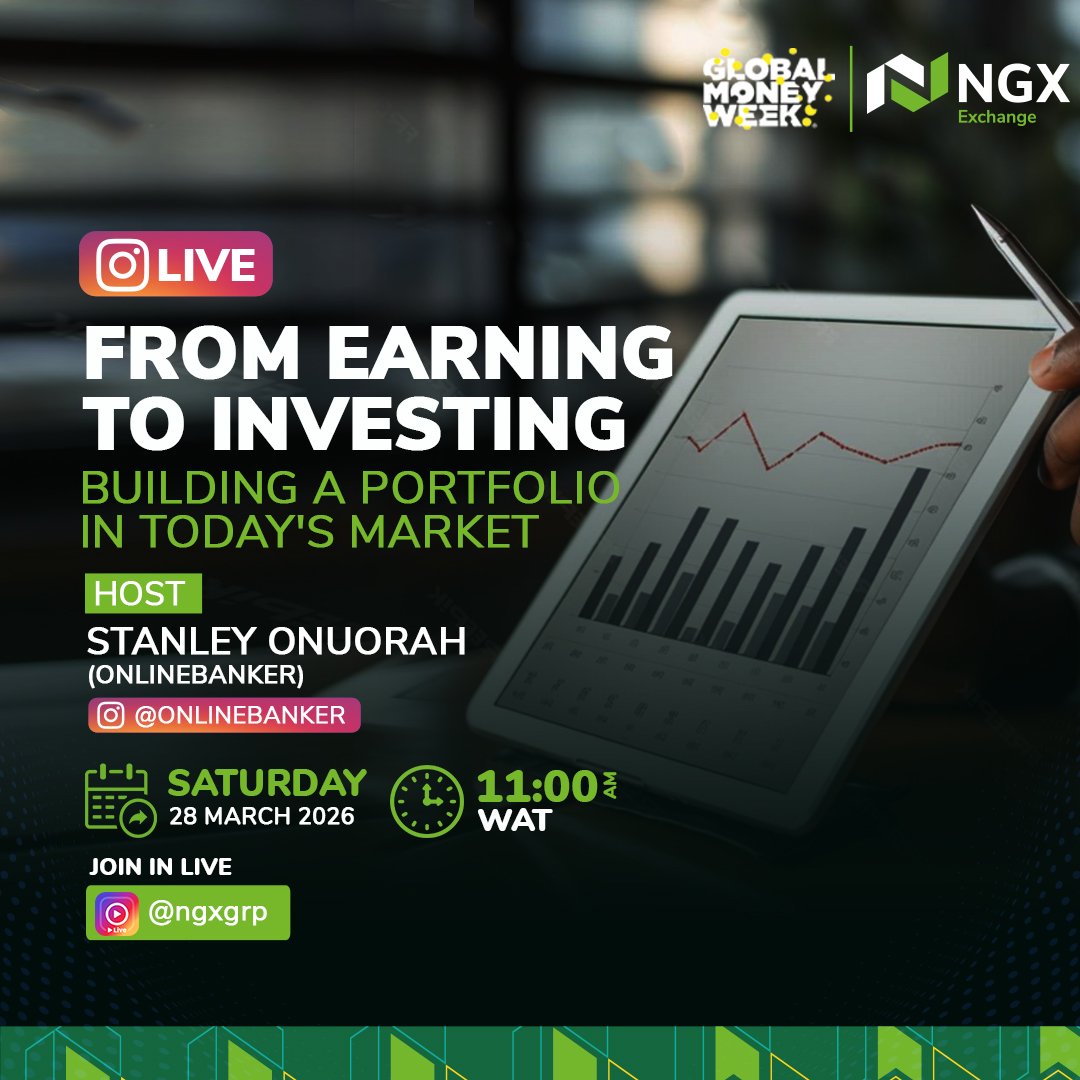
Extending its impact beyond in-person engagement, the exchange also convened an interactive Instagram Live session in collaboration with United Capital Plc.
Featuring Stanley Onuorah, widely known as Online Banker, the session focused on Building a Portfolio in Today’s Markets. It addressed pressing questions from young Nigerians on navigating the capital market, understanding available investment products, and making informed financial choices.
During the session, a representative from NGX’s Trading and Products division shared practical insights into the range of instruments available in the market, including equities, fixed income securities, and exchange-traded funds, while outlining clear pathways for getting started and building resilient portfolios across varying market conditions.
In parallel, a representative from Market Regulation emphasised the importance of investor protection frameworks, educating participants on their rights, the safeguards that ensure fair market practices, and the necessity of due diligence in sustaining trust and integrity within the market.
The session has since attracted thousands of views, significantly amplifying awareness around financial literacy and encouraging greater youth participation in the capital market.
Through these initiatives, NGX continues to play a pivotal role in shaping financially responsible citizens, in line with its broader mandate to drive inclusive growth and strengthen investor confidence within Nigeria’s financial ecosystem.


By Adedapo Adesanya
The NASD Over-the-Counter (OTC) Securities Exchange declined by 2.14 per cent on Monday, March 30, weakening the Unlisted Security Index (NSI) by 89.95 points to 4,109.74 points from 4,199.69 points.
During the session, investors lost N53.82 billion, leaving the market capitalisation of the trading platform at N2.458 trillion versus the previous session’s N2.512 trillion.
The bourse recorded four price gainers and four price losers led by 11 Plc, which shed N35.12 to close at N316.50 per share compared with last Friday’s value of N351.17 per share. MRS Oil Plc declined by N20.00 to quote at N190.00 per unit versus the previous price of N21o.00 per unit, FrieslandCampina Wamco Nigeria Plc dropped N11.00 to trade at N99.00 per share versus N110.00 per share, and Central Securities Clearing System (CSCS) Plc dipped N2.93 to N77.17 per unit from N80.10 per unit.
Conversely, IPWA Plc appreciated by 55 Kobo to N6.06 per share from N5.51 per share, Industrial and General Insurance (IGI) Plc expanded by 5 Kobo to 57 Kobo per unit from 52 Kobo per unit, Geo-Fluids Plc gained 4 Kobo to close at N3.22 per share versus N3.18 per share, and Acorn Petroleum Plc improved by 1 Kobo to N1.34 per unit from N1.33 per unit.
Trading data revealed a decline of 63.7 per cent in the volume of securities to 21.3 million units from 58.6 million units, a 59.6 per cent drop in the value of securities to N651.1 million from N1.6 billion, and a 24 per cent contraction in the number of deals to 38 deals from 50 deals.
The most active stock by value on a year-to-date basis was CSCS Plc with 56.3 million units exchanged for N3.8 billion, trailed by Okitipupa Plc with 27.5 million units traded for N1.8 billion, and Infrastructure Guarantee Credit Plc with 400 million units valued at N1.2 billion.
Resourcery Plc was the most traded stock by volume on a year-to-date basis with 1.1 billion units worth N415.7 million, followed by Infrastructure Guarantee Credit Plc with 400 million units sold for N1.2 billion, and Geo-Fluids Plc with 133.1 million units transacted for N511.2 million.











-
 Feature/OPED6 years ago
Davos was Different this year
-
Travel/Tourism10 years ago
Lagos Seals Western Lodge Hotel In Ikorodu
-

 Showbiz3 years ago
Estranged Lover Releases Videos of Empress Njamah Bathing
-
 Banking8 years ago
Sort Codes of GTBank Branches in Nigeria
-

 Economy3 years ago
Subsidy Removal: CNG at N130 Per Litre Cheaper Than Petrol—IPMAN
-

 Banking3 years ago
Sort Codes of UBA Branches in Nigeria
-

 Banking3 years ago
First Bank Announces Planned Downtime
-

 Sports3 years ago
Highest Paid Nigerian Footballer – How Much Do Nigerian Footballers Earn
Pingback: How to Tackle the Challenges of Crypto Estate Planning | Business Post Nigeria