Economy
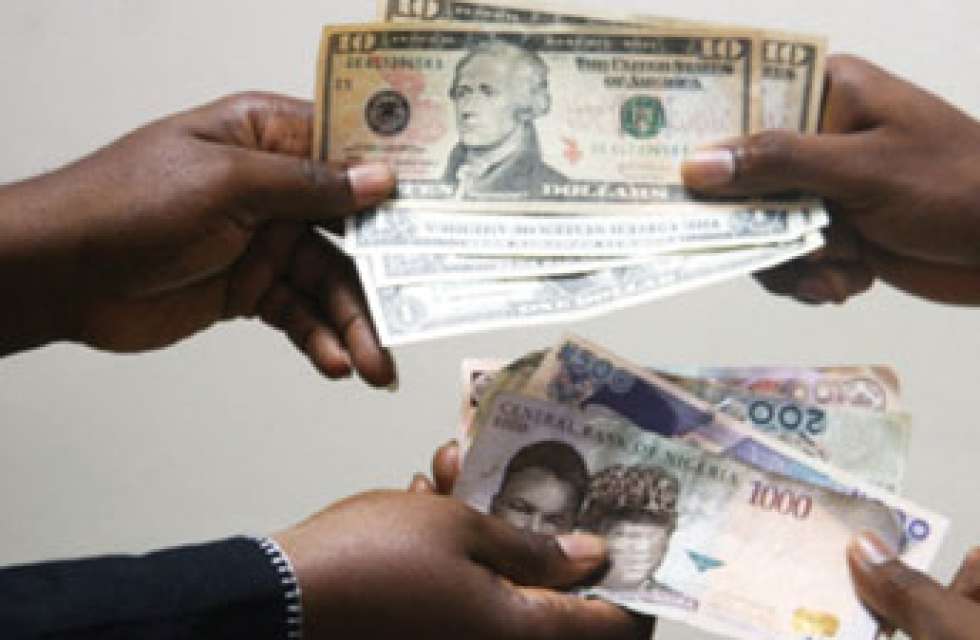
Investors, Exporters Exchange Dollar at N415.07 Friday
By Adedapo Adesanya
The Naira to Dollar exchange rate at the Investors and Exporters (I&E) segment of the foreign exchange (FX) market in Nigeria maintained stability on Friday.
According to data harvested from FMDQ Securities Exchange by Business Post yesterday, the domestic currency was traded at N415.07/$1, the same amount it was sold on Thursday.
It was observed that the local currency closed flat during the session despite a significant increase in the demand for forex at the market window.
At the last trading session of the week on the FX category, transactions valued at $240.97 million were carried out compared with the $103.16 million recorded at the preceding session, indicating a surge of $137.81 million or 133.6 per cent.
But at the interbank segment of the FX market, the Nigerian currency had a bad day against the United States currency as it depreciated by 5 kobo or 0.01 per cent to sell for N410.96/$1 in contrast to N410.91/$1 it traded a day earlier, according to data from the Central Bank of Nigeria (CBN).
At the digital currency market, four of the 10 cryptos monitored by this newspaper on Friday declined, with Bitcoin (BTC), the most popular of the digital currencies, losing 4.7 per cent to sell at N34,434,127.72.
The loss occurred after it went on to chart a brand new all-time high in the week as the market witnessed the approval of the first-ever futures BTC ETF in the US.
Litecoin depreciated by 5.8 per cent to sell at N107,359.81, Ripple (XRP) tumbled by 2.7 per cent to N621.99, while Tron (TRX) recorded a 0.4 per cent drop to trade at N55.94.
However, Ethereum (ETH) recorded the highest gain of the day with a 5.0 per cent growth to trade at N2,400,000.00, Dash (DASH) climbed higher by 3.4 per cent to sell for N112,490.00, Dogecoin (DOGE) rose by 3.2 per cent to N149.35, Cardano (ADA) grew by 0.8 per cent to sell at N1,278.84, Binance Coin (BNB) improved by 0.5 per cent to quote at N197,123.45, while the US Dollar Tether (USDT) increased by 0.2 per cent to sell for N564.99.
Economy
Naira Appreciates to N1,349/$1 at Official FX Window
By Adedapo Adesanya
The Naira appreciated against the United States Dollar by N8.07 or 0.59 per cent in the Nigerian Autonomous Foreign Exchange Market (NAFEM) on Monday, August 17, to N1,349.54/$1 from last Friday’s N1,357.61/$1.
Similarly, the Nigerian Naira gained N9.99 against the Pound Sterling in the official FX market during the session to settle at N1,830.11/£1 versus the previous day’s N1,840.10/£1, and improved its value against the Euro by N6.91 to close at N1,564.79/€1 compared with the preceding session’s N1,571.70/€1.
However, the Nigerian currency traded flat against the US Dollar yesterday at the parallel market at N1,395/$1, and at the GTBank forex counter, it remained unchanged at N1,364/$1.
Interbank FX turnover, according to data from the Central Bank of Nigeria (CBN), accelerated by 265 per cent to $437.529 million from last Friday’s $119.594 million, with the number of deals rising to 178 from 137.
Total FX inflows into the NAFEM window increased significantly to $1.77 billion from $0.83 billion in the previous week, according to the research subsidiary of Coronation Group.
Domestic sources accounted for 63.44 per cent of total inflows, driven primarily by Exporters (31.2 per cent) and Non-Bank Corporates (17.7 per cent), underscoring the growing contribution of autonomous market participants to FX supply.
Notably, the central bank injected $252.1 million, representing 14.3 per cent of total inflows, to enhance market liquidity. On the external side, Foreign Portfolio Investors (FPIs) remained the largest single source of FX, contributing 33.71 per cent of aggregate inflows.
Meanwhile, the cryptocurrency market was mixed on Monday, with Bitcoin (BTC) up by 0.9 per cent to $64,153.93, and Solana (SOL) gaining 0.3 per cent to sell at $75.602.
This occurred amid broader markets continuing their climb following President Donald Trump saying he was not interested in extending the expiring agreement with Iran, and as fighting flared again in Lebanon.
But Cardano (ADA) lost 2.2 per cent to finish at $0.1729, Ripple (XRP) declined by 0.8 per cent to $0.9939, Dogecoin (DOGE) slipped by 0.7 per cent to $0.0698, Binance Coin (BNB) crumbled by 0.4 per cent to $602.80, Ethereum (ETH) slid by 0.3 per cent to $1,892.96, and TRON (TRX) also depreciated by 0.3 per cent to $0.3314, while the US Dollar Tether (USDT) and the US Dollar Coin (USDC) remained unchanged at $1.00, respectively.
Economy
Crude Oil Prices Climb Over $2 as Diplomatic Efforts to End Iran War Stall
By Adedapo Adesanya
Crude oil prices gained more than $2 on Monday amid global supply worries stoked by investor pessimism about diplomatic efforts to resolve the US-Iran war.
Brent crude futures chalked up $2.35 or 2.65 per cent to trade at $90.87 a barrel, while the US West Texas Intermediate (WTI) crude futures grew by $2.10 or 2.55 per cent to $84.50 a barrel.
President Donald Trump said the US was not seeking an extension of the memorandum of understanding with Iran. He also told reporters Iran would not make the type of deal that he thought was necessary.
He further demanded Iran’s surrender and threatened to bomb Oman if the country gets in its way.
Reuters reported that Iran would escalate tensions in the Strait of Hormuz, citing officials and beyond, and launch an attack if the US fails to implement an interim peace deal fully in a matter of weeks.
Iran’s foreign minister has said the waterway will not reopen until America first returns to the deal, while the US Treasury Secretary has warned of unprecedented economic isolation for Iran.
Still, oil prices are unlikely to move substantially higher unless there is a halt in the current flow of crude out of the Strait of Hormuz at night and/or a closure of the Bab el-Mandeb Strait.
Tanker traffic via the Strait of Hormuz slowed further over the weekend, maintaining upward pressure on oil prices. Only five commodity vessels passed the Strait of Hormuz on Saturday, and none were scheduled to transit the waterway on Sunday, data from Kpler showed.
The data, however, does not include tankers that transit Hormuz in so-called dark mode. That compares with 31 tankers passing the Strait of Hormuz the previous weekend.
Before US-Israeli attacks on Iran began in late February, the strait handled about one-fifth of global oil and liquefied natural gas supplies.
Amid the development, Middle East producers like the United Arab Emirates (UAE) and Saudi Arabia stepped up sales to Asian countries.
ADNOC sold at least 14 million barrels of spot crude to Asian refiners at premiums in its latest tender, while Saudi Aramco is offering crude oil outside of the Strait of Hormuz to some Asian refiners.
News about a massive build in US oil inventories helped keep prices below peaks reached earlier in the year. Stocks of crude oil in the US Strategic Petroleum Reserve fell by about 5.3 million barrels to 293.4 million barrels last week, the lowest level since December 1982, according to data from the Department of Energy. The drawdowns are part of a US agreement to release 172 million barrels from the facility.
Economy
Nestoil Debt: EFCC Facilitates $60m Payment to Lenders
By Adedapo Adesanya
The Economic and Financial Crimes Commission (EFCC) has facilitated the recovery of $60 million from Nestoil Limited, with the funds paid to a consortium of lenders as part of efforts to recover the oil and gas company’s outstanding debt.
According to a report by Nairametrics, the payment followed a structured repayment agreement between Nestoil and the lenders, reached during a meeting convened and chaired by EFCC Chairman, Mr Ola Olukoyede.
The meeting brought together Nestoil and the consortium of financial institutions as part of the Commission’s investigation into transactions involving the company and its creditors.
According to sources cited by the publication, operatives of the EFCC’s Lagos Zonal Directorate 2 facilitated the recovery as part of investigations into alleged criminal aspects of the transactions.
The $60 million payment represents the first phase of the repayment arrangement, with about $40 million expected to be received in the next tranche.
The consortium, which includes Access Bank, Zenith Bank, Ecobank, African Export-Import Bank (Afreximbank), First Bank of Nigeria, First City Monument Bank (FCMB), United Bank for Africa (UBA) and Union Bank of Nigeria, is expected to continue working with the EFCC and other stakeholders to recover the outstanding obligations.
The lenders had previously stated that Nestoil’s indebtedness stood at approximately $1.084 billion and N469.43 billion as of June 2026.
The debt arose from several bilateral credit facilities extended to Nestoil by the financial institutions from 2010. The facilities were subsequently consolidated under a restructuring arrangement known as the “Global Club”, which became effective in 2023.
However, the lenders alleged that repayment defaults continued after the restructuring, resulting in substantial outstanding obligations.
The dispute escalated in October 2025 when the Federal High Court in Lagos granted a Mareva injunction freezing assets, bank accounts and shares linked to Nestoil, its affiliate Neconde Energy Limited and their promoters.
The court subsequently appointed Mr Abubakar Sulu-Gambari, a Senior Advocate of Nigeria (SAN), as receiver-manager and authorised him to take possession of identified assets.
Nestoil, however, maintained that it remained operational and described the matter as a commercial dispute being addressed through the courts.
The legal dispute subsequently progressed through the Federal High Court, Court of Appeal and Supreme Court over issues relating to debt recovery, receivership and interim orders.
In June 2026, the Supreme Court set aside interim preservative orders previously granted by the Court of Appeal and directed the parties to return to the lower court to address the substantive issues.
The lenders subsequently clarified that the Supreme Court decision did not extinguish Nestoil’s indebtedness or invalidate the underlying debt recovery process.
The latest $60 million recovery is therefore a significant development in the prolonged debt dispute, although it represents only a fraction of the total amount claimed by the lenders.
Based on the consortium’s previously disclosed dollar-denominated debt of $1.084 billion, the recovered $60 million represents about 5.5 per cent of that amount, excluding the separate N469.43 billion naira obligation.
The recovery could provide a basis for further repayments under the structured arrangement while the EFCC investigation and related legal proceedings continue.