Connect with us

Economy

Investors Purchase 2021 November FGN Savings Bond

Published

on

FGN Savings Bond

By Sodeinde Temidayo David

Retail investors interested in purchasing the Federal Government of Nigeria (FGN) savings bond for the month of November 2021 can begin to do so.

This is because the Debt Management Office (DMO) has commenced the sale and this can be done through the approved organisations for this.

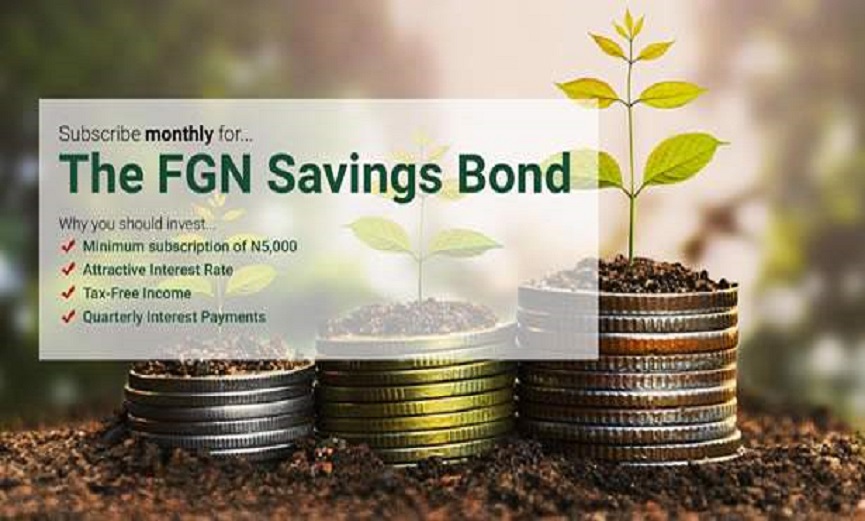
The FGN savings bond is sold every first week of the month and the minimum subscription is N5,000 with N50 million as the maximum amount of the debt instrument that can be bought at a time.

The exercise is supervised by the debt office, with proceeds used to finance various projects the federal government intends to execute in the financial year.

For this month, the DMO commenced the sale on Monday, November 1 and will wrap up on Friday, November 5, giving an opportunity for retail investors who missed the previous auction last month to participate.

This bond is auctioned to give a chance to low-income earners to secure earnings from the investment while supporting the government with its functions.

As usual, the bond is being auctioned in two maturities, a two-year note which will mature on November 10, 2023, and a three-year note with maturity on November 10, 2024.

For this month, DMO is offering the two-year note with the coupon rate of 7.38 per cent per annum and the three-year paper at a rate of 8.38 per cent per annum.

According to the debt office, the coupon will be paid quarterly, with the first interest payment expected on November 10, 2021, and the second on February 10 and so on till maturity, when the bullet payment would be paid.

To purchase the bonds, an investor would be required to pay N1,000 per unit subject to a minimum of five units subscription of N5,000 and the maximum of 50,000 units at N50 million.

The notes can be bought through stockbroking firms appointed as distribution agents by the debt management office.

The savings bonds are tax-free with competitive fixed interest rates to be paid every quarter and can be traded on the Nigerian Exchange (NGX) Limited to provide an exit route before maturity. They can also be used as collateral for loans as it is backed by the full faith and credit of the Federal Government of Nigeria and charged upon the general assets of Nigeria.


Economy

Guinness Nigeria Shareholders to Pocket N4.38bn Interim Dividend for Q1’26

Published

on

Guinness Nigeria

By Aduragbemi Omiyale

Shareholders of Guinness Nigeria Plc will share about N4.38 billion as an interim dividend for the first quarter of 2026, the board has disclosed.

This cash reward amounts to N2.00 per share, as the company has shares outstanding of 2,190,382,819 on the floor of the Nigerian Exchange (NGX) Limited.

The brewer stated that the interim dividend would be paid to investors whose names appear on the register of members as of the close of business on April 20, 2026.

The dividend payout is being proposed following the sustained profitability reflected in the unaudited financial results of the company in the first three months of this year and its “strong performance in FY 2025.”

It would be “paid from distributable profits in accordance with Sections 426–428 of the Companies and Allied Matters Act (CAMA) 2020.”

Analysis of the performance of the brewery giant between January and March 2026 showed that revenue grew by 4 per cent on a year-on-year basis to N122.77 billion from N118.34 billion in the same period of last year, while the gross profit contracted to N43.48 billion from N44.52 billion due to prevailing cost pressures within the operating environment.

The company’s operating profit also shrank to N17.18 billion from N18.00 billion in the first quarter of 2025 due to elevated marketing & distribution costs and administrative expenses.

However, the reduction in net finance costs to N1.43 billion from N7.72 billion in Q1 of 2025 helped the organisation to grow its post-tax profit to N10.39 billion in the period under review versus the N7.03 billion recorded in the corresponding period of last year.

Continue Reading

Economy

Right Institutional Structures Critical to Unlocking Sustainable Growth—Kwairanga

Published

on

NGX BoI Unlocking Sustainable Growth

By Aduragbemi Omiyale

The chairman of the Nigerian Exchange (NGX) Group Plc, Mr Umaru Kwairanga, says enabling entrepreneurship requires more than access to funding.

He said this at a workshop held in Kano under the theme Unlocking Growth – Harnessing the Capital Market for SME Growth.

The event was organisation by the NGX in partnership with the Bank of Industry (BoI) as part of their financing advocacy.

Mr Kwairanga noted that the right institutional structures and market platforms are critical to unlocking sustainable growth.

“Kano provides a fitting backdrop for this engagement, not only as a historic commercial hub but as a gateway to significant untapped potential. The priority is to connect that potential to capital and the frameworks required for long-term growth,” he stated.

The programme was put together to integrate small and medium-sized enterprises (SMEs) into Nigeria’s formal capital market.

The Kano workshop follows the inaugural edition held in Lagos last year, signalling a more structured push by both institutions to bridge the gap between Nigeria’s SME ecosystem and long-term capital.

Participants were equipped with insights on financing pathways, governance structures, and long-term growth strategies within the capital market.

On his part, the chief executive of NGX Limited, Mr Jude Chiemeka, emphasised the central role of SMEs in strengthening market depth and resilience, noting that recent market performance continues to reflect investor confidence despite macroeconomic pressures.

“Through initiatives like this, we are demystifying the capital market and demonstrating that with the right structure and governance, SMEs can access capital to scale sustainably,” he said.

An Executive Director for MSME at BOI, Mr Oluwatoyin Ahmed Edu, said the bank remains focused on bridging financing gaps for businesses that may not yet meet listing requirements.

“Where viable enterprises require capacity building before accessing the market, BOI is positioned to provide the necessary support to prepare them for that transition,” he noted.

Delivering remarks on behalf of the Emir of Kano, Mr Shehu Muhammed Dankade highlighted the region’s strong entrepreneurial base, particularly the growing participation of women-led businesses, describing it as a signal of resilience and economic potential.

The workshop featured detailed presentations from NGX on listing requirements, corporate governance, and the use of the NGX Growth Board as a platform for raising long-term capital.

It also created space for direct engagement with SME operators across Northern Nigeria, offering insights into their challenges, growth ambitions, and readiness to access structured financing.

The initiative aligns with NGX Group’s broader strategy to position SMEs as a critical engine of economic growth, while strengthening the institutional pathways that enable businesses to transition from informal operations to investment-ready enterprises.

Continue Reading

Economy

Spike in Energy Prices Raises Nigeria’s Inflation to 15.38% in March

Published

on

Nigeria's inflation

By Adedapo Adesanya

Nigeria’s inflation rate increased in March 2026 to 15.38 per cent from 15.1o per cent in February, data from the National Bureau of Statistics showed on Wednesday.

The Consumer Price Index (CPI) increased to 135.4 in March 2026, higher than the 130.0 in the preceding month by 5.4 points. The spike was likely stoked by the US-Israeli war on Iran, that’s pushed up the cost of fuel and has had a ripple effect in other areas.

At 15.38 per cent, the inflation numbers beat expectations of analysts at Meristem Research, which projected that the inflation rate in Nigeria for the month should come in at 13.59 per cent, after the price of crude oil on the global market soared as a result of the war in Iran, with prices of items growing in Nigeria.

The March 2026 headline inflation rate showed an increase of 0.32 per cent compared to the February 2026 headline inflation rate. However, on a month-on-month basis, the headline inflation rate in March 2026 was 4.18 per cent, which was 2.17 per cent higher than the rate recorded in February 2026 at 2.01 per cent.

This means that last month, the rate of increase in the average price level was higher than the rate of increase in the average price level a month earlier.

Food inflation rate in the review month stood at 14.31 per cent on a year-on-year basis versus 25.22 per cent in the same month of last year. However, on a month-on-month basis, the food inflation rate in March 2026 was 4.17 per cent, which is 0.52 per cent lower than the 4.69 per cent achieved in February 2026.

According to the stats office, “This can be attributed to the rate of change in the average prices of the following products: Yam, Ginger (Fresh), Cassava Tuber, Groundnuts (Shelled), Irish Potatoes, Avenger (Ogbono/Apon) – Dried Ungrinded, Tomatoes (fresh), Cassava Flour sold loose, etc.”

The average annual rate of food inflation for the twelve months ending March 2026 over the previous twelve-month average was 18.21 per cent, which was 17.81 per cent lower than the average annual rate of change recorded in March 2025 at 36.02 per cent.

On a year-on-year basis, in March 2026, the urban inflation rate was 14.64 per cent, and 3.16 per cent on a month-on-month basis, which is 0.61 per cent higher than the 2.55 per cent in February 2026.

As for the rural inflation rate, it was 17.22 per cent in the month under consideration and on a month-on-month basis, it stood at 6.73 per cent versus 0.71 per cent a month earlier.

Continue Reading

Trending