Economy
Investors Trade 2.7 billion Shares worth N23.7bn in Five Days
By Aduragbemi Omiyale
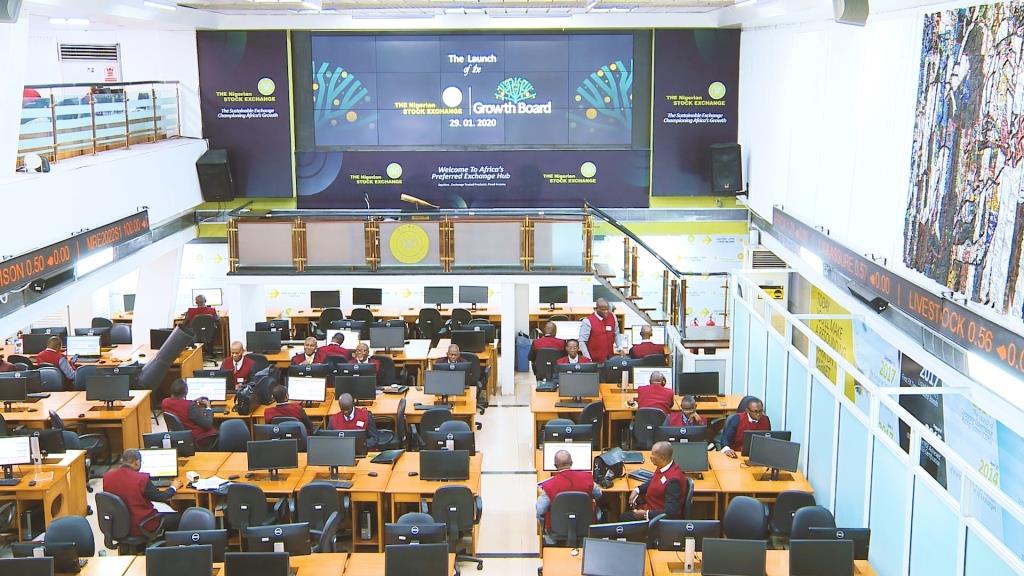
The level of activity at the nation’s stock market waned last week as investors continue to search for other forms of investments better than equities for now.
The recent uptick in the fixed income market has continued to pose a threat to the Nigerian Stock Exchange (NSE), resulting in the decline in the space lately.
Last week, a total of 2.7 billion shares worth N23.7 billion were traded in 27,844 deals in contrast to the 2.8 billion stocks worth N29.7 billion transacted in 31,380 deals a week earlier.
Business Post reports that the activity chart was dominated by financial equities, trading 2.0 billion units valued at N13.4 billion in 14,832 deals, accounting for 75.74 per cent and 56.70 per cent of the trading volume and value respectively.
Consumer goods shares traded 181.8 million units worth N3.6 billion in 4,676 deals, while conglomerates stocks transacted 175.1 million units valued at N324.0 million in 1,168 deals.
It was observed that LivingTrust Mortgage Bank, FBN Holding and Zenith Bank accounted for 1.208 billion units worth N6.6 billion in 3,785 deals in the week, contributing 45.02 per cent and 27.81 per cent to the total equity turnover volume and value respectively.
In the five-day trading week, a total of 16 equities appreciated in price, lower than 22 stocks in the previous week. In addition, 55 equities depreciated in price, lower than 60 shares in the previous week, while 91 stocks traded flat, higher than 80 equities recorded in the previous week.
On the gainers’ list, Mutual Benefits Assurance was top with a price growth of 10.53 per cent to settle at 42 kobo per share.
Morison Industries gained 10.00 per cent to trade at 55 kobo per share, Mc Nichols appreciated by 9.59 per cent to finish at 80 kobo per unit, UPDC REIT moved higher by 9.09 per cent to close at N6 per share, while UAC Property gained 6.67 per cent to end at 80 kobo per unit.
On the flip side, Northern Nigerian Flour Mills was the worst-performing stocks with a price decline of 18.84 per cent to close at N7.02 per share.
NEM Insurance depleted by 18.00 per cent to N2.05 per unit, Royal Exchange lost 16.67 per cent to sell for 30 kobo per unit, GTBank depreciated by 15.69 per cent to settle at N30.35 per share, while Livestock Feeds declined by 15.06 per cent to finish at N2.03 per unit.
When the trading week ended, the All-Share Index and the market capitalisation of the NSE depreciated by 3.04 per cent to close at 40,439.85 points and N21.156 trillion respectively.
Similarly, all other indices finished lower with the exception of NSE Growth index which rose by 0.42 per cent while the NSE ASeM and NSE Sovereign Bond indices remained unchanged.
Economy
Stanbic IBTC Capital Emerges Best Investment Bank in Nigeria
By Aduragbemi Omiyale
The Global Banking and Finance Review has named Stanbic IBTC Capital, a subsidiary of Stanbic IBTC Holdings, as the Best Investment Bank in Nigeria for 2026.
The leading financial publication picked Stanbic IBTC Capital for the honour in recognition of its commitment to leadership and excellence in Nigeria’s investment banking sector.
The selection process involves an extensive evaluation of performance across critical metrics, including innovation, client service, financial health, and industry advancement.
Stanbic IBTC Capital’s accolade reflects its strong dedication to delivering capital markets and financial advisory solutions for clients in both the public and private sectors.
The firm has made significant strides in facilitating groundbreaking transactions, offering market-leading expertise in equity, debt, and structured finance, while nurturing the growth ambitions of businesses and institutions across Nigeria.
“We are truly pleased to be acknowledged for our relentless pursuit of excellence in the investment banking arena.
“This honour reflects our commitment to hard work and further establishes the deep trust our clients have in our expertise and service.
“It further motivates us to maintain our dedication to exceptional service, cultivate impactful partnerships, and continue delivering innovative financial solutions that meet our clients’ aspirations,” the chief executive of Stanbic IBTC Capital, Mr Oladele Sotubo, stated.
The Executive Director of Corporate and Transaction Banking at Stanbic IBTC Bank, Mr Eric Fajemisin, on his part, said, “Receiving this esteemed acknowledgement from the Global Banking and Finance Review Awards underscores our commitment to driving innovation and excellence within Nigeria’s investment banking landscape.
“This accolade highlights the significant role our skilled team plays in fostering economic growth and stability.
“We are dedicated to delivering exceptional value to our clients, which not only supports their financial success but also contributes to the broader development of the nation’s financial ecosystem.”
The Global Banking and Finance Review annually celebrates institutions that demonstrate quality, innovation, and contributions to the advancement of banking and financial services worldwide.
Now in its 16th edition, the awards honour organisations that uphold outstanding service standards, strategic execution, and industry leadership.
Economy
Fubara Presents N1.85trn 2026 Budget to Rivers Assembly
By Aduragbemi Omiyale
The Governor of Rivers State, Mr Siminalayi Fubara, has presented the 2026 Appropriation Bill to the Rivers State House of Assembly.
The 2026 budget estimate of N1.85 trillion, christened Budget of Resilience for Growth and Development, was presented to the state parliament on Friday.
Mr Fubara stated that the proposed spending for the 2026 fiscal year represents a 24.49 per cent increase over the adjusted 2025 budget, driven by anticipated growth in Federation Account Allocation Committee (FAAC) allocations, derivation revenue and internally generated revenue.
He informed the lawmakers that the state hopes to earn N487.61 billion from internally generated revenue, N936.05 billion from FAAC allocations, derivation funds, Value Added Tax (VAT) and exchange gains, and N382.48 billion from capital receipts, including loans, grants and asset sales.
According to him, N413.11 billion is for recurrent expenditure and N1.405 trillion for capital projects, underscoring his administration’s commitment to accelerating development across the state.
He added that personnel costs would gulp N154.77 billion, while N15.22 billion would fund new recruitments, stating that the budget also provides for pensions, gratuities, death benefits and debt servicing.
Governor Fubara further proposed a 50 per cent increase in overhead expenditure for Ministries, Departments and Agencies (MDAs) to strengthen their operational capacity immediately after the budget is signed into law.
He also stated that the largest allocation under the capital budget is the Works and Infrastructure sector with N533.32 billion, followed by Education with N315 billion and Healthcare with N105.43 billion.
In addition, N41.44 billion is for the Rivers State House of Assembly, N30 billion for the Judiciary, N19.26 billion for Agriculture, N15 billion for Power, N8.5 billion for Chieftaincy and Community Development, N7.98 billion for Sports, N7 billion for Youth Development, N6.5 billion for Women Affairs, and N6.61 billion for Environment and Sustainable Development.
The Governor noted that the budget was designed to sustain economic growth, expand critical infrastructure and improve the welfare of residents, pointing out that it builds on the achievements of his administration despite the challenges experienced by the state.
According to him, the budget prioritises the completion of ongoing road projects, new infrastructure investments, improved education and healthcare services, job creation and expanded economic opportunities for residents.
Describing the proposal as a people-centred budget, he assured Rivers people that every public fund would be judiciously utilised to deliver quality services, attract investment and stimulate inclusive development.
Mr Fubara acknowledged the delayed presentation of the budget and appealed to members of the House of Assembly to give the appropriation bill speedy consideration and passage to facilitate timely implementation.
In his remarks, the Speaker of the Rivers State House of Assembly, Mr Martin Amaewhule, acknowledged that the 2026 Appropriation Bill was presented later than expected but assured the Governor that the legislature would expedite its consideration in the interest of the people of Rivers State.
Economy
Nigeria to Begin Mandatory ESG Reporting for Large Public Firms from 2027
By Adedapo Adesanya
The Securities and Exchange Commission (SEC) has unveiled plans to make sustainability reporting mandatory for large public interest entities from 2027.
This comes as Nigeria moves to align its corporate disclosure framework with global environmental, social and governance (ESG) reporting standards.
The phased implementation will begin with voluntary adoption by early adopters and large public interest entities before becoming mandatory in 2027. The requirement will extend to other public interest entities in 2028 and small and medium-scale enterprises (SMEs) by 2030.
The Director-General of the SEC, Mr Emomotimi Agama, disclosed this at the 2026 Financial Institutions Training Centre (FITC) Sustainability and ESG Conference 3.0, themed ‘Building a Sustainable Africa: Integrating Environmental Stewardship, Social Investment, and Strong Governance for a Prosperous Future’ in Lagos.
Mr Agama said Nigeria’s sustainability disclosure regime is being aligned with the International Sustainability Standards Board (ISSB) framework, including IFRS S1 and IFRS S2, which have emerged as the global benchmark for sustainability reporting.
He said that institutional investors increasingly consider ESG performance a key determinant of capital allocation rather than a peripheral corporate responsibility issue, noting that the price of entry is disclosure.
He said the reforms would strengthen investor confidence and position Nigerian businesses to access global capital markets, where sustainability disclosures are becoming an essential investment requirement.
According to him, Nigeria’s capital market has recorded significant expansion, with market capitalisation growing from about N130 trillion to nearly N160 trillion following recent market reforms, while assets under management have surpassed N9 trillion.
To deepen sustainable finance, Agama said the commission was promoting infrastructure, green and municipal bonds, alongside infrastructure-focused investment funds, to mobilise long-term capital for critical national projects.
He added that the commission would also encourage investments in the blue economy and support financing for the power sector through green energy bonds, project bonds and public-private investment structures.
The SEC chief cited the recent launch of the Nigerian Exchange (NGX) Impact Board as another milestone in advancing sustainable finance and urged companies, regulators and investors to move beyond commitments by embedding sustainability into governance, operations and investment decisions.