Economy
Local Stocks Lose N49bn to Open Week Bearish
By Dipo Olowookere
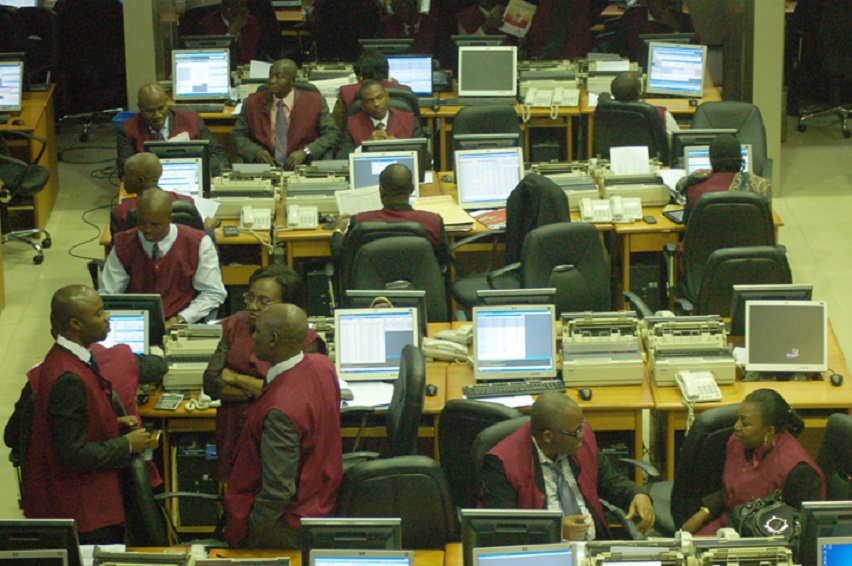
The first trading day of this week started off on a wrong foot on Monday as a result of the profit-taking activities witnessed at local stock market, which resulted in the market closing the trading session 0.36 percent lower to expand the year-to-date loss to 3.53 percent.
Business Post observed that the loss posted by the market yesterday was as a result of the poor performances of the sectors on the Nigerian Stock Exchange (NSE).
Apart from the insurance sector, which slightly appreciated by 0.02 percent, every other sector closed under water.
The industrial sector was the most hit on Monday, going down by 2.35 percent, while the consumer goods sector followed with a decline of 0.62 percent. The oil and gas industry fell yesterday by 0.21 percent, while the banking sector went down by 0.10 percent.
During trading on Monday, the All-Share Index (ASI) went down by 109.94 points to close at 30,322.19 points, while the market capitalisation depreciated by N49 billion to finish at N13.354 billion.
The market breadth ended negative on Monday as a result of the 20 price losers and 15 price gainers printed by the market.
Unilever Nigeria topped the losers’ chart yesterday with a price depreciation of N2.35k, which made the stock to close at N28.60k per share.
CCNN lost N1.50k to finish at N13.50k per unit, while MTN Nigeria went down by 50 kobo to settle at N136 per share.
Dangote Flour declined by 40 kobo to close at N16 per unit, while NAHCO depreciated by 33 kobo to finish at N3.06k per share.
On the flip side, the share price of Forte Oil went up by 75 kobo on Monday to close at N26.50k per unit.
It was followed by UAC property, which recorded a 15 kobo price appreciation to end at N1.65k per unit, and GTBank, which rose by 10 kobo to close at N30.50k per share.
UAC Nigeria went up by 10 kobo yesterday to finish at N6.40k per share, while Flour Mills appreciated by 5 kobo to end at N13.95k per share.
A look at the level of activities at the market yesterday showed that things were not gloomy. The volume and value of shares traded by investors depreciated by 19.04 percent and 10.75 percent respectively.
While the volume of transactions went down to 247.4 million, the value declined to N3.5 billion from N3.9 billion.
Zenith Bank emerged the most traded stock on Monday, with a turnover of 70.3 million equities sold for N1.4 billion.
GTBank followed with 23.1 million units traded for N706.1 million, and Ecobank, which exchanged 18.1 million shares worth N177.7 million.
Custodian Investment transacted 15.7 million shares valued at N95 million, while FBN Holdings traded 11.5 million shares for N80.3 million.
Economy
Oil up 3% as Hormuz Disruption Outweighs UAE OPEC Exit
By Adedapo Adesanya
Oil was up by nearly 3 per cent on Tuesday as persistent worries about supply constraints from the closed Strait of Hormuz continued, with Brent futures for June rising by $3.03 or 2.8 per cent to $111.26 a barrel, and the US West Texas Intermediate (WTI) crude futures growing by $3.56 or 3.7 per cent to $99.93 a barrel.
An earlier round of negotiations between the United States and Iran collapsed last week after face-to-face talks failed.
Ship-tracking data showed significant disruptions in the region, with six Iranian oil tankers forced to turn back due to the US blockade, but some traffic is still moving.
Prices trimmed some of the advances after the United Arab Emirates (UAE), the fourth-largest producer in the Organisation of the Petroleum Exporting Countries (OPEC), said on Tuesday it would exit the group on this Friday, May 1, 2026.
This dealt a blow to the oil-exporting group and its de facto leader, Saudi Arabia.
The UAE could quickly add between 1 million and 1.5 million barrels per day of output. However, with the Strait of Hormuz effectively closed, analysts said that there’s nowhere for that supply to go.
The UAE joined OPEC in 1967, but tension with Saudi Arabia over production quotas has been building for years.
Under the OPEC+ deal, the country has been held to roughly 3 million barrels per day while sitting on capacity above 4 million. It has been pushing toward 5 million barrels per day by 2027, and that target is hard to achieve with quotas built around someone else’s view of the market.
The war in Yemen broke whatever was left of diplomatic patience.
President Donald Trump said he was unhappy with the latest Iranian proposal to end the war. The proposal would avoid addressing the nuclear programme until hostilities cease and Gulf shipping disputes are resolved.
The Idemitsu Maru, a Panama-flagged tanker carrying 2 million barrels of Saudi oil, and an LNG tanker managed by the Abu Dhabi National Oil Company (ADNOC) crossed the Strait on Tuesday, shipping data showed.
Vortexa data showed that the amount of crude oil held around the world on tankers that have been stationary for at least seven days rose to 153.11 million barrels as of April 24.
The American Petroleum Institute (API) estimated that crude oil inventories in the United States fell by 1.79 million barrels in the week ending April 24. The official data from the US Energy Information Administration (EIA) will be released later on Wednesday.
Economy
Nigerian Stock Market Rebounds 2.30% Amid Cautious Trading
By Dipo Olowookere
The Nigerian Exchange (NGX) Limited returned to winning ways on Tuesday after it closed higher by 2.30 per cent amid cautious trading.
Yesterday, investor sentiment at the Nigerian stock market was weak after finishing with 37 price gainers and 40 price losers, indicating a negative market breadth index.
It was observed that the industrial goods sector rose by 4.86 per cent, the energy index appreciated by 4.66 per cent, and the consumer goods segment soared by 2.74 per cent. They offset the 1.38 per cent loss recorded by the banking counter and the 0.20 per cent decline printed by the insurance sector.
At the close of business, the All-Share Index (ASI) was up by 5,137.90 points to 228,740.19 points from 223,602.29 points, and the market capitalisation went up by N3.308 trillion to N147.278 trillion from N143.970 trillion.
The trio of FTN Cocoa, Industrial and Medical Gases, and Lafarge Africa gained 10.00 per cent each to sell for N5.50, N39.60, and N324.50, respectively, while Austin Laz grew by 9.71 per cent to N3.73, and Aradel Holdings jumped 9.52 per cent to N1,840.00.
On the flip side, UBA lost 10.00 per cent trade at N44.55, Trans-Nationwide Express slipped by 9.99 per cent to N6.40, NASCON crashed by 9.18 per cent to N187.90, Jaiz Bank depreciated by 8.93 per cent to N8.01, and Berger Paints crumbled by 8.66 per cent to N68.00.
Yesterday, market participants traded 908.0 million equities valued at N68.2 billion in 72,886 deals compared with the 678.2 million equities worth N44.1 billion transacted in 82,838 deals on Monday, showing a drop in the number of deals by 12.01 per cent, and a spike in the trading volume and value by 33.88 per cent and 54.65 per cent, respectively.
Economy
Nigeria Records Five-Year Peak in Oil Output at 1.71mbpd
By Adedapo Adesanya
Nigeria’s oil production recorded a five-year high of 1.71 million barrels per day, marking a significant rebound for the country’s upstream sector amid renewed efforts to restore output and improve operational stability.
The latest figure, released by Nigerian National Petroleum Company (NNPC) Limited, covers the period from April 2025 to April 2026 and underscores a steady recovery in crude production after years of disruptions caused by theft, pipeline vandalism and underinvestment.
According to the chief executive of the national oil company, Mr Bayo Ojulari, the performance reflects measurable progress across the company’s upstream, gas and downstream operations, with production gains supported by improved asset management and stronger field performance.
Within its exploration and production business, NNPC recorded a peak daily output of 365,000 barrels in December 2025, the highest level ever achieved by its upstream subsidiary. The company also advanced key contractual reforms, including revised production-sharing terms for deepwater assets aimed at unlocking additional gas reserves.
Nigeria’s gas ambitions are also gaining traction. Gas supply rose to 7.5 billion standard cubic feet per day in 2025, driven by major infrastructure milestones such as the River Niger crossing on the Ajaokuta-Kaduna-Kano pipeline and the commissioning of the Assa North-Ohaji South gas processing plant.
These investments are beginning to strengthen domestic gas utilisation. New supply agreements with major industrial consumers, including Dangote Refinery, Dangote Fertiliser and Dangote Cement, are expected to deepen gas penetration across manufacturing and power generation.
On the downstream front, NNPC has continued crude supply to Dangote Refinery under the crude-for-naira arrangement, a policy designed to reduce foreign exchange demand, support local refining and improve fuel market stability. The company also reaffirmed its 7.25 per cent equity stake in the refinery as part of its long-term energy security strategy.
Financially, the national oil company said it has resumed full monthly remittances to the Federation Account since July 2025. It has also reinstated regular performance reporting and held its first earnings call, moves widely seen as part of a broader push towards greater transparency and corporate accountability.
Despite the progress, challenges remain. Crude theft, pipeline outages and infrastructure bottlenecks continue to threaten production stability. Sustaining this recovery will depend on stronger security, reliable infrastructure and policy consistency as Nigeria seeks to maximise the benefits of rising domestic refining capacity.
-
Feature/OPED6 years agoDavos was Different this year
-
Travel/Tourism10 years ago
Lagos Seals Western Lodge Hotel In Ikorodu
-
Showbiz3 years agoEstranged Lover Releases Videos of Empress Njamah Bathing
-
Banking8 years agoSort Codes of GTBank Branches in Nigeria
-
Economy3 years agoSubsidy Removal: CNG at N130 Per Litre Cheaper Than Petrol—IPMAN
-
Banking3 years agoSort Codes of UBA Branches in Nigeria
-
Banking3 years agoFirst Bank Announces Planned Downtime
-
Sports3 years agoHighest Paid Nigerian Footballer – How Much Do Nigerian Footballers Earn