Economy
Mali’s Export Tax System Boosts Illicit Trade of Gold—Report

By Modupe Gbadeyanka
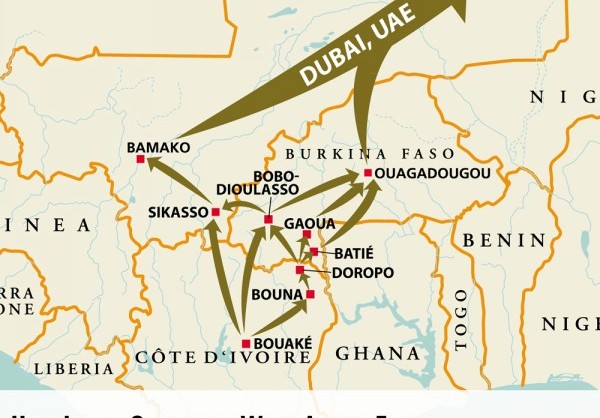
Mali’s taxation practices applicable to gold exports have turned the country into West Africa’s illicit gold trading hub, Partnership Africa Canada said in a report published on Wednesday.
The report, The West African El Dorado: Mapping the Illicit Trade of Gold in Côte d’Ivoire, Mali and Burkina Faso, investigates challenges in the governance of artisanal gold mining in the three countries—and the vulnerabilities posed by the illicit trade of gold on the region.
The investigation finds that all countries have taken important steps towards encouraging legal trade of artisanal gold—a sector which employs an estimated three million miners in Côte d’Ivoire, Mali and Burkina Faso—such as the harmonization of export taxes at 3%. Yet, Partnership Africa Canada found that Mali’s application of export taxes to only the first 50kg of gold per month is promoting smuggling, as traders bring gold over the border into Mali to get a large tax break.
“Mali’s harmful implementation of tax laws is cause for concern in the region, as it actively drives the illicit trade of gold. Mali’s neighbours are missing out on important revenue from taxes as traders smuggle gold over borders to take advantage of the tax break,” said Joanne Lebert, Partnership Africa Canada’s Executive Director.
“Importantly, export statistics from Mali are painting a worrying trend and it is up to international refiners and buyers to exercise additional due diligence on gold exported from the country to ensure the gold is clean,” added Lebert.
An analysis of gold production and trade statistics in Mali, as well as declared imports from the United Arab Emirates of Malian gold spotlighted major inconsistencies in the declared data. Over a four year period, UAE imports of Malian gold successively exceeded Mali’s entire gold production. Mali declared 40 tonnes of gold produced in 2013—while UAE declared 49.6 tonnes imported. In 2014, the figure rose with Mali declaring production at 45.8 and UAE declaring 59.9 in Malian gold imports.
Since much of Mali’s industrial production is exported to Swiss and South African refiners, Partnership Africa Canada found little explanation for the discrepancy. The extent of the illicit gold trade in Mali raises concerns about regional peace and stability and highlights the need for refining centres to exercise additional due diligence on imports.
Partnership Africa Canada calls on Mali to undertake a comprehensive review of its tax regime to address the loopholes that make it magnet for gold produced in West Africa. Additionally, the report calls on the Dubai Multi-Commodities Centre in the UAE to ban hand-carried imports of gold and demonstrate greater oversight over gold imports.
The report also calls on gold producing countries in West Africa to harmonize policies and practices in the gold sector through a Regional Approach, similar to that currently being implemented in the Mano River Union on diamond governance.
Economy
NRS Launches Unified Tax ID System
By Adedapo Adesanya
The Nigeria Revenue Service (NRS) has unveiled a unified Taxpayer Identification (Tax ID) system for all taxable persons across the country as part of efforts to strengthen tax administration and improve transparency.
The agency announced the development in a public notice issued jointly with the Joint Revenue Board (JRB) on Monday.
According to the notice, the initiative is backed by Sections 6, 7, and 8 of the Nigeria Tax Administration Act, 2025, which mandate every taxable person in Nigeria to obtain a Tax ID, in a wider move to expand the country’s tax base.
The NRS said the new framework is designed to create a centralised and harmonised taxpayer database that would enhance interactions between taxpayers and revenue authorities at both federal and sub-national levels.
“The Tax ID will serve as a single, unified identity for all taxpayers, enabling seamless interaction with tax authorities at both federal and sub-national levels. It is designed to consolidate taxpayer records, eliminate duplication, and ensure more efficient management of tax-related information,” the agency stated.
The revenue agency explained that the new system would simplify tax compliance procedures, including taxpayer registration, filing of returns, and payment processes.
According to the NRS, the framework is also expected to improve accountability and reduce leakages in tax collection by creating better visibility and tracking of taxpayer information nationwide.
“The initiative will simplify tax compliance processes, including registration, tax filing, and payment procedures. The system will improve transparency by enabling better visibility and tracking of taxpayer records while reducing leakages and improving accountability in tax collection. The framework will also harmonise taxpayer information across all levels of government,” the notice added.
The agency further disclosed that the new Tax ID system would replace the existing Tax Identification Number (TIN) Validation API currently used by Ministries, Departments and Agencies (MDAs), financial institutions, and other organisations for taxpayer verification.
Economy
OTC Securities Exchange Falls 1.31% as Key Stocks Decline
By Adedapo Adesanya
Three bellwether stocks weakened the NASD Over-the-Counter (OTC) Securities Exchange by 1.31 per cent on Monday, May 18.
This brought the NASD Unlisted Security Index (NSI) by 54.71 points to 4,133.70 points from 4,188.41 points, and shrank the market capitalisation by N32.73 billion to N2.473 trillion from N2.506 trillion.
Yesterday, FrieslandCampina Wamco Plc contracted by N12.45 to sell at N146.55 per share compared with last Friday’s closing price of N159.00 per share, Central Securities and Clearing System (CSCS) Plc declined by N2.34 to N70.00 per unit from N72.34 per unit, and NASD Plc lost 50 Kobo to trade at N34.50 per share versus N35.00 per share.
The trio overpowered the N5.56 gained Newrest Asl Plc. This stock ended the trading session at N61.15 per unit, in contrast to the previous session’s N55.59 per unit.
During the trading day, the volume of securities traded by investors slid by 56.1 per cent to 514,142 units from 1.2 million units, and the value of securities dropped 29.8 per cent to close at N17.4 million versus N29.8 million, while the number of deals jumped 12.5 per cent to 27 deals from 24 deals.
Great Nigeria Insurance (GNI) Plc remained the most traded stock by value on a year-to-date basis, with 3.4 billion units sold for N8.4 billion, followed by CSCS Plc with 60.8 million units exchanged for N4.1 billion, and Okitipupa Plc with 27.9 million units traded for N1.9 billion.
GNI Plc also ended the day as the most traded stock by volume on a year-to-date basis with 3.4 billion units worth N8.4 billion, trailed by Resourcery Plc with 1.1 billion units valued at N415.7 million, and Infrastructure Guarantee Credit Plc with 400 million units transacted for N1.2 billion.
Economy
FX Pressure Pushes Naira Lower to N1,373/$1 at Official Market
By Adedapo Adesanya
It was a horrible day for the Nigerian Naira in the different segments of the foreign exchange (FX) market on Monday, May 15, as its value further weakened against the United States Dollar.
In the black market window, the Naira lost N5 against the Dollar yesterday to sell for N1,390/$1 compared with the previous value of N1,385/$1, but at the GTBank forex counter, it remained unchanged at N1,383/$1.
In the Nigerian Autonomous Foreign Exchange Market (NAFEX), the Nigerian currency depreciated against the greenback by N2.66 or 0.19 per cent to sell for N1,373.70/$1 compared to last Friday’s rate of N1,371.04/$1.
Equally, it fell against the Pound Sterling in the same market segment by N9.05 to trade at N1,839.66/£1 versus N1,830.61/£1, and lost N5.42 on the Euro to close at N1,600.49/€1 versus N1,595.07/€1.
The performance of the local currency during the session indicates early worries despite all signals pointing to stability, amid improved Dollar sales by the Central Bank of Nigeria (CBN), with steady, higher oil receipts to bolster the nation’s reserves.
Activity at the market showed that turnover rose 57.3 per cent to $76.29 million on Monday from $48.49 million posted on Friday.
Over the weekend, S&P raised Nigeria’s credit ratings for the first time since 2012 and highlighted improved FX market liquidity and $10 billion turnover recorded in April 2026 as one of the major gains of the CBN-led FX reforms.
The agency said the liberalisation of the exchange rate has bolstered access to foreign currency and enabled a market-driven exchange-rate environment while supporting investor and consumer confidence.
Meanwhile, the cryptocurrency market was bullish on Monday as investors monitored developments in the Iran conflict and weighed the impact of surging oil prices on inflation and US interest-rate expectations.
Ethereum (ETH) gained 0.7 per cent to trade at $2,134.10, Cardano (ADA) rose by 0.6 per cent to $0.2515, Solana (SOL) expanded by 0.3 per cent to $85.11, Binance Coin (BNB) jumped 0.2 per cent to $643.29, TRON (TRX) increased by 0.03 per cent to $0.3565, and Bitcoin (BTC) advanced by 0.02 per cent to $76,912.12.
On the flip side, Dogecoin (DOGE) slid by 1.5 per cent to $0.1044, and Ripple (XRP) decreased by 0.5 per cent to $1.38, while the US Dollar Tether (USDT) and the US Dollar Coin (USDC) traded flat at $1.00 apiece.
-
Feature/OPED6 years agoDavos was Different this year
-
Travel/Tourism10 years ago
Lagos Seals Western Lodge Hotel In Ikorodu
-
Showbiz3 years agoEstranged Lover Releases Videos of Empress Njamah Bathing
-
Banking8 years agoSort Codes of GTBank Branches in Nigeria
-
Economy3 years agoSubsidy Removal: CNG at N130 Per Litre Cheaper Than Petrol—IPMAN
-
Banking3 years agoSort Codes of UBA Branches in Nigeria
-
Banking3 years agoFirst Bank Announces Planned Downtime
-
Sports3 years agoHighest Paid Nigerian Footballer – How Much Do Nigerian Footballers Earn

1 Comment