Economy
Mining: FG Hires 100 Experts to Boost Earnings
By Dipo Olowookere
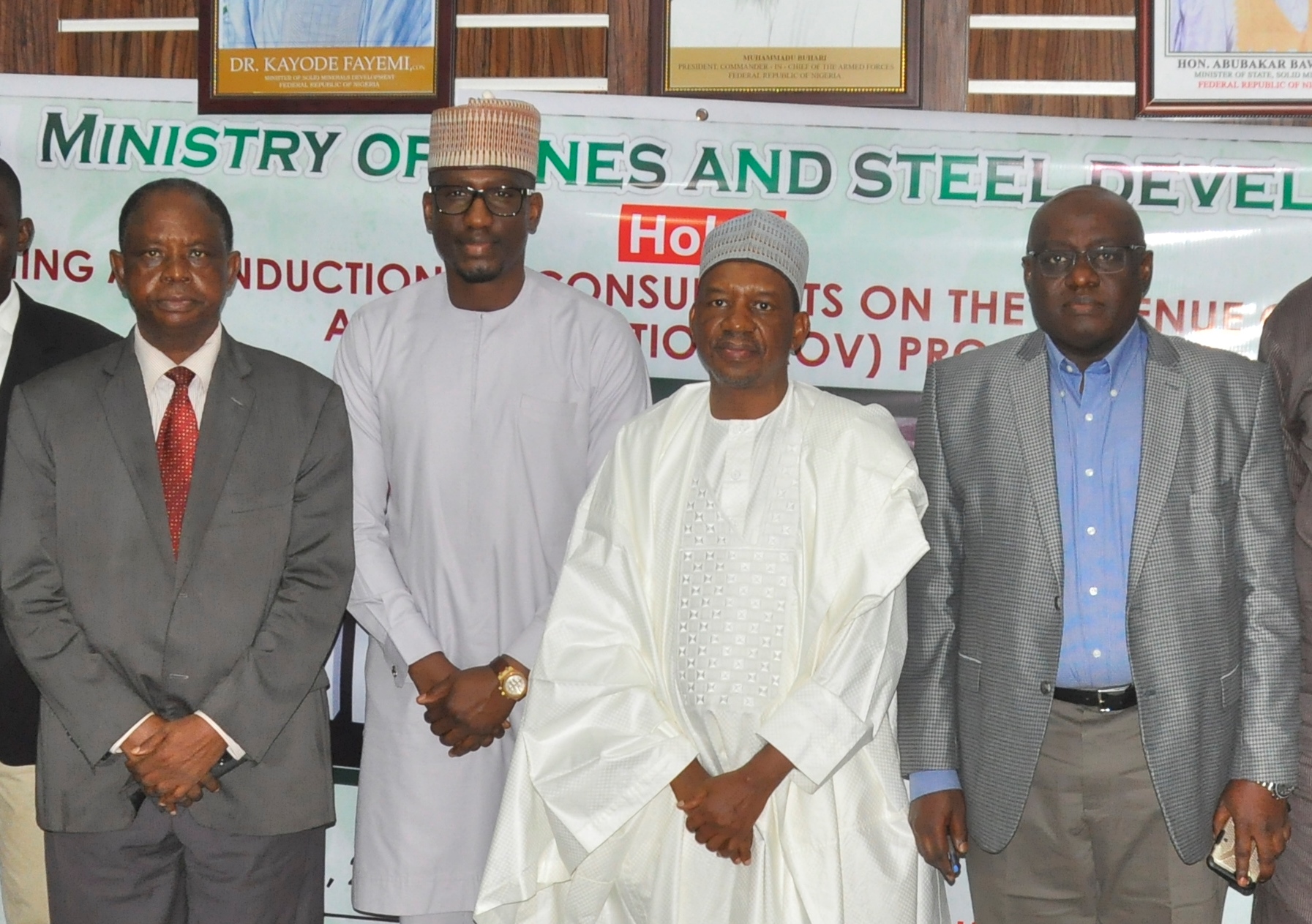
No fewer than 100 revenue consultants have been engaged by the Federal Government to help boost earnings from the mining sector of the country’s economy.
The experts are expected to help the government block leakages in the revenue accrued from the industry, which is still largely untapped in the country.
Minister of Mines and Steel Development, Mr Kayode Fayemi, explained that the consultants would be deployed to the six geo-political zones of Nigeria in the coming week are to examine financial and production records of companies involved in mining activities in the last six years.
After this, they will determine whether appropriate royalties were remitted to government by these firms.
Mr Fayemi, speaking at the three-day induction and training for the Revenue Consultants in Abuja on Monday, noted that the main target of the ministry was to ensure that the Federation Account gets its fair due in royalties and taxes.
According to the Minister, the project, tagged ‘Revenue Optimization and Verification Project,’ would assist in blocking leakages in the mining sector, thereby positioning the sector to achieve its set agenda of contributing significantly to the GDP.
The Minister noted that the consultants, who have already been grouped into all the 36 states in the six geopolitical zones of the country, are to commence work after the training programme.
He said, “Our expectation of this project is that the Ministry would emerge as a lead revenue agency for the Federal Government of Nigeria, in line with the growth projections of the Economic Recovery and Growth Plan (ERGP), which recognizes the mining sector as one of Nigeria’s most promising growth sectors, and acknowledges that its contribution to GDP doubled from N52 billion in 2010 to N103 billion in 2015.
“The ERGP further projects that revenue the mining sector would grow from N103 billion (2015) to N141 billion (2020) at an average annual growth rate of 8.54 per cent (2017-2020).”
Mr Fayemi said he was optimistic that the ministry would surpass these targets, as all stakeholders work collaboratively to ensure the success of the R.O.V. Project, resulting in improved levels of voluntary compliance of operators.
The Minister admitted that leakages in government revenue was a big challenge in the mining sector, a development, which he said the ministry was determined to redress with the ROV Project, following its approval by the National Economic Council (NEC).
He said, “The R.O.V Project is an initiative of our ministry, pursuant of one of our core mandates, which is to significantly increase the contribution of the Mining Sector to our sovereign revenue.
“Indeed, leakages in government revenue remain a big challenge in the sector, which we are working collaboratively with other government entities and sector stakeholders to fix. We have given considerable thought to this challenge and come up with a number of strategies to tackle it, one of which we are witnessing its launch today.
“I am therefore pleased to announce that following the approval of the National Economic Council (NEC), we are today inaugurating a new model of revenue generation and collection in the mining sector. This entails the engagement of Professional Revenue Consultants who would work with our ministry’s mining officers to identify revenue leakages in the system.
“The Revenue Optimization and Verification Project essentially seeks to confirm the adequacy of royalties’ remittances made by the various operators in the mining industry. They are mandated to collect and analyse data from 2012 – 2017 in the course of their work, thus giving us the opportunity to demand and receive accruals due to government from the referenced period.
“It would also ensure compliance of all operators to paying the correct amount in royalties to the government coffers going forward.”
The Minister said the exercise will be carried out in line with the provisions of Section 17 of the Nigeria Mineral and Mining Act of 2007 which empowers the Mining Inspectorate Division of the Ministry to supervise and enforce compliance of laws and also section 43 of the Nigeria Mineral and Mining Act of 2007 which mandates mining operators to keep and supply records upon request by the ministry.
Speaking further, the Minister who was represented by the Permanent Secretary of the Ministry, Dr Muazu Abdullahi, said the project was not designed to witch hunt anybody, even as he warned the consultants to avoid any shady deals.
“This is not a witch hunting initiative, but the exercise of the statutory responsibility of the Ministry to determine the adequacy of remittances made by the various operators in the mining industry,” he said.
Mr Fayemi added that, “The image and reputation of the Ministry of Mines and Steel Development, and indeed the entire Federal Government of Nigeria is key during this Revenue Optimization and Verification Project; therefore, we charge all consultants to stand for what this government stands for by avoiding any form of compromise, illegality and unprofessional conduct.
The Project Coordinator, Mr Makinde Araoye, said the projects is at no cost to the Ministry as the National Economic Council approval stated that consultants and the ministry take a certain percentage of whatever is recovered.
“NEC approved 15 per cent as cost of collection, out of the 15 per cent. The consultant will be paid a certain percentage of what they recover, the lead consultant will be paid a certain percentage of what they recover and the Ministry will also retain certain percentage as cost of collection”, he added.
Economy
NASD Exchange Falls 0.22% After Investors Lose N4.8bn
By Adedapo Adesanya
The NASD Over-the-Counter (OTC) Securities Exchange weakened by 0.22 per cent on Tuesday, April 28, with the market capitalisation down by N4.8 billion to N2.420 trillion from N2.425 trillion, and the NASD Unlisted Security Index (NSI) down by 9.01 points to 4,044.96 points from 4,053.97 points.
During the session, the price of Central Securities Clearing System (CSCS) Plc went down by N1.82 to N767.05 per share from N78.87 per share, while FrieslandCampina Wamco Nigeria Plc appreciated by N1.90 to N100.00 per unit from N98.10 per unit.
According to data, the value of trades increased by 265.7 per cent to N27.1 million from N7.4 million units, and the volume of transactions surged by 305.2 per cent to 1.3 million units from 319,831 units, while the number of deals decreased by 6.9 per cent to 27 deals from 29 deals.
Great Nigeria Insurance (GNI) Plc remained the most traded stock by value on a year-to-date basis, with the sale of 3.4 billion units valued at N8.4 billion, followed by CSCS Plc with 59.8 million units exchanged for N4.0 billion, and Okitipupa Plc with 27.8 million units traded for N1.9 billion.
GNI Plc also finished as the most traded stock by volume on a year-to-date basis, with a turnover of 3.4 billion units worth N8.4 billion, trailed by Resourcery Plc with 1.1 billion units transacted for N415.7 million, and Infrastructure Guarantee Credit Plc with 400 million units sold for N1.2 billion.
Economy
Naira Crashes to N1,380/$ at Official Market, N1,390/$1 at Black Market
By Adedapo Adesanya
Pressure is beginning to mount on the Nigerian Naira in the different segments of the foreign exchange (FX) market despite an oil windfall triggered by the Middle East crisis.
On Monday, April 27, the domestic currency further weakened against the United States Dollar in the Nigerian Autonomous Foreign Exchange Market (NAFEX) by N16.47 or 1.2 per cent to N1,380.71/$1 from the previous day’s N1,364.24/$1.
It was not different against the Pound Sterling in the same market window, as it lost N16.04 to trade at N1,863.76/£1 versus Monday’s closing rate of N1,847.72/£1, and against the Euro, it slipped by N12.72 to close at N1,615.01/€1 versus N1,602.29/€1.
The Naira also depreciated against the Dollar at the black market yesterday by N5 to quote at N1,390/$1 compared with the previous price of N1,385, and at the GTBank forex counter, it further crashed by N9 to settle at N1,379/$1 compared with the preceding session’s N1,370/$1.
The continued decline of the Naira comes as traders increasingly seek other safe-haven currencies amid continued global disruptions.
The benefit awash in the global market is making foreign portfolio investors stay short in Nigerian markets. Despite this, the daily FX publication released showed that interbank turnover rose to $98.829 million across 78 deals, up from $76.65 million.
Meanwhile, the cryptocurrency market remained cautious, with Bitcoin (BTC) trading at $77,216.66 despite surging oil prices and geopolitical tensions over a potential extended US naval blockade of the Strait of Hormuz.
Analysts say the supply overhang has finally dried up, and the sellers who were spooked by macro shifts or quantum fears have already exited, leaving the market much thinner on the sell-side.
Investors will await decisions made by central banks this week. The US Federal Reserve will announce its rate decision later on Wednesday, while the European Central Bank (ECB) follows on Thursday.
Ethereum (ETH) gained 1.5 per cent to trade at $2,324.59, Dogecoin (DOGE) chalked up 1.4 per cent to sell for $0.1016, Solana (SOL) appreciated by 0.6 per cent to $84.85, Cardano (ADA) grew by 0.5 per cent to $0.2483, and Binance Coin (BNB) advanced by 0.2 per cent to $627.15.
However, TRON (TRX) depreciated by 0.6 per cent to $0.3224, and Ripple (XRP) lost 0.03 per cent to sell at $1.39, while the US Dollar Tether (USDT) and the US Dollar Coin (USDC) were unchanged at $1.00 each.
Economy
Oil up 3% as Hormuz Disruption Outweighs UAE OPEC Exit
By Adedapo Adesanya
Oil was up by nearly 3 per cent on Tuesday as persistent worries about supply constraints from the closed Strait of Hormuz continued, with Brent futures for June rising by $3.03 or 2.8 per cent to $111.26 a barrel, and the US West Texas Intermediate (WTI) crude futures growing by $3.56 or 3.7 per cent to $99.93 a barrel.
An earlier round of negotiations between the United States and Iran collapsed last week after face-to-face talks failed.
Ship-tracking data showed significant disruptions in the region, with six Iranian oil tankers forced to turn back due to the US blockade, but some traffic is still moving.
Prices trimmed some of the advances after the United Arab Emirates (UAE), the fourth-largest producer in the Organisation of the Petroleum Exporting Countries (OPEC), said on Tuesday it would exit the group on this Friday, May 1, 2026.
This dealt a blow to the oil-exporting group and its de facto leader, Saudi Arabia.
The UAE could quickly add between 1 million and 1.5 million barrels per day of output. However, with the Strait of Hormuz effectively closed, analysts said that there’s nowhere for that supply to go.
The UAE joined OPEC in 1967, but tension with Saudi Arabia over production quotas has been building for years.
Under the OPEC+ deal, the country has been held to roughly 3 million barrels per day while sitting on capacity above 4 million. It has been pushing toward 5 million barrels per day by 2027, and that target is hard to achieve with quotas built around someone else’s view of the market.
The war in Yemen broke whatever was left of diplomatic patience.
President Donald Trump said he was unhappy with the latest Iranian proposal to end the war. The proposal would avoid addressing the nuclear programme until hostilities cease and Gulf shipping disputes are resolved.
The Idemitsu Maru, a Panama-flagged tanker carrying 2 million barrels of Saudi oil, and an LNG tanker managed by the Abu Dhabi National Oil Company (ADNOC) crossed the Strait on Tuesday, shipping data showed.
Vortexa data showed that the amount of crude oil held around the world on tankers that have been stationary for at least seven days rose to 153.11 million barrels as of April 24.
The American Petroleum Institute (API) estimated that crude oil inventories in the United States fell by 1.79 million barrels in the week ending April 24. The official data from the US Energy Information Administration (EIA) will be released later on Wednesday.
-
Feature/OPED6 years agoDavos was Different this year
-
Travel/Tourism10 years ago
Lagos Seals Western Lodge Hotel In Ikorodu
-
Showbiz3 years agoEstranged Lover Releases Videos of Empress Njamah Bathing
-
Banking8 years agoSort Codes of GTBank Branches in Nigeria
-
Economy3 years agoSubsidy Removal: CNG at N130 Per Litre Cheaper Than Petrol—IPMAN
-
Banking3 years agoSort Codes of UBA Branches in Nigeria
-
Banking3 years agoFirst Bank Announces Planned Downtime
-
Sports3 years agoHighest Paid Nigerian Footballer – How Much Do Nigerian Footballers Earn