Connect with us

Economy

Naira Appreciates 0.04% to N386.94/$1 at I&E

Published

on

devalue naira

By Adedapo Adesanya

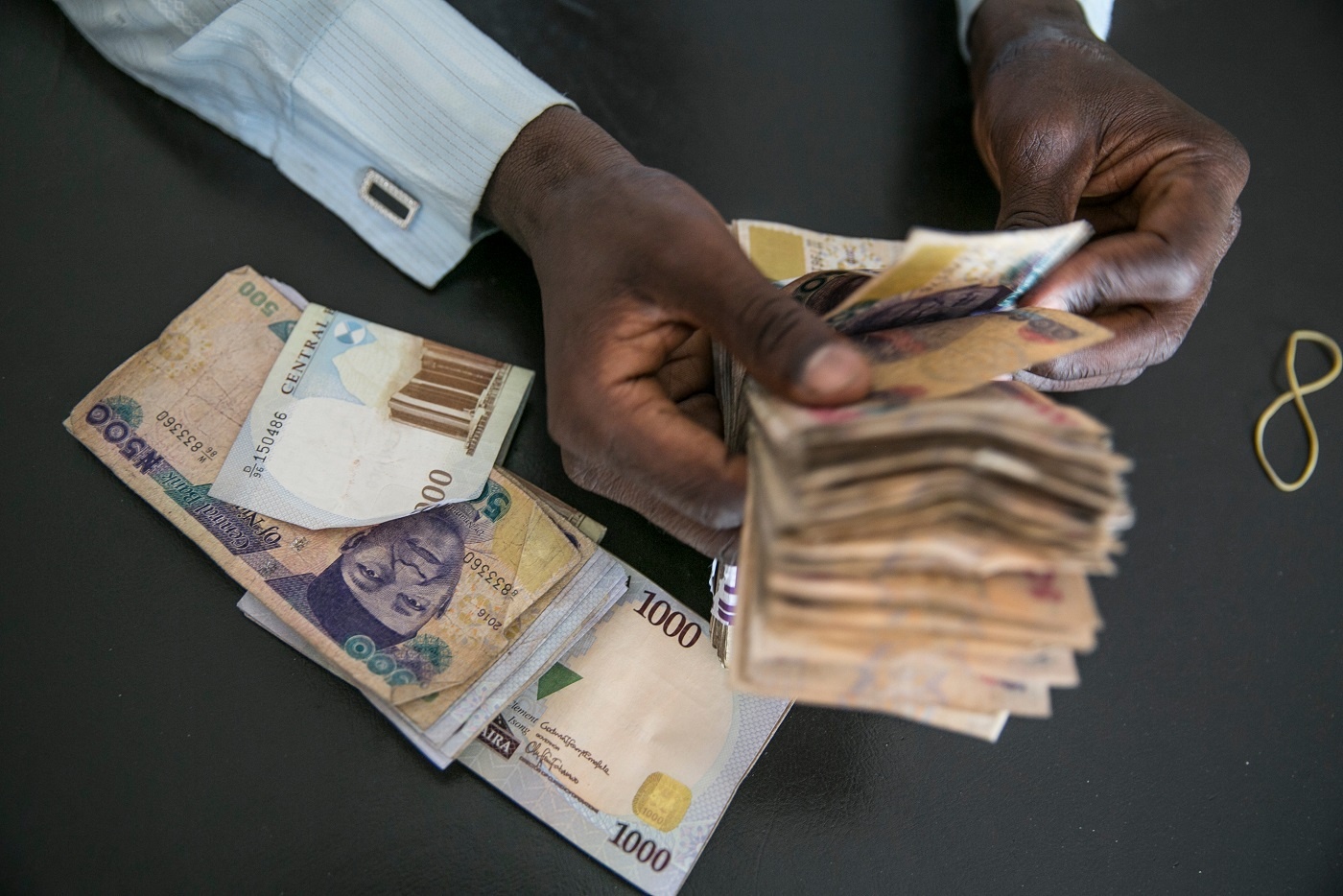
The Naira appreciated by 14 kobo or 0.04 percent at the Investors and Exporters (I&E) window of the foreign exchange (forex) market on Wednesday, June 10.

The domestic currency, which was previously sold at N387.08/$1 at the market window, was traded yesterday at N386.94/$1.

The strengthening of the Nigerian currency happened despite the pressure on it yesterday as a result of an increased demand for forex from customers.

During the midweek trading session, transactions valued at $62.28 million were recorded at the investors’ segment compared with the $31.81 million achieved on Tuesday, indicating a 96 percent or $30.47 million rise.

However, at the black market yesterday, the Naira dropped N2 against the dollar to sell at N450/$1 compared to 448/$1 it sold previously.

Likewise, against the pound, the Naira fell by N3 to close at N548/£1 versus N545/£1 of the previous session and on the Euro, the Naira lost N5 to close at N485/€1 in contrast to N480/€1 it traded on Tuesday.

At the Bureaux De Change (BDC) segment, the Nigerian currency traded flat against the greenback in Lagos at N448/$1. Also, against the Pound, it retained the previous rate of N550/£1, but gained N2 against the Euro to quote at N478/€1 compared to N480/€1 it traded previously.

At the Abuja BDCs market, the Naira gained N1 against the Dollar at N447/$1 compared to N448/$1 and against the Pound Sterling and the Euro it traded flat at N540/£1 and N480/€1 respectively.

At the Port Harcourt BDC market, the Naira closed flat against the Dollar at N446/$1. It also remained unchanged against the Pound and the Euro at N540/£1 and N487/€1 respectively.

It was a similar situation in Kano, where the local currency retained its previous rates against the Dollar, Pound and Euro at N446/$1, N540/£1, and N480/€1 respectively.

A look at the interbank segment of the forex market showed that the Naira/Dollar exchange rate remained at N361/$1 at the close of business on Wednesday.


Adedapo Adesanya is a journalist, polymath, and connoisseur of everything art. When he is not writing, he has his nose buried in one of the many books or articles he has bookmarked or simply listening to good music with a bottle of beer or wine. He supports the greatest club in the world, Manchester United F.C.

Economy

World Bank’s MIGA Targets $6.4bn Annual Guarantees for Africa

Published

on

World Bank Blacklists

By Adedapo Adesanya

The Multilateral Investment Guarantee Agency (MIGA), a World Bank financer, is ramping up efforts to unlock private capital for Africa, with plans to more than double its annual guarantee issuance on the continent to $6.4 billion over the next three and a half years.

The move is expected to catalyse as much as $23 billion in private sector investment across key sectors, including energy infrastructure, food security, trade finance, digital connectivity and sovereign debt restructuring.

The expansion underscores a growing shift among development finance institutions toward deploying guarantees as a primary tool for de-risking investments in frontier markets and attracting private capital flows into economies often viewed as high-risk.

MIGA’s Managing Director, Mr Tsutomu Yamamoto, said the scaled-up programme would play a critical role in mobilising investment, creating jobs and strengthening economic resilience across African countries.

He noted that the agency’s instruments, ranging from political risk insurance to credit enhancement, debt swaps and portfolio guarantees, are designed to reduce investor exposure and improve project bankability.

The guarantee push will continue to focus on strategic sectors such as power grids, local banking systems, agriculture and food supply chains, as well as digital infrastructure, all of which are seen as foundational to long-term economic growth across the continent.

Although the agency did not disclose specific projects in its pipeline, it said the expansion reflects rising demand for risk-sharing mechanisms in emerging markets, particularly as governments grapple with tight fiscal conditions and limited access to affordable financing.

The development follows a broader restructuring within the World Bank Group nearly two years ago, which consolidated guarantee operations to scale up private sector investment mobilisation globally.

MIGA has already played a role in pioneering debt swap transactions in the Ivory Coast and Angola, while also supporting food security initiatives in Kenya and backing more than 100 energy projects across emerging markets. Its guarantees have further underpinned lending operations in countries such as Ghana and Zambia, helping to stabilise financial systems and sustain credit flows.

The agency’s latest push reflects a wider evolution in development finance strategy, where guarantees are increasingly used to stretch limited public funds and crowd in private investors. By lowering perceived risks, these instruments make large-scale infrastructure and development projects more attractive to commercial financiers who would otherwise stay on the sidelines.

This shift is gaining urgency as many advanced economies scale back aid budgets while simultaneously seeking stronger economic ties and resource access in Africa.

In response, multilateral lenders are leaning more heavily on innovative financial tools like guarantees to bridge funding gaps and sustain development momentum.

MIGA’s broader ambition is to help lift the World Bank Group’s global guarantee issuance to $20 billion annually by 2030, positioning guarantees as a central pillar in financing sustainable development across emerging markets.

Continue Reading

Economy

NASD Index Appreciates by 0.58% Amid Robust Turnover

Published

on

NASD Unlisted Securities Index

By Adedapo Adesanya

The NASD Over-the-Counter (OTC) Securities Exchange further appreciated by 0.58 per cent on Tuesday, May 19, buoyed by strong investor appetite for unlisted securities.

Data from the bourse showed that the volume of securities traded during the session ballooned by 365,661.8 per cent to 1.9 billion units compared with the previous day’s 514,142 units, as the value of transactions surged by 30,433.9 per cent to N5.3 billion from the preceding session’s N17.4 million, and the number of deals increased by 22.2 per cent, as these trades were executed in 60 deals versus the 27 deals recorded a day earlier.

Great Nigeria Insurance (GNI) Plc ended the trading session as the most traded stock by value on a year-to-date basis, with the sale of 3.4 billion units valued at N8.4 billion, followed by Infrastructure Credit Guarantee (Infracredit) Plc with 2.3 billion units transacted for N6.5 billion, and Central Securities and Clearing System (CSCS) Plc with 60.9 million units exchanged for N4.1 billion.

GNI Plc was also the most traded stock by volume on a year-to-date basis, with 3.4 billion units worth N8.4 billion, followed by Infracredit Plc with 2.3 billion units sold for N6.5 billion, and Resourcery Plc with 1.1 billion units traded for N415.7 million.

During the session, there were three price gainers and one price loser, led by Afriland Properties Plc, which went down by 5 Kobo to trade at N16.90 per share versus the previous day’s N16.95 per share.

But FrieslandCampina Wamco Plc appreciated by N12.45 to N151.79 per unit from N146.55 per unit, CSCS Plc expanded by 62 Kobo to N70.62 per share from N70.00 per share, and UBN Property Plc added 20 Kobo to close at N2.24 per unit versus N2.04 per unit.

At the close of business, the NASD Unlisted Security Index (NSI) rose by 24.05 points to 4,157.75 points from 4,133.70 points, and the market capitalisation chalked up N14.39 billion to close at N2.487 trillion compared with Monday’s N2.473 trillion.

Continue Reading

Economy

Naira Further Loses 17 Kobo at NAFEX

Published

on

deposit old Naira notes

By Adedapo Adesanya

The Naira further depreciated against the United States Dollar in the Nigerian Autonomous Foreign Exchange Market (NAFEX) on Tuesday, May 19, by 17 Kobo or 0.01 per cent to trade at N1,373.87/$1 compared to the previous day’s N1,373.70/$1.

However, the domestic currency appreciated against the Pound Sterling in the same market window by 5 Kobo to close at N1,839.61/£1 versus Monday’s rate of N1,839.66/£1, and gained N5.97 against the Euro to settle at N1,594.52/€1, in contrast to the preceding session’s N1,600.49/€1.

Data from GTBank FX bench showed that the Naira appreciated against the US Dollar yesterday by N2 to sell at N1,381/$1 versus N1,383, and at the parallel market, it remained unchanged at N1,390/$1.

The outcome across the board came as Nigeria’s external reserves have shown signs of improvement in recent weeks, which may provide some support for FX market interventions by the Central Bank of Nigeria (CBN) and broader macroeconomic stability efforts.

Currency traders and investors are expected to continue monitoring CBN policy direction, foreign portfolio inflows, crude oil earnings, and external reserve performance as key indicators influencing the naira’s trajectory in the coming months.

The Monetary Policy Committee (MPC) meeting began on Tuesday with announcements of decisions expected later on Wednesday after inflation ticked up in April.

In the cryptocurrency market, major digital coins were down as traders focused on macro data, oil prices, and inflation, while the US Senate advanced a measure that could force President Donald Trump to seek congressional approval for the Iran war.

Ripple (XRP) went down by 1.3 per cent to $1.36, Dogecoin (DOGE) slid by 0.9 per cent to $0.1034, Cardano (ADA) dropped by 0.7 per cent to $0.2499, Ethereum (ETH) declined by 0.5 per cent to $2,124.02, Solana (SOL) depreciated by 0.5 per cent to $84.67, TRON (TRX) dipped by 0.4 per cent to $0.3551, and Binance Coin (BNB) slumped 0.1 per cent to $641.39.

On the flip side, Bitcoin (BTC) appreciated by 0.3 per cent to $77,114.20, while the US Dollar Tether (USDT) and the US Dollar Coin (USDC) remained unchanged at $1.00 each.

Continue Reading

Trending