Economy
Naira Falls 0.12% at Spot Market as FX Scarcity Bites Harder
By Adedapo Adesanya
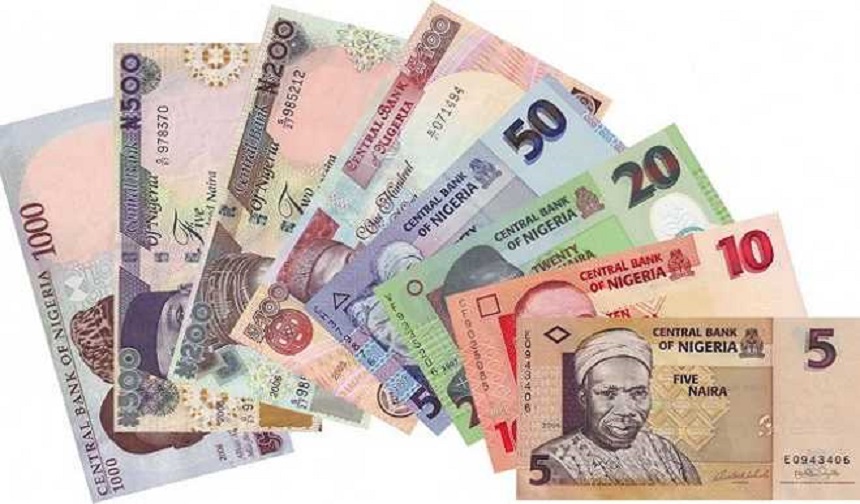
The Naira depreciated by 0.12 per cent or 50 kobo on Monday, June 6 at the Investors and Exporters (I&E) segment of the foreign exchange (forex) market as investors exchanged their local currency for the United States Dollar at N420.25/$1 compared with the previous session’s N419.75/$1.
This occurred as there was no chance for FX traders to meet the rush for the demand for the greenback amid the current supply shortage as well as the commencement of the presidential primary of the ruling All Progressives Congress (APC).
According to data from the FMDQ Securities Exchange, there was a $136.61 million or 73.5 per cent drop in forex turnover to $49.24 million from $185.85 million.
At the Peer-to-Peer (P2P) window, the Naira remained stable against the greenback at N615/$1 but at the interbank segment, the domestic currency depreciated against the Pound Sterling by 59 kobo to trade at N522.53/£1 compared to the previously traded rate of N521.94/£1 and against the Euro, the Nigerian currency depreciated by 55 kobo to sell at N445.97/€1 in contrast to the last Friday’s value of N445.42/€1.
As for the digital currency market, all the 10 benchmarked tokens tracked by Business Post depreciated in value, with the crisis-laden coin TerraClassicUSD (USTC) moving downwards by 8.1 per cent to sell for $0.0147.
Binance Coin (BNB) recorded a 6.5 per cent depreciation to sell at $286.58, Litecoin (LTC) also went down by 6.5 per cent to trade at $61.06, Ethereum (ETH) declined by 6.4 per cent to quote at $1,750.51, while Bitcoin (BTC) retreated by 4.9 per cent to finish at $29,550.04.
In addition, Solana (SOL) depreciated by 4.9 per cent to settle at $39.54, Dogecoin (DOGE) saw a 4.3 per cent slump to trade at $0.09993, Ripple (XRP) recorded a 3.7 per cent fall to close at $0.3875, Cardano (ADA) went down by 2.6 per cent to trade at $0.0793, while the US Dollar Tether (USDT) pointed south by 0.01 per cent to trade at $0.9993.
Economy
NECA Demands Accountability for N10.4tn Subsidy Funds Shared to States, LGs
By Adedapo Adesanya
The Nigeria Employers’ Consultative Association (NECA) has called on state and local governments to account for the N10.4 trillion they received from resources generated following the removal of the petrol subsidy.
The Director-General of NECA, Mr Adewale-Smatt Oyerinde, made the call on Channels Television’s Sunrise Daily on Thursday morning, a day after the Minister of Finance and Coordinating Minister of the Economy, Mr Taiwo Oyedele, disclosed details of the financial impact of the federal government’s economic reforms.
Mr Oyedele had said the removal of the petrol subsidy and reforms to the foreign exchange market mobilised N15.8 trillion for the Federation between June 2023 and December 2025.
According to the minister, the federal government received N5.4 trillion of the amount, while N10.4 trillion was distributed to state and local governments through the Federation Account.
Reacting to the disclosure, Mr Oyerinde said the states and local governments should now provide details of how the funds they received were utilised.
He particularly called on state commissioners for finance to disclose the amounts their respective governments received and how the funds were spent.
“Absolutely. I think it should trickle down. The commissioners of finance in states, you come out and also say, this is how much we’ve received; this is how much we have spent,” he said on the television programme.
Mr Oyerinde compared the expected disclosure by governments to the financial reporting obligations of private businesses, where companies present audited accounts and performance reports to shareholders.
“We believe strongly that as private businesses, at the end of the year you audit your accounts, you present your scorecard to your shareholders to gauge what we have done. The Minister of Finance has led the way now, and the states also should follow,” he said.
The NECA director-general urged state governments to provide a breakdown of the funds received, the challenges encountered and how the money was deployed.
“And so this is how much we have received. These are the constraints we face, and this is how we have expended this amount. I think we should move progressively towards transparency in government,” he said.
Mr Oyerinde commended the Federal Government for publicly disclosing details of its finances, describing the presentation by the finance minister as a step towards greater transparency in public administration.
He said the level of detail provided by Mr Oyedele would enable citizens and other stakeholders to better scrutinise government spending and assess the impact of the reforms.
The NECA boss also said greater disclosure by the sub-national governments would allow citizens to engage state and local governments more constructively on the use of public funds.
“I also put citizens, and I must say this, citizens are also in a good position now to engage constructively, engage the state governments constructively, and also engage local governments constructively, because that is where development should actually start,” Mr Oyerinde said.
Economy
How FG, States, LGs Shared N15.8trn Subsidy Savings
By Adedapo Adesanya
The Minister of Finance and Coordinating Minister of the Economy, Mr Taiwo Oyedele, has said from the N15.8 trillion in subsidy savings, N5.4 trillion went to the federal government, and N10.4 trillion was shared between the 36 states and the 774 local governments of the federation between June 2023 and December 2025.
Mr Oyedele disclosed this on Wednesday in Abuja while presenting the federal government’s Nigeria’s Reform Scorecard: The Benefits, Costs and Harms Prevented, an assessment of the economic reforms implemented under President Bola Tinubu.
The finance minister said the N15.8 trillion in subsidy savings was distributed through the Federation Account, rather than being retained entirely by the federal government.
According to him, the central government received N5.4 trillion, representing about 34 per cent of the total savings, the states received N6.5 trillion, or 41 per cent, and the local councils received N3.9 trillion, representing about 24 per cent.
The combined N10.4 trillion allocated to states and local governments accounted for almost two-thirds of the total subsidy savings and was nearly twice the amount received by the federal government.
Mr Oyedele clarified that the N15.8 trillion should not be understood as money accumulated in a dedicated government account labelled “subsidy savings”.
Rather, he said the impact of the reforms was reflected in increased resources available to the federation through higher revenue collections, which were subsequently shared among the three tiers of government through the Federation Account.
The minister said the federal government’s N5.4 trillion share formed only one component of the additional resources available to it during the period.
It also recorded N3.1 trillion in incremental independent revenue, mainly from remittances by government-owned entities, and obtained N11.9 trillion in incremental borrowing.
Together, the three sources provided the federal government with N20.4 trillion in incremental resources between June 2023 and December 2025.
Mr Oyedele said the distribution of the subsidy savings underscored that the reform was not designed simply to increase Federal Government revenue, as a substantial portion of the additional resources accrued to the sub-national governments.
“The reform was never introduced for revenue purposes, but to address entrenched corruption in an artificially managed fuel subsidy and foreign exchange market,” he said.
He added that the federal government subsequently deployed its additional resources, alongside funds from its existing revenue base, to meet N30.64 trillion in incremental expenditure during the period.
Of the N20.4 trillion in incremental resources available to the federal government, borrowing accounted for 58 per cent, subsidy savings for 27 per cent and other revenue for 15 per cent.
The minister said the figures provided a clearer picture of how the financial impact of the subsidy reform was distributed across the Federation, with states and local governments collectively receiving the largest share.
Economy
NIRSAL Relishes Participation of Non-Interest Banks in Credit Risk Guarantees for Loans
By Aduragbemi Omiyale
The Nigeria Incentive-Based Risk Sharing System for Agricultural Lending (NIRSAL) Plc has expressed satisfaction with the growing participation of non-interest financial institutions in its credit risk guarantees for loans to farmers, processors, aggregators, exporters and other businesses across multiple agricultural value chains.
The chief executive of the non-bank financial institution created by the Central Bank of Nigeria (CBN) to de-risk agricultural lending in the country, Mr Sa’ad Hamidu, said non-interest lenders accounted for well over 50 per cent of the loans guaranteed by NIRSAL in the first half of 2026.
In 2025, the company guaranteed more than N100 billion to beneficiaries, and according to Mr Hamidu, this figure has already been surpassed in 2026 year-to-date.
Speaking at the AFRACA Masterclass on Inclusive Finance for Climate Resilience and Artificial Intelligence for Financial Services and Agricultural Finance in Lagos, the NIRSAL chief stated that the trend demonstrates what becomes possible when appropriate risk-sharing frameworks create sufficient confidence for different forms of capital to participate in agriculture.
“At NIRSAL, we have always maintained that agriculture, especially in sub-Saharan Africa, is not underfinanced because opportunities do not exist, but because the risks have not been sufficiently understood, measured, appropriately priced, and managed,” Mr Hamidu, represented by the agency’s Executive Director of Operations, Mr Ewaen Imohe, said.
He explained that NIRSAL’s response has been to co-develop systems and financing frameworks that bring greater structure to agricultural value chains, better define and mitigate their risks, and improve financiers’ understanding of the sector and confidence to lend.
The NIRSAL boss described the masterclass as particularly timely, noting that climate change is no longer an abstract global concern but a practical reality confronting farmers, agribusinesses and their financiers every production season across Africa.
The programme’s first major theme, Inclusive Finance for Climate Resilience, exposed participants to the concepts, tools, and approaches required to understand climate risk and develop financeable adaptation and mitigation projects.
For the second major theme, Artificial Intelligence for Financial Services and Agricultural Finance, Mr Hamidu expressed the expectation that participants would move beyond the excitement surrounding AI to examine how it can improve risk understanding, transaction assessment, and financial decision-making in agriculture.
He also pointed to opportunities for technology to complement climate finance, blended finance, grants, and other innovative mechanisms capable of expanding the financial and technical resources available to African agriculture.
On deepening AFRACA-NIRSAL collaboration, he stated that, “AFRACA, for us, is a platform for knowledge, continental exchange, and global insight. On our part, we remain a results-driven source of practical experience for AFRACA member countries.”