Economy
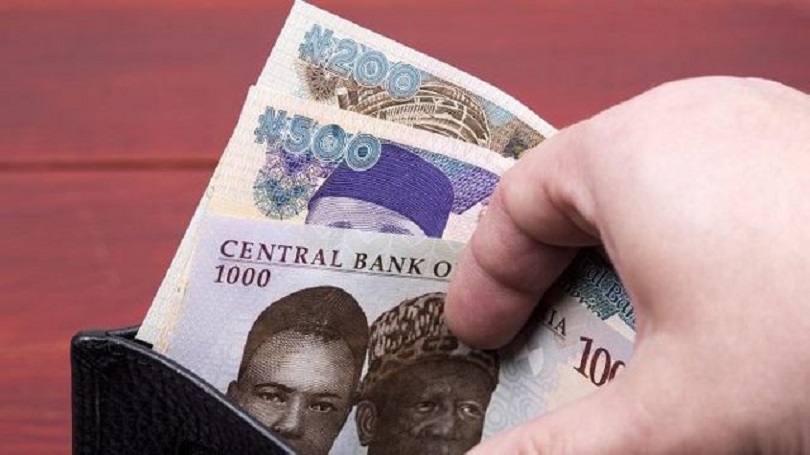
Naira Falls to N1,154/$1 at NAFEM, N1,120 at Black Market
By Adedapo Adesanya
The Naira plunged against the US Dollar by N70 in the parallel market segment of the foreign exchange (FX) market on Thursday to settle at N1,120/$1, in contrast to Wednesday’s closing price of N1,050/$1.
Similarly, it had a bad day in the Nigerian Autonomous Foreign Exchange Market (NAFEM), which is the official market, as it slumped against the greenback by 7.6 per cent or N7.78 to close at N1,154.08/$1 compared with the previous day’s value of N1,072.74/$1.
However, the Nigerian currency close flat against the British Pound Sterling and the Euro in the spot market yesterday at N1,147.53/£1 and N1,220.17/€1, respectively.
Recently, the local currency strengthened towards the N1,000 per Dollar mark following a string of policies instituted by the Central Bank of Nigeria (CBN) and despite reassurance from the apex bank and fiscal authorities that it would intensify efforts, the rate at the official market tumbled.
However, volatility returned to the ecosystem on Thursday as the value of forex turnover declined by $3.50 million or 1.85 per cent to $185.62 million from the $189.12 million recorded a day earlier.
In the cryptocurrency market, Bitcoin (BTC) made a 1.3 per cent rise ahead of its halving, which will take off a considerable number of the coins off the market.
The price of the coin is likely to weaken after the reward halving, a quadrennial event that slows the rate of growth in bitcoin supply and looks set to occur around April 19-20, Wall Street giant JPMorgan (JPM) said in a research report on Wednesday.
Solana (SOL) gained 2.9 per cent during the session to sell at $138.35.
However, Ripple (XRP) slumped by 1.8 per cent to $0.488, Cardano (ADA) slid by 1.6 per cent to $0.4431, Litecoin (LTC) declined by 1.1 per cent to $79.13, Binance Coin (BNB) lost 0.8 per cent to close at $543.70, Dogecoin (DOGE) went down by 0.3 per cent to $0.1477, and Ethereum (ETH) depreciated by 0.1 per cent to $3,001.79, while the US Dollar Tether (USDT) and the US Dollar Coin (USDC) traded flat at $1.00 apiece.
Economy
Zichis Gains 39.62% in One Week, Now Sells N21.78 Per Share
By Dipo Olowookere
Zichis Agro-Allied Industries Plc continued its upward movement on the Nigerian Exchange (NGX) Limited last week, emerging as the best-performing stock after chalking up 39.62 per cent to trade at N21.78 per share.
The company’s stock has shown no signs of slowing down despite a downward price adjustment it suffered a week ago after an investigation into its price movement.
Zichis joined the local bourse in January 2026 at a unit price of N1.81, but within a month, its share price rose to N17.36 per unit, indicating an 859.12 per cent surge.
After a look into its rise in value, its price was trimmed to N8.58 per unit after the NGX Regulation lifted a suspension on trading on its shares on March 23, 2026.
Last week, which had four trading sessions, Zichis led the price gainers’ chart of 52 equities versus 46 equities of the previous week. Fifty-three shares depreciated versus 53 shares of the preceding week, and 41 stocks closed flat versus 47 stocks recorded a week earlier.
Trailing Zichis on the gainers’ table was The Initiates, which appreciated by 33.04 per cent to N30.60, UAC Nigeria expanded by 27.82 per cent to N181.50, BUA Cement solidified by 24.78 per cent to N408.00, and CAP grew by 22.53 per cent to M145.20.
On the flip side, UBA slumped by 22.27 per cent to N42.75, Royal Exchange shrank by 20.00 per cent to N1.36, Trans-Nationwide Express depleted by 18.99 per cent to N6.40, Deap Capital went down by 14.49 per cent to N4.19, and First Holdco slipped by 13.80 per cent to N64.65.
In the week, the All-Share Index (ASI) and the market capitalisation soared by 7.33 per cent each to 242,277.81 points and N155.994 trillion, respectively.
Also, all other indices finished higher except CG, banking, insurance, AFR Bank Value, MERI Value and sovereign bond indices, which lost 0.80 per cent, 5.52 per cent, 1.13 per cent, 5.80 per cent, 3.31 per cent and 0.26 per cent, respectively
Business Post reports that a total of 4.842 billion shares worth N287.756 billion exchanged hands in 332,453 deals last week compared with the 3.805 billion shares valued at N213.955 billion traded in 297,202 deals a week earlier.
The financial services industry led the activity chart with 3.755 billion units worth N124.398 billion in 146,938 deals, contributing 77.56 per cent and 43.23 per cent to the total trading volume and value, respectively.
The consumer goods sector transacted 177.009 million units worth N30.853 billion in 36,609 deals, and the third place was the services industry with a turnover of 176.809 million units worth N4.387 billion in 15,310 deals.
Access Holdings, UBA, and Wema Bank led the activity chart with 2.026 billion equities worth N60.036 billion in 39,925 deals, contributing 41.85 per cent and 20.86 per cent to the total equity turnover volume and value, respectively.
Economy
OPEC+ Agrees Modest Output Hike for June as Hormuz Closure Limits Impact
By Adedapo Adesanya
The Organisation of the Petroleum Exporting Countries and allies (OPEC+) agreed to another modest oil output hike for June, which will remain largely on paper as long as the war in Iran continues to disrupt Gulf oil supplies through the Strait of Hormuz.
Seven OPEC+ countries will raise oil output targets by 188,000 barrels per day in June, the third consecutive monthly increase, OPEC+ said in a statement after an online meeting on Sunday.
The increase is the same as that agreed for May, minus the share of the United Arab Emirates (UAE), which exited the alliance on May 1 to focus on its energy future.
The seven members who met on Sunday were Saudi Arabia, Iraq, Kuwait, Algeria, Kazakhstan, Russia, and Oman. With the UAE leaving, OPEC+ includes 21 members, including Iran and Russia. However, in recent years, only the seven nations plus the UAE have been involved in monthly production decisions.
The move is designed to show the group is ready to raise supplies once the war stops.
The Iran war, which began on February 28, and the resulting closure of the Hormuz Strait have throttled exports from OPEC+ members Saudi Arabia, Iraq and Kuwait, as well as from the UAE. Before the conflict, these producers were the only countries in the group able to raise production.
Top OPEC+ producer Saudi Arabia’s quota will rise to 10.291 million barrels per day in June under the agreement, far above actual production. The kingdom reported actual production of 7.76 million barrels per day to OPEC in March.
Market analysts noted that even when shipping through the Strait of Hormuz reopens, it will take several weeks or months for flows to normalise.
In the meantime, the supply disruption has propelled oil prices to a four-year high above $125 per barrel.
Crude oil output from all OPEC+ members averaged 35.06 million barrels per day in March, down 7.70 million barrels per day from February, OPEC said in a report last month, with Iraq and Saudi Arabia making the biggest cuts due to constrained exports.
The seven OPEC+ members will meet again on June 7.
Economy
Brent, WTI Ease on Iran Proposal Despite Ongoing Supply Disruptions
By Adedapo Adesanya
The prices of the two major crude oil grades moderated on Friday amid news of an Iranian proposal on negotiations with the United States. However, prices remained on track for weekly gains, with Iran still blocking the Strait of Hormuz and the US Navy blocking exports of Iranian crude.
Brent crude settled at $108.17 per barrel after losing $2.23 or 2.02 per cent, while the US West Texas Intermediate (WTI) crude finished at $101.94 a barrel after giving up $3.13 or 2.98 per cent. Both benchmarks gained 2.9 per cent over the week.
It was reported on Friday that Iran sent its latest proposal for negotiations with the US to Pakistani mediators on Thursday, a move that could improve prospects for breaking an impasse in efforts to end the Iran war.
Oil prices have been on the rise since the US and Israel attacked Iran at the end of February, resulting in the closure of the Strait of Hormuz and the disruption of shipments of about a fifth of the world’s oil and liquefied natural gas supply.
Although a ceasefire has been in place since April 8, the oil market appeared to be accepting the uneasy truce in the conflict since Iran had already said and signalled that it won’t open the chokepoint to free traffic and won’t return to negotiations unless the American blockade is lifted.
There are fears of an escalation amid reports that US President Donald Trump would be briefed on further military options to force Iran’s hand to sign a deal, which could involve a ground operation.
Prices could spike to $140 per barrel, according to the Speaker of Iran’s Parliament, Mr Mohammad Bagher Ghalibaf, saying the US Administration is getting “junk advice” from people like [Treasury Secretary] Bessent, “who also push the blockade theory and cranked oil up to $120+. Next stop:140.”
The United Arab Emirates’ departure from the Organisation of the Petroleum Exporting Countries (OPEC) this week may still mean that the market’s most striking feature in the next few years is not too little supply, but too much. It left the cartel to boost production (target ~5 million barrels per day by 2027) and gain full control over its oil strategy and global partnerships.
-
Feature/OPED6 years agoDavos was Different this year
-
Travel/Tourism10 years ago
Lagos Seals Western Lodge Hotel In Ikorodu
-
Showbiz3 years agoEstranged Lover Releases Videos of Empress Njamah Bathing
-
Banking8 years agoSort Codes of GTBank Branches in Nigeria
-
Economy3 years agoSubsidy Removal: CNG at N130 Per Litre Cheaper Than Petrol—IPMAN
-
Banking3 years agoSort Codes of UBA Branches in Nigeria
-
Banking3 years agoFirst Bank Announces Planned Downtime
-
Sports3 years agoHighest Paid Nigerian Footballer – How Much Do Nigerian Footballers Earn