Economy
Naira Falls to N878.57/$1 at Official FX Market
By Adedapo Adesanya
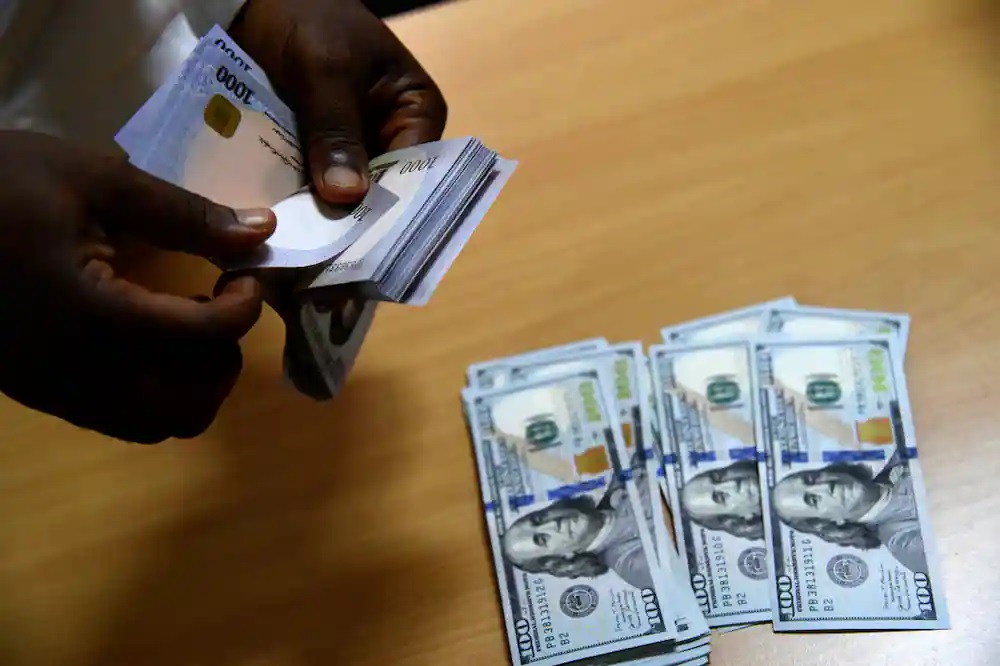
The Naira slid against the US Dollar in the Nigerian Autonomous Foreign Exchange Market (NAFEM) on Tuesday, January 16.
The local currency weakened by 4.7 per cent or N39.62 against the greenback to trade at N878.57/$1 compared with the preceding day’s value of N838.95/$1, according to data obtained from the FMDQ Securities Exchange.
In the same pattern, the domestic currency depreciated against the Pound Sterling in the spot market yesterday by N6.48 to close at N1,080.11/£1 compared with Monday’s closing price of N1,086.59/£1 and against the Euro, it depreciated by N5.72 to sell at N929.07/€1 versus the previous session’s N934.79/€1.
A recent boost to the foreign exchange (FX) market translated to a rise in turnover in the official market on Tuesday, with $147.81 million worth of forex traded compared with the $26.37 million transacted in the previous day, representing a rise by $121.44 million or 460.5 per cent.
In the Peer-to-Peer (P2P) window, the Naira lost N19 against the US Dollar during the trading session to finish at N1,303/$1, in contrast to the previous day’s N1,284/$1.
In the parallel market, the Nigerian currency fell against the Dollar yesterday by N20 to sell for N1,300/$1 compared with the previous day’s value of N1,280/$1.
A look at the digital currency market showed that the majority of the benchmarked tokens were in the negative territory as the appetite of investors appeared to be waning.
Analysts say investors are assessing the future of the market before making any further bets. This is coming as regulatory concerns remain although the US Securities Exchange Commission (SEC) approved Spot Bitcoin exchange traded funds (ETFs).
Bitcoin ETFs are traditional financial vehicles that may give retail and institutional investors alike easier exposure to Bitcoin’s price.
Litecoin (LTC) dropped 2.2 per cent to trade at $69.90, Ripple (XRP) depreciated by 1.7 per cent to $0.5761, Cardano (ADA) fell by 1.2 per cent to $0.5326, and Solana (SOL) recorded a 0.8 per cent slump to close at $95.70.
Further, Dogecoin (DOGE) weakened by 0.6 per cent to $36.07, US Dollar Tether (USDT) shed 0.09 per cent to settle at $0.999, and Binance Coin (BNB) went south by 0.02 per cent to $314.86.
However, BTC gained 0.2 per cent to quote at $42,748.09, and Ethereum (ETH) rose by 0.6 per cent to $2,528.05, while the US Dollar Coin (USDC) traded flat at $1.00.
Economy
Nigeria Needs $38.3bn to Meet 2030 Oil, Gas Production Targets—Verheijen
By Adedapo Adesanya
The Special Adviser to the President on Energy, Mrs Olu Verheijen, has said Nigeria requires about $38.3 billion in fresh investment to sustain current oil and gas production and achieve its 2030 output targets.
Speaking at the recently concluded 25th NOG Energy Week Conference and Exhibition in Abuja, Mrs Verheijen said global investors are now prioritising countries with predictable policies, competitive fiscal terms and credible regulatory systems.
“For Africa, that question is urgent. And for Nigeria, the scale of the task is equally clear: to sustain the current base and grow toward our 2030 production target, analysis shows a financing gap of about $38.3 billion,” she said.
According to her, the era when countries relied solely on resource endowment to attract capital has ended.
“Capital has no passport. It is rational. It prices risk. It follows credibility. It asks one question: can this country turn resources into bankable projects, and bankable projects into reliable returns?”
She said Nigeria had deliberately repositioned itself through reforms aimed at improving investor confidence and accelerating project execution.
“We recalibrated fiscal terms, clarified regulation and streamlined oversight. We introduced targeted incentives and cut contracting timelines by more than half. We made a clear statement to the world: Nigeria is no longer asking to be trusted; Nigeria is working to be bankable.”
Highlighting progress recorded under the reforms, Verheijen said Nigeria now has more than $50 billion worth of upstream projects in its visible investment pipeline.
“We now have more than 50 billion dollars of upstream projects in the visible pipeline. In the last three years, more than 10 billion dollars of long-awaited final investment decisions have come through.”
She added that crude oil and condensate production has increased by about 400,000 barrels per day since 2023, while onshore production is at its highest level in two decades.
“Crude oil and condensate production has risen by about 400,000 barrels per day since 2023. Onshore production is at its strongest level in twenty years.”
Mrs Verheijen said the Federal Government remains committed to achieving its target of producing three million barrels of oil per day and 10 billion standard cubic feet of gas daily by 2030, while strengthening Nigeria’s competitiveness in the global energy market.
She also highlighted ongoing reforms in the power sector, including the N4 trillion Presidential Power Sector Financial Reforms Programme, which she described as critical to restoring confidence across Nigeria’s electricity value chain.
On gas development, she said the government was expanding domestic LPG supply, improving affordability and supporting investments through tax and import duty incentives.
“A gas-rich nation cannot be comfortable when families are priced back to firewood, charcoal or kerosene,” she said.
Mrs Verheijen stressed that Nigeria’s ambition extends beyond exporting crude oil to building an industrial economy anchored on value addition.
“We have chosen not merely to produce molecules, but to convert molecules into megawatts, fertiliser, petrochemicals, mobility, manufacturing, jobs and exports.”
She concluded that the country’s reforms were laying the foundation for long-term growth despite lingering challenges.
“The age of Nigerian hesitation is ending. The age of Nigerian ambition has begun. Our task now is to turn reform into relief, capital into projects, projects into jobs, and energy into national greatness.”
Economy
Nigeria’s Headline Inflation Slows Marginally to 15.91% in June
By Adedapo Adesanya
Nigeria’s headline inflation rate in June 2026 moderated to 15.91 per cent from 15.93 per cent in May, as pressure from the Iran war mildly eased, though it largely remained in focus during the review month.
In the report on Wednesday, the statistical office showed that the headline inflation rate for June on a month-on-month basis was 1.66 per cent, 0.09 per cent lower than the 1.75 per cent recorded in May 2026.
On an annualised basis, the print was down from 25.29 per cent in the same month of the preceding year (June 2025). This was due to the rebasing of the calculation year from 2009 to 2024.
The rise in prices, which stemmed from the continued conflict in the Middle East, continued to stoke food prices and energy costs, which account for a huge chunk of average spending.
The food inflation rate in May 2026 on a month-on-month basis was 3.75 per cent, up by 0.77 percentage points from May 2026 (2.98 per cent), while on a year-on-year basis, it was 17.52 per cent and stood at 25.41 per cent in the same month of the preceding year (June 2025).
At 15.91 per cent print, the inflation marginally beat expectations by Meristem Research, predicted at 15.95 per cent.
There had been expectations that the ceasefire between the United States and Iran would help drive oil prices lower, raising expectations of some relief on the inflation front. However, with conflicts now flaring up again, oil prices are likely to increase again, and the anticipated easing in energy-driven inflation may not materialise as broadly as earlier envisaged.
Meristem Research said it expects inflationary pressures to re-emerge across key economies in the near term, as the re-escalation of the US-Iran conflict has reignited upward pressure on global oil prices.
This will be a core factor that the Monetary Policy Committee (MPC) of the Central Bank of Nigeria (CBN) will be looking at when it meets for the next policy meeting. At its last meeting, the committee left benchmarked interest rates at 26.5 per cent.
Economy
PenCom Assures Strong Risk Controls for PFA Investments in Custodians’ Parent Companies
By Adedapo Adesanya
The National Pension Commission (PenCom) has defended its decision to allow Pension Fund Administrators (PFAs) to invest in the parent companies of their custodians, insisting that adequate safeguards are in place to protect contributors’ funds.
The director-general of the pension regulator, Ms Omolola Oloworaran, speaking on Tuesday during the Meet the Press Briefing at the Presidential Villa, Abuja, said the commission’s decision to relax the investment restriction followed a comprehensive risk assessment that found minimal conflict of interest.
She explained that under PenCom’s investment regulations, PFAs are only permitted to invest pension assets in carefully selected instruments that meet stringent criteria, including profitability, strong credit ratings and proven track records.
According to her, the commission regularly reviews its investment regulations, conducts routine examinations and spot checks on PFAs to ensure strict compliance with established risk management guidelines.
“PFAs cannot just go into the stock market and buy any kind of stock. There are strict guidelines. Companies must demonstrate profitability, have a proven track record and satisfy other criteria before pension funds can invest,” she said.
Ms Oloworaran noted that each PFA also operates under the oversight of a board, an investment committee and a risk management committee, providing additional layers of governance to safeguard contributors’ funds.
She said PenCom recently issued a circular allowing PFAs to invest in the parent companies of their custodians after determining that the potential conflict of interest was negligible.
The PenCom boss explained that the parent companies involved are largely Tier-1 banks, including First Bank, United Bank for Africa (UBA) and Zenith Bank, which she described as A-rated institutions with strong financial foundations.
She said the policy was intended to widen investment opportunities for pension funds without compromising safety.
Using Stanbic IBTC as an example, Ms Oloworaran explained that if its custodian is Zenith Bank, the previous restriction prevented the pension administrator from investing in Zenith Bank shares despite the bank’s strong performance.
“We reviewed the risks and any potential conflict of interest and found the risks to be very low. That is why we opened that investment window,” she said.