Connect with us

Economy

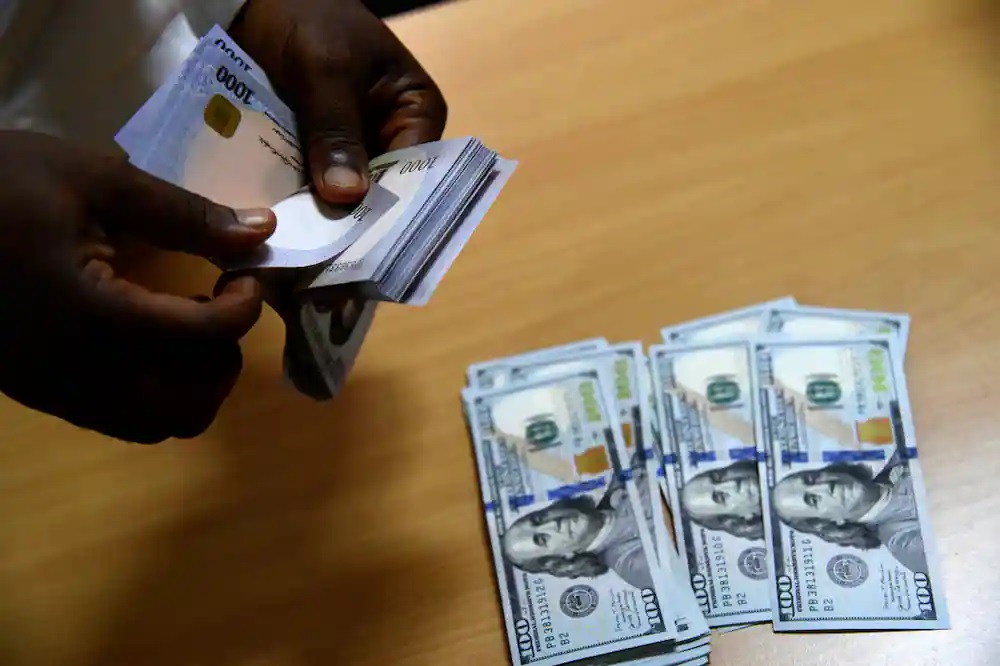
Naira Falls to N902.45/$1 at Official Market, N1,355/$1 at Parallel Market

Published

on

funds in Naira accounts

By Adedapo Adesanya

The Naira recorded a slight decline against the United States currency in the Nigerian Autonomous Foreign Exchange Market (NAFEM) segment of the foreign exchange (FX) market on Friday, January 19.

During the last trading session of the week, the value of the Nigerian currency slumped by 0.04 per cent or 33 Kobo to close at N902.45/$1 compared with Thursday’s closing price of N902.08/$1.

Also, the domestic currency performed badly against the Pound Sterling in the official market yesterday by N1.12 to wrap the day at N1,129.27/£1 compared with the preceding day’s N1,128.15/£1 and against the Euro, the Nigerian currency shed N2.02 to settle at N969.69/€1 versus the previous day’s exchange rate of N967.67/€1.

Data from the FMDQ Securities Exchange showed that the value of forex transactions on Friday depreciated by 39.5 per cent or $30.64 million to $145.89 million from the $176.53 million recorded in the previous trading session.

Similarly, in the parallel market, the local currency weakened against the US Dollar by N15 on Friday to sell for N1,355/$1 versus the previous day’s value of N1,340/$1.

However, the Naira appreciated against the Dollar in the Peer-to-Peer (P2P) window by N10 yesterday to trade at N1,337/$1, in contrast to Thursday’s exchange rate of N1,347/$1.

The cryptocurrency market recorded a largely bullish outcome as Bitcoin (BTC) moved to recover after falling to the lowest price level since the US approved the much expected exchange-traded funds (ETFs), gaining 0.9 per cent to sell for $41,616.84, and  Ethereum (ETH) improved by 0.7 per cent to $2,477.71.

Also, Litecoin (LTC) surged by 5.6 per cent to $72.24, Cardano (ADA) appreciated by 1.6 per cent to $0.5056, Dogecoin (DOGE) grew by 0.9 per cent to $0.0786, Binance Coin (BNB) went up by 0.4 per cent to $313.26, and the US Dollar Tether (USDT) rose by 0.04 per cent to $0.9994.

But Solana (SOL) slumped by 1.6 per cent to trade at $92.61, and Ripple (XRP) dropped 1.1 per cent to finish at $0.5447, while the US Dollar Coin (USDC) closed flat at $1.00.


Adedapo Adesanya is a journalist, polymath, and connoisseur of everything art. When he is not writing, he has his nose buried in one of the many books or articles he has bookmarked or simply listening to good music with a bottle of beer or wine. He supports the greatest club in the world, Manchester United F.C.

Economy

FG Rules Out Return of Fuel Subsidy, Price Control Introduction

Published

on

By Aduragbemi Omiyale

The federal government has stressed that it does not plan to bring back the payment of subsidies on premium motor spirit (PMS), otherwise known as petrol

This disclosure was made by the Minister of Finance and Coordinating Minister of the Economy, Mr Taiwo Oyedele, during a meeting with some global investors in France.

Some of the investors were from Citibank and France’s Amundi, led by Valerie Baudson. There were also BlueCrest, the Britain- and South Africa-based Ninety One, Kirkoswald Capital, Principal Finisterre, US groups Prudential Global Investment Management (PGIM) and Mesarete Capital.

There had been calls for the return of petrol subsidy in Nigeria as a result of higher energy costs triggered by the Middle East crisis. The price of crude oil on the global market has surpassed $115 per barrel, and this is making Nigerians pay more for petroleum products, despite being an oil-producing nation.

A few days ago, the federal government, to calm the nerves of airline operators who threatened to shut down operations due to the high cost of aviation fuel, had 30 per cent of their debt written off, and also got a deal to buy Jet fuel at a steady price, indicating a subsidy.

“We will not bring back fuel subsidy because it creates distortions for the economy, and we won’t introduce price control because we believe in the market… the situation in Iran presents new opportunities for us as the world looks to diversify sources of energy and invest in new markets,” Mr Oyedele said in Paris, the French capital.

“Nigeria recorded a strong GDP growth rate of 11.2 per cent in US dollar terms in 2025, reinforcing the country’s ambition to achieve a $1 trillion economy by 2030,” he added.

The Finance Minister emphasised the government’s near-term priorities of translating reforms into results for the Nigerian people. He also pledged to publish quarterly financial data.

Mr Oyedele is in France with President Bola Tinubu, who departed Nigeria on Sunday for a three-nation trip to France, Kenya, and Uganda.

The President said the economic reform programme of his administration includes measures to remove economic distortions and stabilise macroeconomic indicators, laying the foundation for sustained inclusive growth.

He assured that his government was committed to deepening reforms, enhancing transparency across the oil value chain, and implementing a multi-pronged security strategy, including police decentralisation and disrupting terrorist financing.

“The focus remains on policy stability and diligent execution to ensure these strategic shifts translate into concrete benefits for all Nigerians,” Mr Tinubu said.

Continue Reading

Economy

NGX All-Share Index Gives up 0.58% to Profit-taking

Published

on

NGX All-Share Index

By Dipo Olowookere

The Nigerian Exchange (NGX) Limited tasted defeat for the first time in a while on Tuesday after closing lower by 0.58 per cent as a result of profit-taking.

The market came under selling pressure yesterday, though investor sentiment remained bullish, as there were 45 price gainers and 25 price losers, implying a positive market breadth index.

Guinness Nigeria lost 10.00 per cent to close at N447.30, Union Dicon shed 9.82 per cent to finish at N19.75, AIICO Insurance depreciated by 9.28 per cent to N4.30, Wema Bank dipped by 8.72 per cent to N30.35, and MTN Nigeria crashed by 8.63 per cent to N836.00.

On the flip side, McNichols gained 10.00 per cent to sell for N7.92, RT Briscoe expanded by 10.00 per cent to N12.87, Zichis grew by 10.00 per cent to N25.08, Vitafoam rose by 10.00 per cent to N170.50, and CAP advanced by 9.99 per cent to N175.65.

Business Post reports that the energy index was down by 2.91 per cent and the banking sector declined by 1.48 per cent.

However, the industrial goods segment rose by 2.49 per cent, the insurance counter appreciated by 0.94 per cent, and the consumer goods space expanded by 0.40 per cent.

The All-Share Index (ASI) contracted by 1,411.37 points during the session to 241,750.15 points from 243,161.52 points, and the market capitalisation retreated by N906 billion to N155.152 trillion from N156.058 trillion.

Market participants transacted 1.3 billion stocks valued at N75.2 billion in 102,665 deals on Tuesday compared with the 967.5 million stocks worth N43.8 billion traded in 122,041 deals on Monday, showing a shortfall in the number of deals by 15.88 per cent, and a surge in the trading volume and value by 34.37 per cent and 71.69 per cent, respectively.

FCMB was the busiest equity yesterday with 160.6 million units sold for N1.8 billion, GTCO traded 94.1 million units worth N13.1 billion, Access Holdings transacted 81.8 million units valued at N2.1 billion, Zenith Bank exchanged 63.1 million units for N8.1 billion, and Fidelity Bank traded 48.4 million units valued at N911.8 million.

Continue Reading

Economy

Nigeria Loses N1.493trn Potential Revenue to Gas Flaring in 2025

Published

on

gas flaring nigeria

By Adedapo Adesanya

Nigeria lost $1.1 billion (N1.493 trillion)  to gas flaring in 2025, as oil and gas companies operating in the country burnt 323 billion Standard Cubic Feet (SCF) of gas between January and December 2025.

This is according to the latest data released by the National Oil Spill Detection and Remediation Agency (NOSDRA).

The agency, in its gas flare report for 2025, released recently, disclosed that the volume of gas flared in 2025 was 7.2 per cent higher than the 301.3 billion SCF (BSCF) of gas flared in 2024, which was also valued at $1.1 billion, about N1.493 billion.

The environmental impact regulator further stated that the volume of gas flared in the 12-month period of 2025 contributed 17.2 million tonnes of carbon dioxide into the atmosphere; had the potential to generate 32,300 gigawatt-hours (GWh) of electricity; while the offending companies were liable for penalties payment of $646.1 million, about N876.622 billion.

NOSDRA maintained that in the 12-month period of 2024, the 301.3 billion SCF of gas flared by oil and gas firms was valued at $1.1 billion, about N1.493 trillion, with penalties payable at $602.7 million, about N818.271 billion, while it contributed 16 million tonnes of carbon dioxide emissions, and had power generation potential of 30,100 GWh.

Providing a breakdown of gas flared data across segments of the oil-producing space in 2025, the agency reported that 206.3 billion SCF of gas was flared by oil and gas firms operating in the country’s onshore oil space, accounting for 63.8 per cent of total gas flared in the period under review, and was 18.36 per cent higher than the volume lost to gas flaring in this same segment in 2024.

NOSDRA added that the volume of gas flared onshore caused the country a loss of 20,600 GWh of electricity, and the emission of 11 million tonnes of greenhouse gases; this was valued at $722 million, about N979.754 billion; while the companies were liable to pay penalties of $412.6 million, about N560.441 billion.

In comparison, the 174.3 billion SCF of gas flared in 2024 by companies operating onshore was valued at $610 million, about N827.77 billion; with penalties payable at $348.6 million, about N473.593 billion; caused the loss of power generation potential of 17,400 GWh; and contributed 9.3 million tonnes of carbon dioxide into the atmosphere.

On the other hand, companies operating offshore accounted for 36.2 per cent of total gas flared between January and December 2025, with 116.8 billion SCF of gas, valued at $408.7 million (N555.013 billion); penalties payable at $233.5 million (N317.538 billion); contributed 6.2 million tonnes of carbon dioxide emission; and eroded 11,700 GWh of electricity generation potential.

Similarly, in the same 12-month period in 2024, offshore operations emitted 6.7 million tonnes of carbon dioxide into the atmosphere, causing the loss of power generation capacity of 12,700 GWh, with 127.1 billion SCF of gas flared, valued at $444.7 million (N603.865 billion), and penalties payable at $254.1 million (N344.678 billion).

NOSDRA noted that the offending companies flared gas from Oil Mining Leases (OML) 04, 05, 11, 13, 14, 17, 18, 22, 28, 23, 24, 38, 40, 42, 43, 72, 49, 54, 86, 90, 95, 67, 70, 104, 59, 99, 100, 101, 102, 110 and Oil Prospecting Licences (OPL) 090, 209, 212, 216, 222, 246, 316 and 306, among others.

It identified the offending companies as Shell Petroleum, Development Company (SPDC), Nigerian Petroleum Development Company (NPDC), Chevron Nigeria, Mobil Oil, Elf Petroleum Nigeria, Nigeria Agip Oil Company (NAOC), Addax Petroleum, Texaco Overseas (Nigeria), Esso Exploration and Production Nigeria, Allied Energy Resources, Ultramar Petroleum, Atlas Petroleum; Cromwell, Afric Oil and Marketing, Famfa Oil, Moni Pulo, and South Atlantic Petroleum, Star Deep Water, Summit Oil, among others.

Continue Reading

Trending