Connect with us

Economy

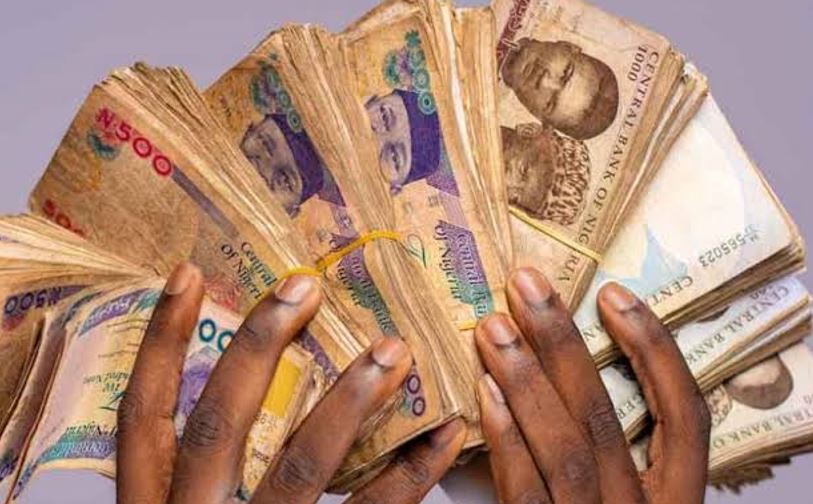
Naira Firms to N1,507/$1 at Official Market, N1,535/$1 at Parallel Market

Published

on

currency in circulation eNaira

By Adedapo Adesanya

The Naira extended its recent gaining spree by 0.15 per cent or N2.24 on the US Dollar at the Nigerian Autonomous Foreign Exchange Market (NAFEM) on Wednesday, February 19.

Yesterday, the local currency was exchanged with the greenback at N1,507.33/$1 in the official market compared with the preceding day’s value of N1,509.57/$1.

Against the Pound Sterling and the Euro in the spot market, the domestic currency closed flat at N1,900.46/£1 and N1,605.17/€1 , respectively at the midweek session.

In the parallel market, the Nigerian Naira appreciated against the US Dollar during the trading day by N5 to quote at N1,535/$1, in contrast to Tuesday’s exchange rate of N1,540/$1.

The Naira’s positive outcome aligns with expectations that it would firm up in the first quarter of the year, backed by continued policy support by the Central Bank of Nigeria (CBN).

Also, the recent rebasing of Nigeria’s Consumer Price Index (CPI) which rejigged inflation to 24.48 per cent supports possible rate pause or cuts by the apex bank.

The CBN started its 299th Monetary Policy Committee (MPC) meeting on Wednesday and the decision will be announced later today.

In the cryptocurrency market, most of the tokens appreciated despite waning demand, faltering blockchain activity, and lack of liquidity inflows to crypto.

Also, demand for bitcoin, which picked up in late 2024 amid optimism over easing regulatory headwinds on Trump’s election win, is now retreating.

In addition, sentiment in the broader crypto market has been battered by highly controversial memecoin launches in the past weeks, with the likes of TRUMP memecoin and LIBRA burning speculative capital.

Ripple (XRP) gained 5.8 per cent to trade at $2.69, Cardano (ADA) rose by 4.2 per cent to $0.7809, Solana (SOL) improved by 2.4 per cent to $171.94, Bitcoin (BTC) jumped by 1.4 per cent to $96,924.55, Ethereum (ETH) chalked up 1.1 per cent to sell for $2,729.55, Dogecoin (DOGE) grew by 1.0 per cent to $0.2547, and the US Dollar Tether (USDT) added 0.03 per cent to quote at $0.9999.

Conversely, Litecoin (LTC) slid by 1.2 per cent to settle at $130.28, and Binance Coin (BNB) also went down by 1.2 per cent to $647.50, while the US Dollar Coin (USDC) closed flat at $1.00.


Adedapo Adesanya is a journalist, polymath, and connoisseur of everything art. When he is not writing, he has his nose buried in one of the many books or articles he has bookmarked or simply listening to good music with a bottle of beer or wine. He supports the greatest club in the world, Manchester United F.C.

Economy

Brent Nears $110 on Stalled Diplomacy, Tight Global Supply

Published

on

Brent Price

By Adedapo Adesanya

Brent futures gained $2.90 or 2.8 per cent to trade at $108.23 a barrel on Monday as peace talks between the United States and Iran stalled and shipments through the Strait of Hormuz remained limited, keeping global ‌oil supplies tight.

Also, the US West Texas Intermediate crude rose by $1.97 or 2.1 per cent to $96.37 per barrel after Iran reportedly offered to reopen the Strait of Hormuz, but insisted US nuclear talks be postponed, a condition the Americans are unlikely to accept.

Iran presented the proposal through regional mediators to reopen the waterway and move toward ending the war first, while postponing nuclear negotiations. The proposal would separate shipping security from the dispute over uranium enrichment, where negotiations have deadlocked.

The stalled negotiations are leading to fears for the global economy as both nations are no closer to a lasting truce after US President Donald Trump cancelled American participation in talks with Iran.

President Trump ⁠discussed a new Iranian proposal on resolving the war with Iran with his top national security aides, with the conflict currently in a stalemate and energy supplies ​from the Middle East region reduced.

The market is also beginning to price the supply story beyond crude. Higher petrol and heating oil prices are feeding concern that the conflict is moving into transport, manufacturing, and consumer costs.

At least seven ships – mainly dry bulk vessels – have crossed the Strait of Hormuz in the past 24 hours, in line with muted activity in recent days. That represents a fraction of the average 140 daily passages before the Iran war ​began on February 28, when around 20 per cent of global oil supplies passed through the strait.

In addition, six tankers loaded with Iranian oil have been ​forced back to Iran by the US blockade in recent days.

Also, Russian President Vladimir Putin praised the Iranian people for battling to stay independent in the face of US and Israeli pressure ‌and said ⁠Russia would do all it could to help Iran.

Major global central banks are set to hold interest rates steady this week.

The European Central Bank (ECB) will meet on Thursday, with a ceasefire easing the pressure on it for an immediate interest rate hike. Higher interest rates ​increase consumer borrowing costs, which can ⁠reduce economic growth and oil demand.

Traders are betting that the US Federal Reserve, ECB, Bank of Japan, and Bank of England will all maintain rates at current levels.

Continue Reading

Economy

Stocks Sheds 0.94% on Commencement of NGX Extended Market Session

Published

on

NGX Group

By Dipo Olowookere

The Nigerian Exchange (NGX) Limited suffered a 0.94 per cent loss on Monday, April 27, 2026, which marked the commencement of an extended market session.

A few weeks ago, it was announced that trading activities on Customs Street would now be from 9:00 am to 4:00 pm instead of the usual 9:30 am to 2:30 pm.

This action was taken to allow market participants more time to explore the bourse and further make it robust, especially after the restoration of Nigeria’s frontier market status by FTSE Russell.

The NGX came under selling pressure, which resulted in 35 equities finishing on the gainers’ chart and 40 equities ending on the losers’ table, indicating a negative market breadth index and weak investor sentiment.

Trans-Nationwide Express, First Holdco, and UBA were the worst-performing equities after giving up 10.00 per cent each to trade at N7.11, N67.50, and N49.50, respectively. Access Holdings depreciated by 9.90 per cent to N28.20, and Fidelity Bank crashed by 9.87 per cent to N20.10.

The best-performing equity for the session was Abbey Mortgage Bank, which gained 9.26 per cent to N5.90, Zichis went up by 8.91 per cent to N16.99, Wema Bank expanded by 8.80 per cent to N34.00, NPF Microfinance Bank soared by 8.19 per cent to N5.68, and Coronation Insurance grew by 7.27 per cent to N2.66.

It was observed that the profit-taking was mainly from banking stocks, as the index shed 6.49 per cent. The consumer goods sector lost 0.41 per cent, and the energy counter depreciated by 0.24 per cent.

However, the industrial goods space improved by 0.85 per cent, and the insurance segment appreciated by 0.15 per cent.

But at the close of business, the All-Share Index (ASI) slipped by 2,120.20 points to 223,602.29 points from 225,722.49 points, and the market capitalisation shrank by N1.365 trillion to N143.970 trillion from N145.335 trillion.

A total of 678.2 million shares worth N44.1 billion were traded in 82,838 deals on Monday compared with 627.6 million shares valued at 44.5 billion transacted in 55,232 deals last Friday, representing a drop in the trading value by 0.90 per cent, and a surge in the trading volume and number of deals by 8.06 per cent and 49.98 per cent, respectively.

Zenith Bank was at the zenith of the activity chart yesterday with 76.1 million units sold for N9.5 billion. Wema Bank traded 49.9 million units worth N1.7 billion, Access Holdings exchanged 39.1 million units valued at N1.1 billion, Tantalizers transacted 30.0 million units worth N113.9 million, and AIICO Insurance traded 28.3 million units valued at N118.3 million.

Continue Reading

Economy

Nigeria Boosts Oil Theft Curbing with Naval Drill

Published

on

Crude Oil Theft special court

By Adedapo Adesanya

Nigeria has ramped up efforts to secure its oil-rich waters and curb maritime crime, deploying significant naval assets under Exercise Obangame Express 2026 to protect critical energy infrastructure and trade routes in the Gulf of Guinea.

Flagging off the exercise in Onne, Rivers State, the Chief of Naval Staff, Vice Admiral Idi Abbas, said the exercise is central to safeguarding economic assets and sustaining investor confidence in Nigeria’s maritime domain.

“The safer maritime environment has enhanced investor confidence, increased shipping activities and supports the Federal Government’s drive towards a sustainable blue economy,” he said in a statement.

The multinational exercise, coordinated with the United States Africa Command, focuses on combating oil theft, piracy, illegal trafficking and other threats that directly impact Nigeria’s oil revenues and regional trade flows.

The focus on maritime security comes amid persistent concerns over crude oil theft and supply chain disruptions, which continue to undermine Nigeria’s production capacity.

Mr Abbas emphasised that coordinated regional efforts remain the most effective response to evolving threats.

“OBANGAME EXPRESS provides a unique opportunity for participating nations to train together, operate together and build the trust necessary for real-time coordination,” he said.

He added that no country can independently secure its maritime domain, stressing the need for sustained partnerships to protect the Gulf’s strategic energy corridor.

Also, the Commander, Eastern Naval Command, Rear Admiral CD Okehie, said the operation reflects a strategic shift toward protecting high-value maritime assets.

“The Gulf of Guinea serves as a major global sea lane of commerce, making it indispensable not only to regional economies but also to international trade,” he noted.

According to him, the Navy’s deployment of 10 ships, helicopters and special forces is designed to strengthen surveillance, interdiction and rapid response capabilities.

With Nigeria’s offshore assets and export routes forming a backbone of national revenue, the exercise signals a renewed push to tighten security, reduce losses and stabilise the broader oil and gas ecosystem.

Continue Reading

Trending