Connect with us

Economy

Naira Gains 0.15% to Trade N1,471/$1 at Official Market

Published

on

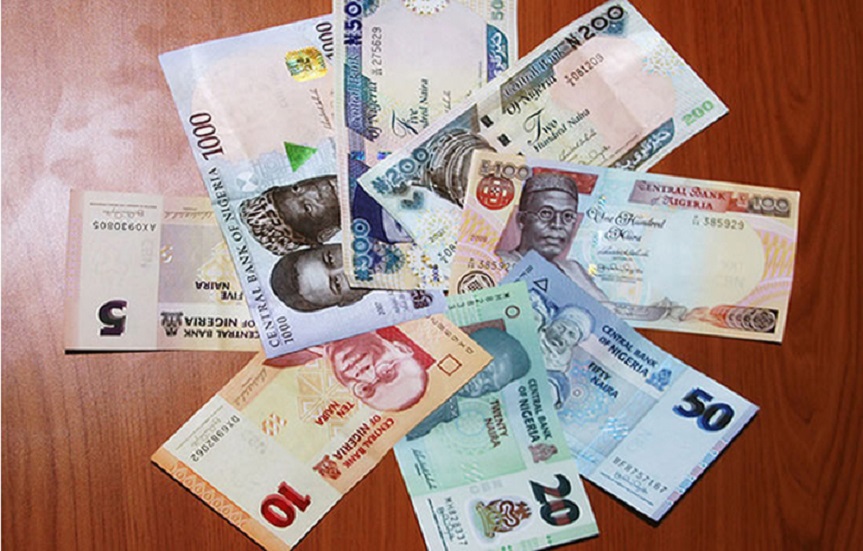
redesign Naira Notes

By Adedapo Adesanya

The foreign exchange (FX) demand pressure on the Naira eased on Thursday, October 16, causing it to gain 0.15 per cent or N2.26 against the United States Dollar in the Nigerian Autonomous Foreign Exchange Market (NAFEM) to trade at N1,471.03/$1 compared with the previous day’s N1,473.29/$1.

However, the local currency depreciated further against the Pound Sterling in the official market yesterday by N10.07 to sell for N1,976.18/£1 compared with the preceding session’s N1,966.11/£1, and lost N2.23 against the Euro to quote at N1,714.49/€1, in contrast to the N1,712.26/€1 it was traded a day earlier.

Equally, at GTBank, the Nigerian Naira weakened against the greenback during the session by N5 to close at N1,475/$1 compared with the previous day’s rate of N1,470/$1.

In the black market segment, the Nigerian currency traded flat against the Dollar on Thursday at N1,485/$1.

The Naira is expected to depreciate further next week as foreign investors sell local assets amid global risk aversion and limited dollar supply.

This will overpower expectations that recent moderating inflation will support the local currency with traders noting that foreign investors are selling local assets owing to a global risk-off mood caused by escalating trade tensions between the US and China, the world’s two biggest economies and weak Dollar supply by the Central Bank of Nigeria (CBN).

On Wednesday, the National Bureau of Statistics (NBS) reported that Nigeria’s inflation stood at 18.02 per cent in September 2025, the first time it has dropped below 20 per cent in years.

Investment firm CardinalStone in a note said “the ongoing disinflationary trends bode well for currency valuation. Combined with a sustained current account surplus and a steady build-up in FX reserves, this is expected to underpin further Naira appreciation. “

As for the cryptocurrency market, it was under pressure as other assets like gold and silver notched new record highs.

Key metrics point to tightening liquidity conditions in the US financial system, leading to traders exiting their positions.

Dogecoin (DOGE) fell by 3.5 per cent to $0.1889, Cardano (ADA) slid by 3.5 per cent to $0.6455, Solana (SOL) went down by 3.3 per cent to $186.65, Binance Coin (BNB) depreciated by 3.1 per cent to $1,141.78, and .Litecoin (LTC) slumped by 2.8 per cent to $91.64.

Further, Ripple (XRP) declined by 2.6 per cent to close at $2.34, Ethereum (ETH) shrank by 2.3 per cent to $3,908.66, and Bitcoin (BTC) lost 2.1 per cent to finish at $108,761.93, while the US Dollar Tether (USDT) and the US Dollar Coin (USDC) traded flat at $1.00 each.


Adedapo Adesanya is a journalist, polymath, and connoisseur of everything art. When he is not writing, he has his nose buried in one of the many books or articles he has bookmarked or simply listening to good music with a bottle of beer or wine. He supports the greatest club in the world, Manchester United F.C.

Economy

Chiemeka Highlights Role of Non-Interest Finance in Enhancing Market Inclusion

Published

on

Jude Chiemeka NGX CEO

By Aduragbemi Omiyale

The chief executive of the Nigerian Exchange (NGX) Limited, Mr Jude Chiemeka, has emphasised the importance of non-interest finance in the economy and the nation’s capital market.

Speaking at the 7th African International Conference on Islamic Finance (AICIF) in Lagos recently, he said non-interest finance drives sustainable economic transformation and enhances market inclusion.

According to him, this was why the stock exchange created a special board for the sub-market segment to attract ethical investors.

“At NGX, our Non-Interest Finance Board represents more than a platform, it embodies our commitment to unlocking ethical capital, diversifying investment opportunities, and driving sustainable development.

“By leveraging innovation and strategic partnerships, we are creating pathways for inclusive growth and positioning Nigeria at the forefront of Islamic finance in Africa,” Mr Chiemeka stated at the event organised by The Metropolitan Skills Limited in collaboration with the Securities and Exchange Commission (SEC).

Business Post reports that Nigeria’s non-interest capital market has recorded significant expansion in recent years, with sovereign Sukuk issuances at over N1.4 trillion for multiple projects nationwide.

It was gathered that the two-day AICIF attracted policymakers, regulators, development partners, and market participants, who explored policy reforms, product innovation, and strategies to unlock liquidity across Africa’s Islamic finance markets.

Also speaking, the chairman of NGX Group Plc, Mr Umaru Kwairanga, said NGX’s Non-Interest Finance Board has become a central platform for expanding access to Sharia-compliant financial instruments and attracting investors seeking transparency, inclusivity, and sustainability.

“Through the Non-Interest Finance Board, NGX is building a dedicated platform for Sukuk, Islamic collective investment schemes, and non-interest exchange-traded funds. Our goal is to broaden market participation while channelling capital towards productive sectors of the economy,” he said.

On his part, the Vice President of Nigeria, Mr Kashim Shettima, represented by the Special Adviser to the President on Economic Matters, Mr Tope Fasua, described Islamic finance as a credible mechanism for fostering equitable prosperity and sustainable development, urging broader adoption across African economies.

Continue Reading

Economy

NECA Backs Tinubu’s 15% Fuel Import Levy

Published

on

NECA Adewale Smatt-Oyerinde

By Adedapo Adesanya

The Nigeria Employers’ Consultative Association (NECA) has backed the proposed 15 per cent fuel import tariff introduced by the President Bola Tinubu-led government.

According to NECA Director General, Mr Wale Smatt Oyerinde, the move will enhance local production of the commodity.

“We support the policy of a 15 per cent tariff on imported petroleum products — not on locally produced ones.

“If the 15 per cent tariff is the ‘punishment’ we must bear collectively for our recklessness in allowing our four refineries to collapse, then so be it,” he said when he was interviewed on Channels Television on Friday.

“Even developed nations like the US are introducing protectionist policies to protect their local industries. We don’t have much excuse not to do the same,” the NECA boss said.

Recall that President Tinubu had approved the 15 percent tariff increase in a letter sent to the Federal Inland Revenue Service (FIRS) and the Nigerian Midstream and Downstream Petroleum Regulatory Authority, mandating its enforcement.

Critics have faulted the move, arguing it will lead to an increase in the landing cost of the product, with petrol and diesel expected to see further increment.

However, support for the programme has come from many quarters including energy businessman, Mr Femi Otedola, who backed move recently.

The NECA chief also believes the policy is a step in the right direction, adding that a similar actions should be extended to other areas.

“The president gave approval about two weeks ago, and the OPS has done its analysis. We’re also looking beyond petrol and diesel.

“To ramp up production in the manufacturing and real sectors, this kind of policy should extend there too. Why do we import things we can produce locally? It affects forex and other aspects of the economy,” Mr Oyerinde said.

“We’ve said that everything we can produce locally should attract import duties, provided we have made sufficient arrangements for local production to meet our needs. If we have to give businesses a one- or two-year moratorium to integrate backward, then fine, but let’s reduce the tendency to import,” he added.

Continue Reading

Economy

Shell Gives Nigerian Offshore Gas Deal to Halliburton

Published

on

Shell UK stock

By Adedapo Adesanya

Shell Nigeria Exploration and Production Company has given US-based Halliburton an integrated drilling contract to work on the oil major’s $2 billion shallow-water HI offshore gas project in Nigeria.

According to reports, the financial terms of the deal, awarded by Shell, were not disclosed.

Halliburton, based in Houston, said it will deploy remote operations and automated technologies for the work.

In October, Shell announced HI, located in Nigeria’s Oil Mining Licence (OML) 144. The UK major operates the HI project with a 40 per cent working interest alongside its local partner, Sunlink Energies and Resources, which owns a 60 per cent stake.

The project, when completed, will supply 350 million standard cubic feet (approximately 60 thousand barrels of oil equivalent) of gas per day at peak production to Nigeria LNG (NLNG; Shell interest 25.6 per cent), which produces and exports liquefied natural gas (LNG) to global markets.

According to a statement, production is expected to begin before the end of this decade.

At the time of the announcement, Mr Peter Costello, Shell’s Upstream President, said that “This Upstream project will help Shell grow our leading Integrated Gas portfolio, while supporting Nigeria’s plans to become a more significant player in the global LNG market.”

The gas will be sent to the delayed Train 7 of the Nigeria Liquefied Natural Gas (NLNG) plant, currently being built by a Saipem-led consortium.

The increase in feedstock to NLNG, via the Train 7 project that aims to expand the Bonny Island terminal’s production capacity, is in line with Shell’s plans to grow its global LNG volumes by an average of 4-5 per cent per year until 2030.

Continue Reading

Trending