Connect with us

Economy

Naira Gains Against Dollar as Cryptos Rise Amid US Inflation Data

Published

on

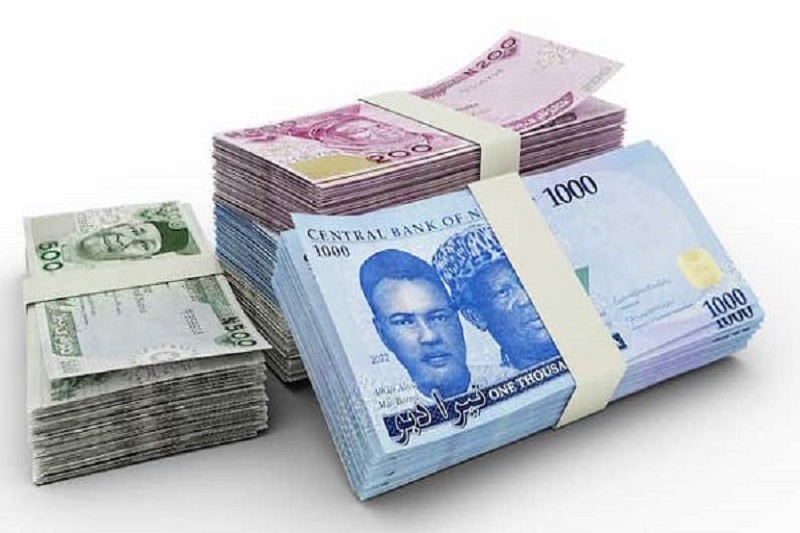
old Naira notes

By Adedapo Adesanya

The Naira appreciated against the Dollar on Tuesday at the Peer-2-Peer (P2P), the Investors and Exporters (I&E), and the black market windows of the foreign exchange (forex) market.

In the parallel market, the Nigerian Naira gained N1 against the US Dollar during the session to settle at N745/$1 compared with Monday’s exchange rate of N746/$1.

Similarly, in the P2P segment, the local currency was fortified against the greenback by N1 to close at N753/$1, in contrast to the previous session’s value of N754/$1.

In the same vein, the domestic currency was strengthened against its American counterpart in the I&E window or the spot market by 25 Kobo or 0.05 per cent to trade at N461.42/$1 versus Monday’s N461.67/$1.

Business Post observed that the Naira withstood the heavy FX demand pressure it came under on Tuesday, as data from the FMDQ Securities Exchange showed that the turnover surged by 46.11 per cent or $35.80 million to $113.44 million from $77.64 million.

However, the local currency depreciated against the Pound Sterling in the interbank segment yesterday by N4.18 to close at N561.67/£1 versus Monday’s N557.49/£1 and lost N2.06 against the Euro to settle at N494.65/€1 compared with the preceding day’s N492.59/€1.

As for the digital currency market, the bulls maintained their grip after the release of the February Consumer Price Index in the US showed a drop in inflation to 6 per cent from the previous month’s reading of 6.4 per cent.

Also, investors believed that the potential risk of contagion from the closure of Silicon Valley Bank (SVB) and Signature Bank had been contained.

Consequently, Bitcoin (BTC) moved up by 1.9 per cent to $24,943.32, as Ethereum (ETH) rose 1.8 per cent to $1,713.67, with Solana (SOL) climbing higher by 5.5 per cent to $21.47.

Further, Litecoin (LTC) improved by 5.2 per cent to $85.38, Dogecoin (DOGE) appreciated by 4.8 per cent to sell at $0.0760, Binance Coin (BNB) went up by 2.4 per cent to $313.69, Ripple (XRP) jumped by 1.7 per cent to $0.3769, and Cardano (ADA) increased its value by 1.1 per cent to $0.3475, while Binance USD (BUSD) and the US Dollar Tether (USDT) closed flat at $1.00 apiece.


Adedapo Adesanya is a journalist, polymath, and connoisseur of everything art. When he is not writing, he has his nose buried in one of the many books or articles he has bookmarked or simply listening to good music with a bottle of beer or wine. He supports the greatest club in the world, Manchester United F.C.

1 Comment

Leave a Reply

Your email address will not be published. Required fields are marked *

Economy

Fubara Presents N1.85trn 2026 Budget to Rivers Assembly

Published

on

Fubara N1.85trn 2026 Budget

By Aduragbemi Omiyale

The Governor of Rivers State, Mr Siminalayi Fubara, has presented the 2026 Appropriation Bill to the Rivers State House of Assembly.

The 2026 budget estimate of N1.85 trillion, christened Budget of Resilience for Growth and Development, was presented to the state parliament on Friday.

Mr Fubara stated that the proposed spending for the 2026 fiscal year represents a 24.49 per cent increase over the adjusted 2025 budget, driven by anticipated growth in Federation Account Allocation Committee (FAAC) allocations, derivation revenue and internally generated revenue.

He informed the lawmakers that the state hopes to earn N487.61 billion from internally generated revenue, N936.05 billion from FAAC allocations, derivation funds, Value Added Tax (VAT) and exchange gains, and N382.48 billion from capital receipts, including loans, grants and asset sales.

According to him, N413.11 billion is for recurrent expenditure and N1.405 trillion for capital projects, underscoring his administration’s commitment to accelerating development across the state.

He added that personnel costs would gulp N154.77 billion, while N15.22 billion would fund new recruitments, stating that the budget also provides for pensions, gratuities, death benefits and debt servicing.

Governor Fubara further proposed a 50 per cent increase in overhead expenditure for Ministries, Departments and Agencies (MDAs) to strengthen their operational capacity immediately after the budget is signed into law.

He also stated that the largest allocation under the capital budget is the Works and Infrastructure sector with N533.32 billion, followed by Education with N315 billion and Healthcare with N105.43 billion.

In addition, N41.44 billion is for the Rivers State House of Assembly, N30 billion for the Judiciary, N19.26 billion for Agriculture, N15 billion for Power, N8.5 billion for Chieftaincy and Community Development, N7.98 billion for Sports, N7 billion for Youth Development, N6.5 billion for Women Affairs, and N6.61 billion for Environment and Sustainable Development.

The Governor noted that the budget was designed to sustain economic growth, expand critical infrastructure and improve the welfare of residents, pointing out that it builds on the achievements of his administration despite the challenges experienced by the state.

According to him, the budget prioritises the completion of ongoing road projects, new infrastructure investments, improved education and healthcare services, job creation and expanded economic opportunities for residents.

Describing the proposal as a people-centred budget, he assured Rivers people that every public fund would be judiciously utilised to deliver quality services, attract investment and stimulate inclusive development.

Mr Fubara acknowledged the delayed presentation of the budget and appealed to members of the House of Assembly to give the appropriation bill speedy consideration and passage to facilitate timely implementation.

In his remarks, the Speaker of the Rivers State House of Assembly, Mr Martin Amaewhule, acknowledged that the 2026 Appropriation Bill was presented later than expected but assured the Governor that the legislature would expedite its consideration in the interest of the people of Rivers State.

Continue Reading

Economy

Nigeria to Begin Mandatory ESG Reporting for Large Public Firms from 2027

Published

on

ESG Reporting

By Adedapo Adesanya

The Securities and Exchange Commission (SEC) has unveiled plans to make sustainability reporting mandatory for large public interest entities from 2027.

This comes as Nigeria moves to align its corporate disclosure framework with global environmental, social and governance (ESG) reporting standards.

The phased implementation will begin with voluntary adoption by early adopters and large public interest entities before becoming mandatory in 2027. The requirement will extend to other public interest entities in 2028 and small and medium-scale enterprises (SMEs) by 2030.

The Director-General of the SEC, Mr Emomotimi Agama, disclosed this at the 2026 Financial Institutions Training Centre (FITC) Sustainability and ESG Conference 3.0, themed ‘Building a Sustainable Africa: Integrating Environmental Stewardship, Social Investment, and Strong Governance for a Prosperous Future’ in Lagos.

Mr Agama said Nigeria’s sustainability disclosure regime is being aligned with the International Sustainability Standards Board (ISSB) framework, including IFRS S1 and IFRS S2, which have emerged as the global benchmark for sustainability reporting.

He said that institutional investors increasingly consider ESG performance a key determinant of capital allocation rather than a peripheral corporate responsibility issue, noting that the price of entry is disclosure.

He said the reforms would strengthen investor confidence and position Nigerian businesses to access global capital markets, where sustainability disclosures are becoming an essential investment requirement.

According to him, Nigeria’s capital market has recorded significant expansion, with market capitalisation growing from about N130 trillion to nearly N160 trillion following recent market reforms, while assets under management have surpassed N9 trillion.

To deepen sustainable finance, Agama said the commission was promoting infrastructure, green and municipal bonds, alongside infrastructure-focused investment funds, to mobilise long-term capital for critical national projects.

He added that the commission would also encourage investments in the blue economy and support financing for the power sector through green energy bonds, project bonds and public-private investment structures.

The SEC chief cited the recent launch of the Nigerian Exchange (NGX) Impact Board as another milestone in advancing sustainable finance and urged companies, regulators and investors to move beyond commitments by embedding sustainability into governance, operations and investment decisions.

Continue Reading

Economy

International Breweries Plans Share Capital Reduction to Remove N191bn Losses, Enable Dividend Payout

Published

on

International Breweries

By Aduragbemi Omiyale

The board of International Breweries Plc is proposing a share capital reduction exercise to enable it to pay dividends from future profits.

The brewery firm has been unable to give shareholders a cash reward despite bouncing back into profitability because of accumulated losses of up to N191 billion.

To resolve this issue, which is becoming worrisome to the company’s investors, the board is planning to apply a portion of the balance in the Share Premium Account to eliminate the accumulated losses.

In a notice signed by its scribe, Temitope Oluwatosin, International Breweries informed the Nigerian Exchange (NGX) Limited and the investing public that the share capital reduction should restore distributable reserves and re-establish its capacity to pay dividends to shareholders.

It was disclosed that the transaction would be “executed pursuant to the provisions of Section 131 of the Companies and Allied Matters Act, 2020 (as amended), subject to the appropriate regulatory approval and confirmation by the Federal High Court.”

“Following the elimination of accumulated losses, the company proposes a further reduction of the Share Premium Account to enable the return of capital to shareholders.

“The amount payable per ordinary share will be distributed on a pro rata basis, determined with reference to the total amount approved by the board for distribution from the Share Premium Account,” a part of the disclosure stated.

International Breweries noted that shareholders would be required to vote on the proposed share capital reduction at the forthcoming Annual General Meeting (AGM) scheduled for the Grand Ballroom of the Federal Palace Hotel, Lagos, on Thursday, July 30, 2026, at 11.00 am.

Continue Reading