Connect with us

Economy

Naira Gains N8.46 to Trade N1,357/$ at Official Market

Published

on

currency in circulation eNaira

By Adedapo Adesanya

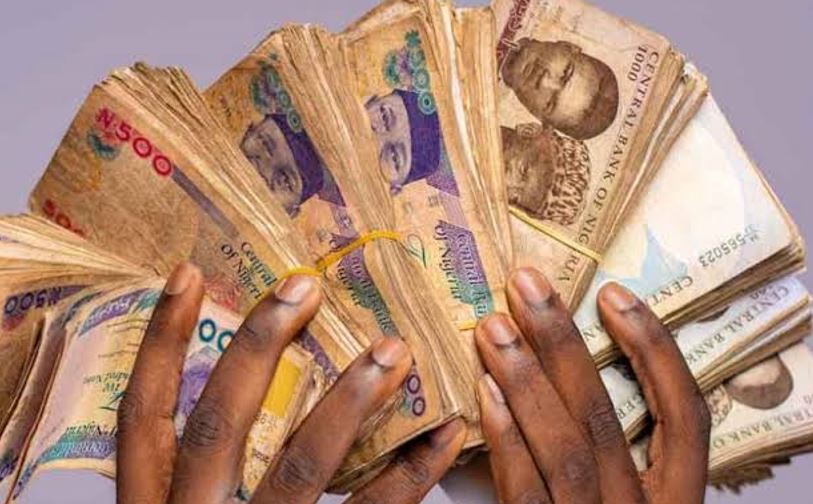
The Naira opened the week stronger against the United States Dollar in the Nigerian Autonomous Foreign Exchange Market (NAFEX) on Monday, March 16, by N8.46 or 0.62 per cent to trade at N1,357.77/$1 compared with the previous session’s N1,366.23/$1.

In the same vein, the local currency appreciated against the Pound Sterling in the same market segment yesterday by N23.45 to quote at N1,789.54/£1 compared with last Friday’s value of N1,812.99/£1, and improved its value against the Euro by N9.72 to N1,558.31/€1 from N1,568.03/€1.

Similarly, the Naira gained N5 against the greenback in the parallel market during the trading session to sell for N1,395/$1 compared with the previous rate of N1,400/$1, and closed flat at the GTBank FX desk at N1,385/$1.

The pressure that piled on the domestic currency appeared to have eased, buoyed by higher oil prices, which have continued to bolster market sentiment.

A report by Coronation Merchant Bank Research said Brent crude prices advanced by 11.16 per cent week-on-week, rising from $91.00 per barrel to close at $101.16 per barrel amid escalating geopolitical tensions in the Middle East.

The bank noted that developments in the region heightened concerns about potential disruptions to global oil supply, increasing volatility in energy markets.

Nigeria recorded modest portfolio inflows as investors sought higher-yielding opportunities, but the inflows helped support liquidity in the FX market and contributed to the Naira’s recovery during the past week.

Also, Nigeria’s inflation cooled to 15.06 per cent in February 2026 from 15.10 per cent in January 2026, data from the National Bureau of Statistics (NBS) showed.

As for the cryptocurrency market, prices continued to weigh the tensions around the Strait of Hormuz — a critical oil shipping route between the Persian Gulf and global markets — appeared to ease slightly.

US President Donald Trump called on other nations to help secure the waterway, while some tankers reportedly have crossed the Strait, suggesting that traffic through the corridor has not been fully disrupted.

This weakened some coins, including Dogecoin (DOGE), which slumped by 1.7 per cent to $0.0998, and Cardano (ADA), which depreciated 1.6 per cent to $0.2832. Binance Coin (BNB) lost 1.5 per cent to sell for $674.25, TRON (TRX) declined by 0.6 per cent to $0.2964, and Solana (SOL) dropped 0.2 per cent to $93.66.

On the flip side, Ripple (XRP) jumped 2.2 per cent to $1.51, Ethereum (ETH) grew by 1.5 per cent to $2,302.08, and Bitcoin (BTC) appreciated by 0.1 per cent to $73,951.40, while the US Dollar Tether (USDT) and the US Dollar Coin (USDC) closed flat at $1.00 each.


Adedapo Adesanya is a journalist, polymath, and connoisseur of everything art. When he is not writing, he has his nose buried in one of the many books or articles he has bookmarked or simply listening to good music with a bottle of beer or wine. He supports the greatest club in the world, Manchester United F.C.

Click to comment

Leave a Reply

Your email address will not be published. Required fields are marked *

Economy

Senate Probes N1.2trn Fuel Subsidy Deductions as NEITI Claims N1.16tn Spent in 2021

Published

on

NEITI

By Adedapo Adesanya

The Senate Public Accounts Committee has heard that Nigeria spent N1.16 trillion on fuel subsidy in 2021, while N1.20 trillion was deducted from federation crude oil sales proceeds during the same period.

The disclosure came from the Chairman of the Revenue Mobilisation Allocation and Fiscal Commission (RMAFC), Mr Mohammed Bello Shehu, during the committee’s ongoing investigation into the 2021 to 2023 Nigeria Extractive Industries Transparency Initiative (NEITI) audit reports on the oil and gas sector.

According to the commission, crude and petroleum product losses cost N16.2 billion, pipeline repairs accounted for N22.05 billion, while strategic stock holding attracted N6.75 billion.

The revelations come against the backdrop of Nigeria’s long-running fuel subsidy regime, which successive governments maintained to keep the pump price of petrol artificially low despite mounting fiscal pressures.

Over the years, subsidy payments consumed trillions of Naira, significantly reducing revenues available to the three tiers of government and contributing to widening budget deficits.

The issue reached a turning point in May 2023 when President Bola Tinubu announced the removal of fuel subsidy during his inauguration speech, declaring that “fuel subsidy is gone.” The decision followed years of concerns over the rising cost of the programme, allegations of fraud, and repeated recommendations by fiscal authorities and international financial institutions that the subsidy had become unsustainable.

The removal triggered a sharp increase in the pump price of Premium Motor Spirit (petrol), leading to higher transportation and living costs across the country. In response, the federal government introduced a series of palliative measures, including cash transfers, support for mass transit, and wage-related interventions, while arguing that savings from the subsidy would be redirected to infrastructure, education, healthcare, and other critical sectors of the economy.

The commission also argued that the current method of calculating the 13 per cent derivation fund undermines the constitutional intention of the policy.

Meanwhile, the committee stood down the Niger Delta Development Commission’s presentation until next Wednesday to allow lawmakers review its submission.

The committee also expressed displeasure over the absence of the Auditor-General of the Federation, warning that he must appear before lawmakers next Tuesday or face compulsory appearance through the constitutional powers of the National Assembly.

Continue Reading

Economy

Nigerian Businesses Expect Naira to Appreciate on Dollar Till January 2027

Published

on

Naira 4 Dollar

By Adedapo Adesanya

Businesses in the country expect the Naira to gradually appreciate against the US Dollar between now and January 2027, according to the Central Bank of Nigeria’s (CBN) July 2026 Business Expectations Survey Report released on Thursday.

The report showed that the Business Confidence Index (BCI) remained positive throughout the review period despite perceived macroeconomic challenges. It noted that all sectors expressed optimism about the economy, with the electricity, gas and water sector posting the highest Business Confidence Index of 59.4 points and the strongest expansion prospects for August 2026.

According to the report, “In July 2026, the Business Confidence Index was 5.7 points, reflecting continued optimistic sentiment among formal businesses.”

It attributed the positive sentiment mainly to increased demand (22.3 per cent), economic diversification (21.4 per cent), and improved access to finance (15.0 per cent). However, respondents identified inflation (27.7 per cent), energy-related challenges (23.4 per cent), insecurity (22.4 per cent), and heightened geopolitical uncertainties (16.5 per cent) as the major factors weighing on business confidence.

On the outlook by broad sector, the central bank said confidence remained positive across all sectors in July. The Industry sector recorded a modest improvement, with its index rising to 11.5 points from 10.5 points, while the Services sector increased to 3.6 points from 2.9 points.

By contrast, the Agriculture sector recorded a significant moderation, with its index falling to 3.4 points from 12.2 points.

Despite this, the apex bank said the six-month outlook remained upbeat, with confidence indices across all sectors indicating positive expectations over the review period.

On the macroeconomic outlook by region, the report noted a divergence in sentiment, with businesses in Northern Nigeria expressing stronger confidence than their Southern counterparts in July. Nevertheless, respondents across all regions maintained positive expectations for August.

Continue Reading

Economy

SEC Engages Abuja Investors on Unclaimed Capital Market Assets

Published

on

Investments and Securities Act 2025

By Aduragbemi Omiyale

A programme, tagged Probate and Unclaimed Monies Awareness and Investor Clinic, has been organised by the Securities and Exchange Commission (SEC).

The event, held on Thursday, August 6, 2026, was put together to educate investors and beneficiaries on how to recover unclaimed monies and inherited investments in the Nigerian capital market.

It is part of a nationwide awareness campaign launched by the capital market regulator in collaboration with Meristem Registrars and Probate Services Limited to improve investor protection, financial literacy and confidence in the capital market.

According to the Director General of the agency, Mr Emomotimi Agama, the campaign is to help investors and beneficiaries understand the procedures for recovering investments due to them while strengthening public confidence in the Nigerian capital market.

Thousands of investors and beneficiaries across the country remain unaware that they may be entitled to unclaimed funds arising from scheme consideration, return monies or inherited investments belonging to deceased relatives, largely because they are unfamiliar with the required documentation and claims procedures.

“Investor protection remains at the heart of the Commission’s mandate. Through this awareness campaign and Investor Clinic, we are bringing regulators and market operators together to help investors and beneficiaries understand the claims process, recover investments due to them and strengthen public confidence in the Nigerian capital market,” the SEC DG stated.

At the programme, participants received one-on-one support from SEC officials, registrars and other capital market professionals on issues relating to unclaimed investments, share ownership, probate, share transmission and beneficiary claims.

Continue Reading