Economy
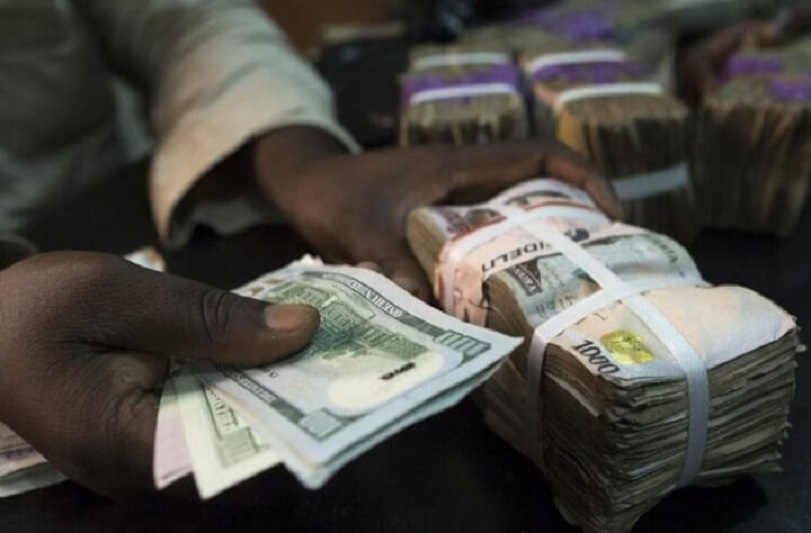
Naira Plunges to N789/$1 at I&E, N872/$1 at Parallel Market
By Adedapo Adesanya
The Naira depreciated heavily against the US Dollar at the Investors and Exporters (I&E) window of the foreign exchange market on Tuesday, August 1, by N32.14 or 4.25 per cent to settle at N789.08/$1, in contrast to the preceding day’s rate of N756.94/$1.
This came as the daily turnover published on FMDQ Securities Exchange witnessed no significant change, with the value of FX transactions marginally growing to $67.33 million from $67.21 million.
Also, in the parallel market, the local currency shed N7 against the Dollar during the trading session to trade at N872/$1 compared with Monday’s exchange rate of N865/$1.
In the same vein, the domestic currency depreciated against the greenback in the Peer-to-Peer (P2P) segment of the forex market, the Nigerian currency lost N5 against its American counterpart yesterday to close at N876/$1 compared with the previous day’s closing value of N871/$1.
Also, in the official segment of the fx market, the Naira depreciated against the British Pound Sterling by N12.93 to sell at N990.69/£1 versus the preceding session’s N977.76/£1 and against the Euro, it weakened by N12.42 to sell at N851.11/€1, in contrast to Monday’s N838.69/€1.
Speaking at the Senate on Tuesday, the Special Adviser to President Bola Tinubu on Monetary Policies, Mr Wale Edun, said the currency will soon begin to appreciate as he warned speculators.
He also said corruption in the country’s exchange-rate system had led to the wide disparity and said that it is now being addressed by President Tinubu.
“As liquidity flows in, the rate will come down,” he said.
As for the digital currency market, it was mixed as investors remain cautious and undecided on where to turn at the moment.
Bitcoin (BTC) rose by 0.1 per cent to sell at $25,787.83, Binance Coin (BNB) gained 1.9 per cent to trade at $245.90, and Litecoin (LTC) appreciated by 0.8 per cent to $93.01.
On the flip side, Ethereum (ETH) shed 0.3 per cent to quote at $1,850.11, Solana (SOL) slumped by 0.9 per cent to $23.60, Cardano (ADA) slid by 0.7 per cent to trade at $0.3069, and Dogecoin (DOGE) declined by 0.2 per cent to $0.0773.
However, the trio of the US Dollar Tether (USDT), Binance USD (BUSD) and Ripple (XRP) traded flat at $1.00, $1.00, and $0.7003, respectively.
Economy
Oil Jumps 5% as Trump Declares Iran Deal Over
By Adedapo Adesanya
Oil prices surged over 5 per cent to a two-week high on Wednesday after US President Donald Trump declared that the interim ceasefire agreement with Iran is officially.
Brent futures rose $4.40 or 5.9 per cent to settle at $78.02 a barrel, while the US West Texas Intermediate (WTI) crude increased by $3.64 or 5.2 per cent to $73.52 per barrel.
The American President said an interim deal signed last month to end the war with Iran was “over” and that the US was likely to launch new strikes on Wednesday night following Iranian attacks on US bases in the Gulf and tankers in the Strait of Hormuz.
Asked before a NATO summit in Turkey whether the memorandum of understanding was over, President Trump said: “It’s a very interesting question. To me, I think it’s over. I don’t want to deal with them.”
He later ruled out the restart of full-fledged war with Iran, which pulled oil benchmarks lower from the session’s highest gains of as much as 9 per cent.
A fifth of global oil supplies moved through the Strait before the Iran war began on February 28 after US-Israeli airstrikes against Iran, which led to retaliation that forced Middle Eastern oil producers to cut millions of barrels of oil production.
Iran on Tuesday attacked three commercial vessels transiting the Strait of Hormuz, prompting retaliatory attacks by the US. A Saudi-flagged LNG tanker was struck on its port side, causing an engine room fire, while the supertanker suffered minor damage off the coast of Oman.
In response, US Central Command (CENTCOM) conducted massive offensive airstrikes hitting more than 80 military targets inside Iran while the Trump administration also revoked a temporary sanctions waiver that allowed Iran to sell oil and petrochemicals, cutting off a key revenue stream for the oil producer.
Freight rates for tankers operating in the Gulf have surged as shipowners demand higher risk premiums, while refiners in Asia are scrambling to secure alternative cargoes from West Africa, the US, and Latin America in case Hormuz remains closed.
The International Monetary Fund (IMF) downgraded its 2026 global economic growth forecast to 3 per cent, down from 3.5 per cent posted in 2025, with the impact of the Iran war expected to negate gains made by the ongoing AI boom.
Economy
IPPG Seeks Harmonised Tax Regime as Members Pay Over 270 Taxes, Levies
By Adedapo Adesanya
The Independent Petroleum Producers Group (IPPG) is pushing for a harmonised tax regime for Nigeria’s oil and gas sector, citing the burden of more than 270 different taxes, fees and statutory levies imposed on operators.
The Chairman of IPPG, Mr Adegbite Falade, stated this in his keynote address at the opening of the 2026 NOG Energy Week in Abuja.
He said a situation where oil firms pay as many as 270 different types of taxes and levies discourages investment and threatens the viability of many projects.
Mr Falade said while recent government reforms have improved investor confidence, the multiplicity of charges imposed by different government agencies risks undermining those gains.
“Today, the Nigerian oil and gas industry remains the most taxed and levied in the country, and perhaps globally, with over 270 separate fees, taxes and levies,” he said.
According to him, the cumulative burden of these charges has begun to outweigh the incentives introduced under the Petroleum Industry Act (PIA), particularly for smaller indigenous operators managing mature oil assets.
He warned that the situation could force some operators to abandon projects, urging the federal government to harmonise the various charges into a transparent and globally competitive fiscal framework.
“We therefore urge the government to undertake a comprehensive harmonisation of all fees and levies across all agencies to eliminate duplication, ensure transparency in how these charges are computed and applied, and align the overall fiscal burden with the incentive-driven spirit of the PIA,” he said.
Beyond fiscal reforms, the IPPG chairman identified an emerging manpower crisis as another major threat to the industry, noting that the retirement of experienced professionals and recent international oil company divestments have created significant skills gaps that require urgent investment in workforce development.
Mr Falade also called for a comprehensive review of the PIA five years after its enactment, to address implementation challenges and incorporate presidential directives that have improved investment conditions.
He stressed that Nigeria must shift its focus from simply increasing crude oil production to creating greater value through refining, gas processing, power generation, fertiliser production and petrochemicals.
According to him, the country’s vast hydrocarbon resources should serve as a catalyst for industrialisation rather than continued exports of raw crude and gas.
While commending the administration’s reforms that have helped secure more than $8 billion in upstream final investment decisions since 2023 and boosted oil production to about 1.6 million barrels per day, Mr Falade maintained that sustainable growth would depend on creating a more competitive operating environment for investors.
Economy
NGX RegCo Lifts Embargo on Trading in Thomas Wyatt Nigeria Shares
By Aduragbemi Omiyale
The embargo earlier placed in the trading of Thomas Wyatt Nigeria shares has been lifted by the Nigerian Exchange (NGX) Regulation Limited.
The regulatory subsidiary of NGX Group lifted the suspension on Monday, July 6, 2026, via a notice signed by Bonaventure Onwuji on behalf of the Head of the Issuer Regulation Department of NGX RegCo.
Investors were earlier prevented from buying and selling equities of the organisation after it failed to submit its relevant financial statements as required by the listing rules.
The embargo was placed on October 31, 2025, in line with the provisions of Rule 3.1: Rules for Filing of Accounts and Treatment of Default Filing, which provides that if an issuer fails to file the relevant accounts by the expiration of the cure period, the exchange will: a) send to the issuer a second filing deficiency notification within two business days after the end of the cure period, b) suspend trading in the issuer’s securities, and c) notify the Securities and Exchange Commission (SEC) and the market within 24 hours of the suspension.
After filing the results with NGX Limited, and pursuant to Rule 3.3 of the Default Filing Rules, which states that the suspension of trading in the issuer’s securities shall be lifted upon submission of the relevant accounts provided the exchange is satisfied that the accounts comply with all applicable rules of the exchange. The exchange shall thereafter also announce through the medium by which the public and the SEC was initially notified of the suspension, that the suspension has been lifted, the suspension was lifted.