Connect with us

Economy

Naira Sells N1,418/$1 at Official Market, N1,480/$1 at Black Market

Published

on

Black Market

By Adedapo Adesanya

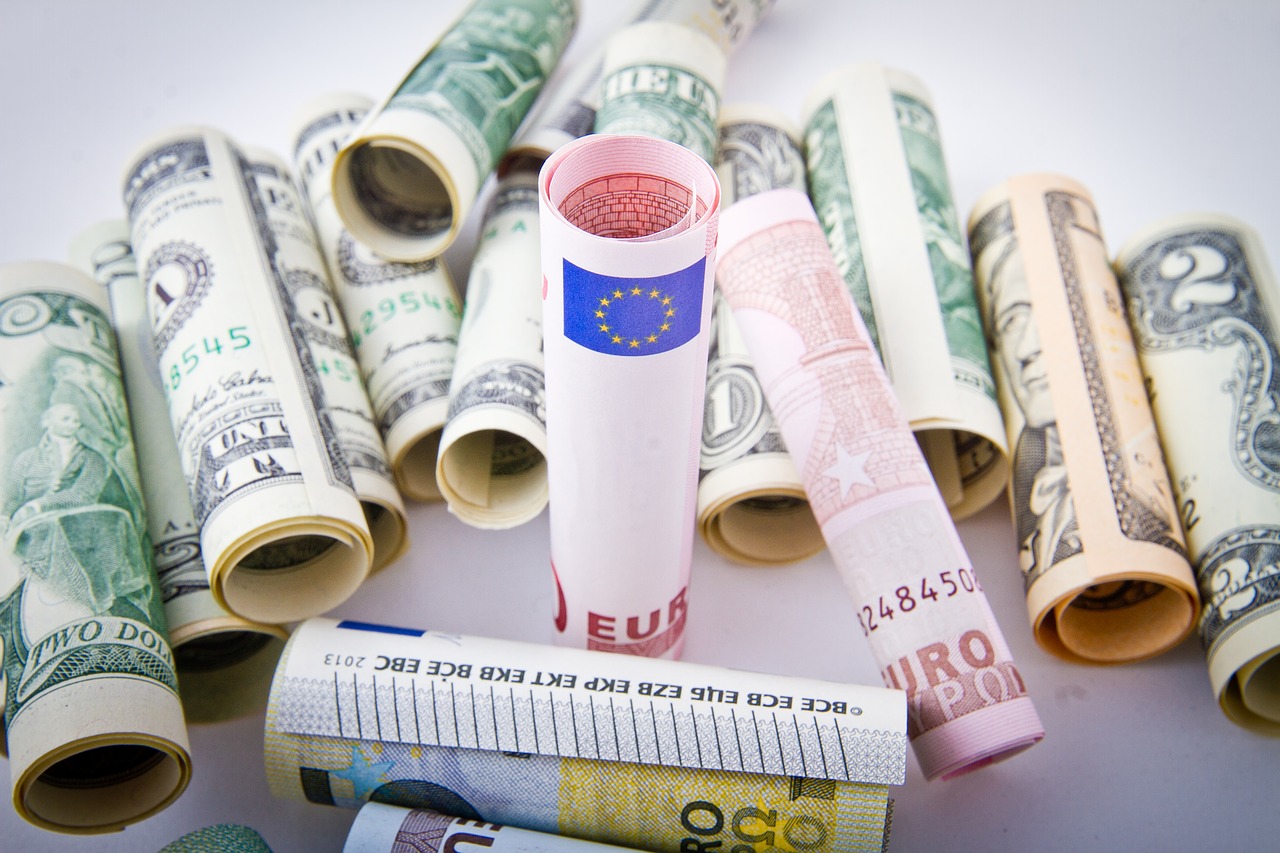
The Naira put up a better performance against United States Dollar in the different segments of the foreign exchange (FX) market on Monday, January 26, though it traded flat at the GTBank forex desk at N1,430/$1 at the close of transactions.

In the black market, the Nigerian Naira improved its value against the US Dollar yesterday by N5 to close at N1,480/$1 compared with the preceding trading day’s value of N1,485/$1. It had maintained stability for several days before appreciating on Monday.

In the Nigerian Autonomous Foreign Exchange Market (NAFEX) window, the domestic currency further gained N2.68 or 0.19 per cent on the greenback to quote at N1,418.95/$1, in contrast to last Friday’s price of N1,421.63/$1.

Equally, the local currency appreciated against the Pound Sterling in the official market by N3.05 to settle at N1,921.12/£1 compared with the previous session’s N1,924.17/£1 and chalked up N3.60 on the Euro to trade at N1,682.31/€1, in contrast to the preceding session’s closing price of N1,669.56/€1.

It has been projected that the Naira will continue to trade at expected range buoyed by improved FX market efficiency, higher capital inflows, a current account surplus, and a broad-based economic recovery. It is thus expected to maintain this momentum in the near-term backed by a favourable supply environment as well as sustained diaspora remittances.

Nigeria’s external reserves have maintained a steady growth trajectory, rising to an eight-year high of $46.01 billion as of January 22, 2025, according to data from the Central Bank of Nigeria (CBN). The last time the country’s foreign currency reserves reached a similar level was on August 24, 2018, when they stood at $46.09 billion.

As for the cryptocurrency market, major tokens closed higher as investors looked ahead of the Federal Reserve decision. However, traders fear that gains may be limited as a weaker Dollar and rising geopolitical uncertainty have fueled gains in equities and precious metals, safer havens than digital assets.

Litecoin (LTC) rose by 2.8 per cent to $69.43, Ethereum (ETH) grew by 2.4 per cent to $2,936.42, Solana (SOL) gained 1.7 per cent to sell at $124.33, Cardano (ADA) increased by 1.6 per cent to $0.3520,Binance Coin (BNB) went up by 1.6 per cent to $883.71, Ripple (XRP) which appreciated by 1.2 per cent to $1.89, Bitcoin (BTC) soared by 0.8 per cent to $88,367.32, and Dogecoin (DOGE) advanced by 0.8 per cent to $0.1223, while the US Dollar Tether (USDT) and the US Dollar Coin (USDC) traded flat at $1.00 each.


Adedapo Adesanya is a journalist, polymath, and connoisseur of everything art. When he is not writing, he has his nose buried in one of the many books or articles he has bookmarked or simply listening to good music with a bottle of beer or wine. He supports the greatest club in the world, Manchester United F.C.

Click to comment

Leave a Reply

Your email address will not be published. Required fields are marked *

Economy

FGN Savings Bond for July 2026 Closes Today

Published

on

FGN Savings Bond

By Dipo Olowookere

Subscription for the July 2026 edition of the FGN savings bond is closing today, Friday, July 10.

The exercise started on Monday, July 6, with two tenures of two years and three years on offer to retail investors.

The retail bonds are sold by the federal government through the Debt Management Office (DMO) to raise funds for the country’s budget deficits.

The savings bond offers investors steady tax-free income. It is risk-free, backed by the Nigerian government, and listed on the Nigerian Exchange (NGX) Limited, allowing for secondary market trading and easy exit before maturity.

For the two-year FGN savings bond maturing on July 15, 2028, the debt office is offering it at a 14.716 per cent per annum interest rate, while the three-year FGN savings bond due July 15, 2029, is at 15.716 per cent per annum, with the interest on the investment being paid by the government every quarter.

Intending investors can purchase the debt instrument at a unit price of N1,000, subject to a minimum subscription of N5,000 and in multiples of N1,000 thereafter, subject to a maximum subscription of N50.0 million.

Continue Reading

Economy

NGX Maintains Upward Trend Despite Profit-taking in Energy Stocks

Published

on

energy stocks

By Dipo Olowookere

The upward trend on the Nigerian Exchange (NGX) Limited continued on Thursday despite profit-taking in energy stocks by investors.

The local exchange further appreciated by 0.62 per cent yesterday, as market participants mopped up equities in the other key sectors, especially in the financial services.

The banking space rose by 1.33 per cent, the consumer goods counter expanded by 1.21 per cent, and the insurance index grew by 0.26 per cent, while the industrial goods segment closed flat, with the energy sector down by 0.19 per cent.

At the close of business, the All-Share Index (ASI) gained 1,498.75 points to finish at 243,958.73 points compared with the previous day’s 242,459.98 points, and the market capitalisation advanced by N962 billion to N156.548 trillion from N155.586 trillion.

The market breadth index remained positive, though the bears are giving the bulls a close marking. Customs Street ended the session with 28 price gainers and 26 price losers, representing strong investor sentiment.

International Breweries improved by 10.00 per cent to N12.10, First Holdco appreciated by 9.96 per cent to N69.55, Abbey Bank grew by 9.88 per cent to N8.90, Trans-Nationwide Express rose by 9.76 per cent to N3.26, and Honeywell Flour increased by 9.68 per cent to N17.00.

Conversely, Thomas Wyatt declined by 10.00 per cent to N2.70, Geregu Power shrank by 10.00 per cent to N825.70, McNichols moderated by 9.76 per cent to N5.55, UPDC slipped by 9.20 per cent to N3.95, and Neimeth contracted by 8.16 per cent to N9.00.

A total of 1.7 billion stocks valued at N112.0 billion were traded in 44,780 deals yesterday, in contrast to the 518.4 million stocks worth N22.8 billion traded in 48,495 deals on Wednesday, indicating a slip in the number of deals by 7.66 per cent, and a surge in the trading volume and value by 227.93 per cent and 391.23 per cent, respectively.

First Holdco was the busiest equity for the day, with a turnover of 1.3 billion units worth N85.6 billion. Zenith Bank exchanged 43.8 million units for N4.7 billion, Access Holdings transacted 41.0 million units valued at N1.0 billion, FCMB traded 17.7 million units worth N188.3 million, and Fidelity Bank sold 16.0 million units valued at N315.2 million.

Continue Reading

Economy

Crude Oil Down 2% as Inflation Fears Eclipse Middle East Risks

Published

on

crude oil wells

By Adedapo Adesanya

Crude oil slid about 2 per cent on Thursday amid worries that rising inflation and other economic concerns could weigh on global oil ​demand despite fresh Middle East tensions.

Brent futures fell by $1.72 or 2.2 per cent to settle at $76.30 a barrel, while the US West Texas Intermediate (WTI) crude went down by $1.44 or 2.0 per cent to $72.08 per barrel.

Iranian armed forces launched attacks on US military infrastructure in Gulf states on Thursday following America’s strikes on its southern coastal and eastern provinces, further straining a three-week-old ceasefire agreement.

This adds to continued supply constraints as the US-Iran conflict has delayed the full reopening of the Strait of Hormuz, where about 20 per cent of global oil supplies passed through the strait ‌before the war.

On Thursday, only one tanker reportedly moved along the waterway, and it was a sanctioned Very Large Crude Carrier (VLCC) that passed along the Iran-controlled route along with an Iranian container ship.

According to Bloomberg, around 14 commodity-carrying vessels had traversed the Strait of Hormuz on Wednesday. In the past three weeks, following the ceasefire deal, the strait saw an average of 34 tanker crossings per day, peaking at 59 on June 24, data from Kpler showed.

Axios reported that the US Administration believes it has more room for escalation as millions of barrels of oil have managed to exit the Strait of Hormuz in recent weeks, easing concerns about oil price spikes.

Qatar, which has often mediated between the US and its adversaries, including Iran, condemned attacks on commercial shipping and called ​for a return to diplomacy. The foreign ministers of Turkey and Oman also stressed the need to avoid further military escalation in calls with their Iranian counterpart, Mr Abbas Araqchi.

Minutes of the US Federal Reserve’s June 16 to 17 meeting showed policymakers’ concerns about inflation mounted last month. When the US central bank boosts interest rates to keep inflation in check, it can reduce economic growth and cut oil demand.

In China, the world’s second-biggest economy behind the US, producer price inflation surged in June to its highest level in four years, piling pressure on manufacturers’ ​profit margins as weak domestic demand limited pricing power.

Continue Reading