Connect with us

Economy

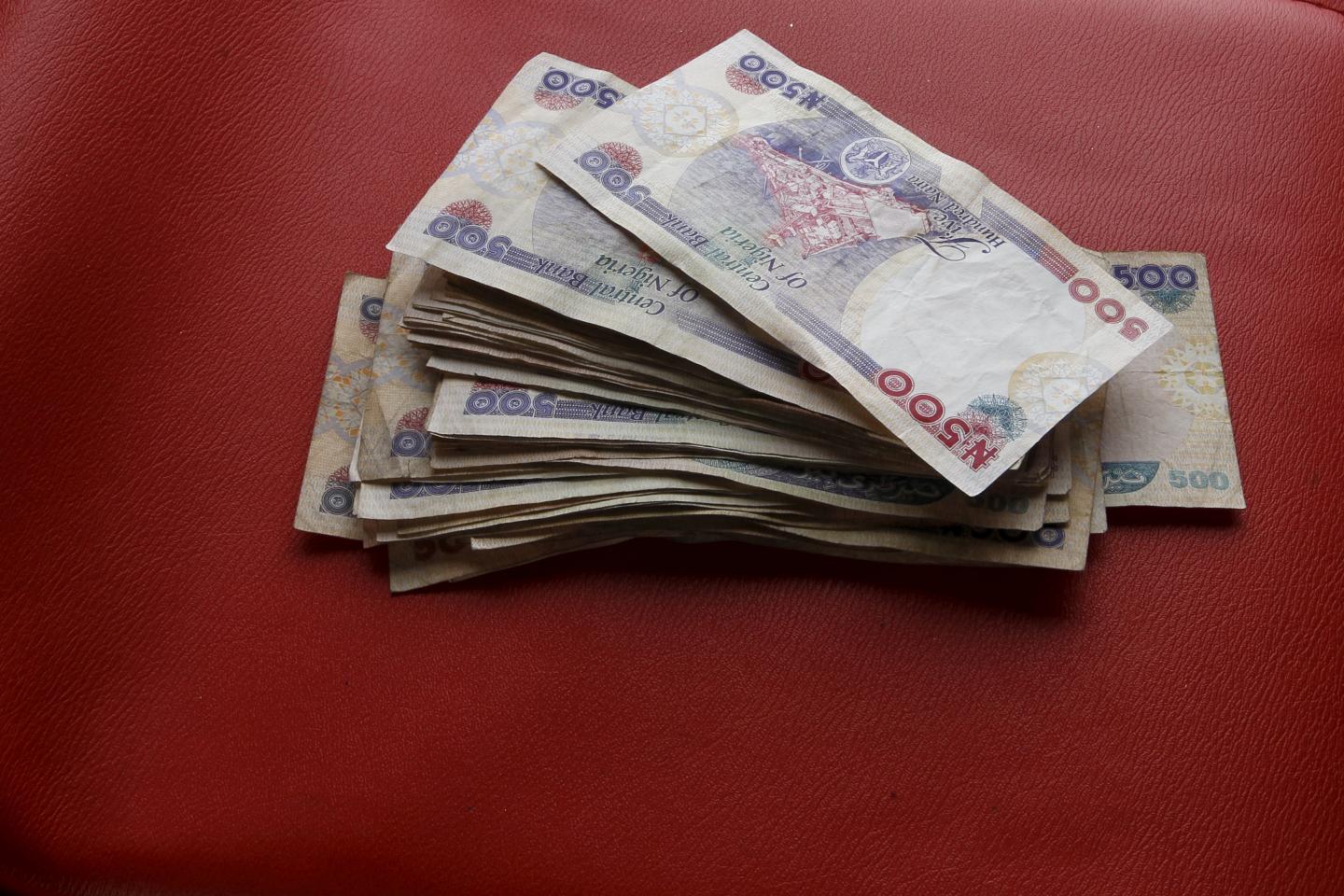
Naira Sells N465/$1 at Black Market Monday After N1 Loss

Published

on

Naira BDC Segment

By Adedapo Adesanya

Traders witnessed the weakening of the Naira by N1 against the US Dollar at the parallel market segment of the foreign exchange market on Monday, November 9.

Business Post reports that at the close of transactions yesterday, the local currency closed at N465/$1 in contrast to the N464/$1 it ended at the last session, which was last Friday.

The Nigerian currency also followed the same trend at the black market against the two other major foreign currencies traded at the segment; the British Pound Sterling and the Euro.

Against the British currency, the Naira lost N2 to close at N598/£1 compared to N596/£1 of the prior session while on the Euro, the Nigerian currency lost N3 to close the day at N543/€1 versus N540/€1.

The local currency, however, recorded a different outcome against the US Dollar at the Investors and Exporters (I&E) window as it appreciated by 33 kobo or 0.09 per cent to close at N385.67/$1 compared to N386/$1 it closed last Friday.

This occurred as there was a drop in value of transactions recorded at the market segment as data from the FMDQ disclosed that forex worth $51.62 million changed hands, lower than the $163.71 million quoted at the previous day by 68.5 per cent or $112.09 million.

At the Bureaux De Change (BDC) segment, data from the Association of the Bureaux De Change Operators of Nigeria (ABCON) showed that the Naira/Dollar exchange rate remained at N386/$1.

Similarly, the exchange rate of the Naira to the United States Dollar remained unchanged at the interbank window at N379/$1 yesterday.

Meanwhile, a look at the cryptocurrency market on Monday showed that the Bitcoin appreciated by 0.3 per cent to N7,108,525.01, while Tron (TRX) gained 0.9 per cent to sell for N11.79.

However, Litecoin (LTC) dropped 2.8 per cent to N27,494.12, Dash (DASH) lost 2.2 per cent to trade at N31,199.99, Ripple (RPX) fell by 0.6 per cent to sell at N116.46, Ethereum (ETH) went down by 0.4 per cent to trade at N208,548.85, while the US Dollar Tether (USDT) lost 0.1 per cent to sell for N461.08.


Adedapo Adesanya is a journalist, polymath, and connoisseur of everything art. When he is not writing, he has his nose buried in one of the many books or articles he has bookmarked or simply listening to good music with a bottle of beer or wine. He supports the greatest club in the world, Manchester United F.C.

Click to comment

Leave a Reply

Your email address will not be published. Required fields are marked *

Economy

How FG, States, LGs Shared N15.8trn Subsidy Savings

Published

on

subsidy savings

By Adedapo Adesanya

The Minister of Finance and Coordinating Minister of the Economy, Mr Taiwo Oyedele, has said from the N15.8 trillion in subsidy savings, N5.4 trillion went to the federal government, and N10.4 trillion was shared between the 36 states and the 774 local governments of the federation between June 2023 and December 2025.

Mr Oyedele disclosed this on Wednesday in Abuja while presenting the federal government’s Nigeria’s Reform Scorecard: The Benefits, Costs and Harms Prevented, an assessment of the economic reforms implemented under President Bola Tinubu.

The finance minister said the N15.8 trillion in subsidy savings was distributed through the Federation Account, rather than being retained entirely by the federal government.

According to him, the central government received N5.4 trillion, representing about 34 per cent of the total savings, the states received N6.5 trillion, or 41 per cent, and the local councils received N3.9 trillion, representing about 24 per cent.

The combined N10.4 trillion allocated to states and local governments accounted for almost two-thirds of the total subsidy savings and was nearly twice the amount received by the federal government.

Mr Oyedele clarified that the N15.8 trillion should not be understood as money accumulated in a dedicated government account labelled “subsidy savings”.

Rather, he said the impact of the reforms was reflected in increased resources available to the federation through higher revenue collections, which were subsequently shared among the three tiers of government through the Federation Account.

The minister said the federal government’s N5.4 trillion share formed only one component of the additional resources available to it during the period.

It also recorded N3.1 trillion in incremental independent revenue, mainly from remittances by government-owned entities, and obtained N11.9 trillion in incremental borrowing.

Together, the three sources provided the federal government with N20.4 trillion in incremental resources between June 2023 and December 2025.

Mr Oyedele said the distribution of the subsidy savings underscored that the reform was not designed simply to increase Federal Government revenue, as a substantial portion of the additional resources accrued to the sub-national governments.

“The reform was never introduced for revenue purposes, but to address entrenched corruption in an artificially managed fuel subsidy and foreign exchange market,” he said.

He added that the federal government subsequently deployed its additional resources, alongside funds from its existing revenue base, to meet N30.64 trillion in incremental expenditure during the period.

Of the N20.4 trillion in incremental resources available to the federal government, borrowing accounted for 58 per cent, subsidy savings for 27 per cent and other revenue for 15 per cent.

The minister said the figures provided a clearer picture of how the financial impact of the subsidy reform was distributed across the Federation, with states and local governments collectively receiving the largest share.

Continue Reading

Economy

NIRSAL Relishes Participation of Non-Interest Banks in Credit Risk Guarantees for Loans

Published

on

NIRSAL guaranteed loan

By Aduragbemi Omiyale

The Nigeria Incentive-Based Risk Sharing System for Agricultural Lending (NIRSAL) Plc has expressed satisfaction with the growing participation of non-interest financial institutions in its credit risk guarantees for loans to farmers, processors, aggregators, exporters and other businesses across multiple agricultural value chains.

The chief executive of the non-bank financial institution created by the Central Bank of Nigeria (CBN) to de-risk agricultural lending in the country, Mr Sa’ad Hamidu, said non-interest lenders accounted for well over 50 per cent of the loans guaranteed by NIRSAL in the first half of 2026.

In 2025, the company guaranteed more than N100 billion to beneficiaries, and according to Mr Hamidu, this figure has already been surpassed in 2026 year-to-date.

Speaking at the AFRACA Masterclass on Inclusive Finance for Climate Resilience and Artificial Intelligence for Financial Services and Agricultural Finance in Lagos, the NIRSAL chief stated that the trend demonstrates what becomes possible when appropriate risk-sharing frameworks create sufficient confidence for different forms of capital to participate in agriculture.

“At NIRSAL, we have always maintained that agriculture, especially in sub-Saharan Africa, is not underfinanced because opportunities do not exist, but because the risks have not been sufficiently understood, measured, appropriately priced, and managed,” Mr Hamidu, represented by the agency’s Executive Director of Operations, Mr Ewaen Imohe, said.

He explained that NIRSAL’s response has been to co-develop systems and financing frameworks that bring greater structure to agricultural value chains, better define and mitigate their risks, and improve financiers’ understanding of the sector and confidence to lend.

The NIRSAL boss described the masterclass as particularly timely, noting that climate change is no longer an abstract global concern but a practical reality confronting farmers, agribusinesses and their financiers every production season across Africa.

The programme’s first major theme, Inclusive Finance for Climate Resilience, exposed participants to the concepts, tools, and approaches required to understand climate risk and develop financeable adaptation and mitigation projects.

For the second major theme, Artificial Intelligence for Financial Services and Agricultural Finance, Mr Hamidu expressed the expectation that participants would move beyond the excitement surrounding AI to examine how it can improve risk understanding, transaction assessment, and financial decision-making in agriculture.

He also pointed to opportunities for technology to complement climate finance, blended finance, grants, and other innovative mechanisms capable of expanding the financial and technical resources available to African agriculture.

On deepening AFRACA-NIRSAL collaboration, he stated that, “AFRACA, for us, is a platform for knowledge, continental exchange, and global insight. On our part, we remain a results-driven source of practical experience for AFRACA member countries.”

Continue Reading

Economy

CSCS Loses N10.30 Per Share to Slash NASD OTC Market Cap by 0.36%

Published

on

ISSA CSCS

By Adedapo Adesanya

The Central Securities Clearing System (CSCS) Plc weakened the NASD Over-the-Counter (OTC) Securities Exchange by 0.36 per cent on Wednesday, August 19, slicing the market capitalisation of the platform by N9.41 billion to N2.60 trillion from N2.610 trillion, and reducing the NASD Security Index (NSI) by 15.67 points to 4,333.09 from 4,348.76 points.

The securities depository company lost N10.30 at midweek to close at N88.12 per share versus Tuesday’s closing price of N90.02 per share.

This offset the 38 Kobo gained by Golden Capital Plc during the session. The stock traded at N14.05 per unit compared with the preceding day’s N13.67 per unit.

Yesterday, the volume of securities soared by 557.2 per cent to 747,429 units from 113,728 units, the value of securities jumped by 934.0 per cent to N9.4 million from N375.7 million, and the number of deals increased by 35.5 per cent to 42 deals from 31 deals.

Great Nigeria Insurance (GNI) Plc remained the most active stock by value on a year-to-date basis, with 3.4 billion units valued at N8.4 billion, trailed by Infrastructure Credit Guarantee (Infracredit) Plc with 2.3 billion units exchanged for N6.5 billion, and CSCS Plc with 79.9 million units worth N5.8 billion.

GNI Plc also finished the session as the most traded stock by volume on a year-to-date basis, with 3.4 billion units transacted for N8.4 billion, followed by Infracredit Plc with 2.3 billion units traded for N6.5 billion, and Resourcery Plc with 1.1 billion units sold for N415.7 million.

Continue Reading