Connect with us

Economy

Naira Sheds 0.09% at Investors FX Window

Published

on

FX Window

By Adedapo Adesanya

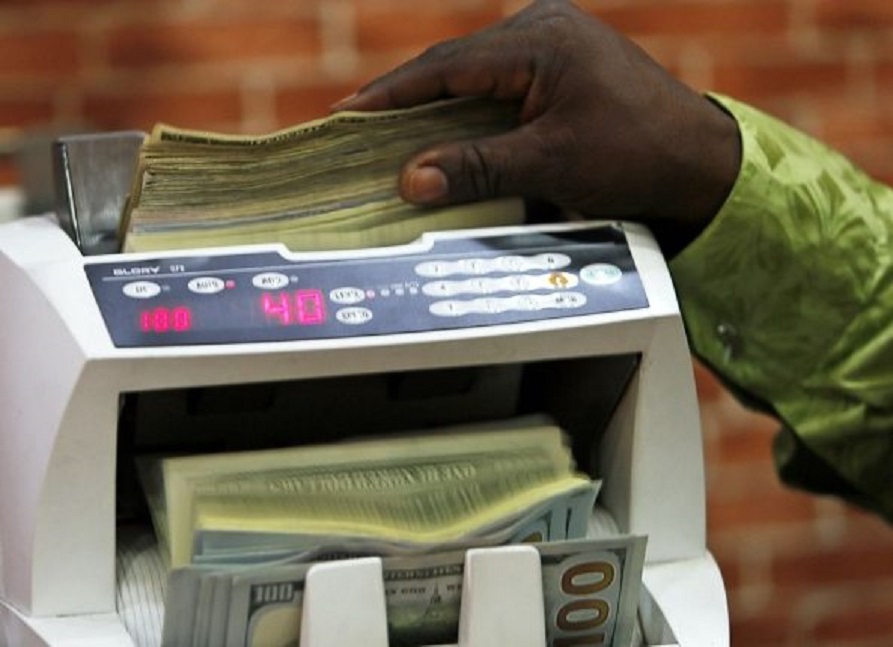
The Naira depreciated against the US Dollar at the Investors and Exporters (I&E) window of the foreign exchange market by 0.09 per cent or 38 Kobo on Monday, August 22.

Data from the FMDQ Securities Exchange showed that the exchange rate of the Naira to the Dollar stood at N429.43/$1 yesterday compared with last Friday’s value of N429.05/$1.

This depreciation occurred amid a significant rise in the demand for forex at the investors’ FX window, with many business owners making efforts to jostle for the few available in the system.

The turnover for the session stood at $161.94 million, 222.5 per cent or $111.72 million higher than the $50.22 million achieved at the preceding trading day.

However, the local currency gained strength against its American counterpart in the Peer-to-Peer (P2P) segment of the market, appreciating by N1 to sell for N699/$1 compared with the previous day’s N700/$1.

Also, the domestic currency appreciated against the British Pound Sterling at the interbank segment by 14 Kobo yesterday to sell for N498.42/£1 in contrast to last Friday’s exchange rate of N498.56/£1 and against the Euro, it gained N5.86 to close at N421.96/€1 versus N427.82/€1 of the preceding session.

Meanwhile, in the parallel market, the Nigerian currency lost N2 against the greenback on Monday to sell for N686/$1 compared with the previous session’s N684/$1.

In the cryptocurrency market, transactions remained bearish, with Solana (SOL) losing 2.5 per cent to sell at $35.33 and Shiba Inu (SHIB) recording a 1.4 per cent drop to trade at $0.00001318.

Bitcoin (BTC) fell by 0.9 per cent to trade for $21,283.29, Ripple (XRP) went lower by 0.3 per cent to $0.3395, Dogecoin (DOGE) followed with a 0.2 per cent fall to trade at $0.0685 while the United States Dollar Tether (USDT) slid by 0.01 per cent to trade at $0.9999.

But Litecoin (LTC) appreciated by 2.5 per cent to quote at $56.01, Binance Coin (BNB) improved by 0.5 per cent to $299.41, Ethereum (ETH) rose by 0.4 per cent to sell at $1,611.96, while Cardano (ADA) recorded a 0.04 per cent gain to sell at $0.457.


Adedapo Adesanya is a journalist, polymath, and connoisseur of everything art. When he is not writing, he has his nose buried in one of the many books or articles he has bookmarked or simply listening to good music with a bottle of beer or wine. He supports the greatest club in the world, Manchester United F.C.

1 Comment

Leave a Reply

Your email address will not be published. Required fields are marked *

Economy

FG to Issue Fresh N729bn Bond to Clear Verified GenCos’ Debts

Published

on

Nigerian Eurobonds

By Adedapo Adesanya

The federal government will soon issue a fresh N729 billion bond to settle verified legacy debts owed to electricity generation companies (GenCos), marking another major step in its plan to restore liquidity and financial stability across Nigeria’s power sector.

The bond forms the second tranche of the first phase of the N4 trillion Presidential Power Sector Debt Reduction Programme and follows the successful issuance of about N501 billion in January 2026. Combined, both issuances make up the N1.23 trillion Series 1 and Series 2 components of the Capital Market Multi-Instrument Issuance Programme.

The initiative is part of the federal government’s broader strategy to clear longstanding payment obligations in the Nigerian Electricity Supply Industry (NESI), strengthen investor confidence and improve the financial health of the electricity value chain.

The chief executive of the Nigerian Bulk Electricity Trading Plc (NBET), Mr Johnson Akinnawo, said the forthcoming bond issuance represents the first phase of the wider N4 trillion programme approved by President Bola Tinubu to address verified legacy liabilities in the power sector.

“The second issuance demonstrates the Federal Government’s commitment to resolving verified legacy obligations through a transparent, structured and market-based mechanism,” Mr Akinnawo said.

He explained that the January 2026 bond issuance reflected the government’s fiscally responsible approach to settling outstanding obligations owed to GenCos while improving liquidity within the electricity market and strengthening the long-term sustainability of the sector.

According to him, the new bond will further reinforce confidence among investors and provide much-needed financial relief to market participants whose operations have been constrained by accumulated debts.

“By improving liquidity across the electricity value chain, the programme will help strengthen the financial position of market participants, support new investment and promote sustainable electricity generation for the benefit of Nigerians,” he stated.

Mr Akinnawo recalled that the Federal Executive Council (FEC) approved the establishment of the N4 trillion Presidential Power Sector Debt Reduction Programme in 2025, with NBET designated as the sponsoring institution responsible for coordinating the settlement of verified legacy obligations across the electricity industry.

He explained that the debt reduction programme is being implemented through multiple issuances of debt instruments by NBET Finance Company Plc, a Special Purpose Vehicle (SPV) established specifically to execute the programme.

According to him, the debt instruments are backed by the full faith and credit of the federal government and supported by comprehensive risk mitigation measures designed to ensure successful implementation and attract investor participation.

“The programme has the full backing of the federal government and incorporates a robust suite of instruments designed to mitigate transaction risks and support successful execution,” the NBET boss said.

He noted that the issuance of the approximately N729 billion bond would represent another decisive milestone in resolving longstanding financial obligations that have weighed on the electricity market for years.

Mr Akinnawo added that clearing the outstanding debts would strengthen the financial position of electricity generation companies, improve liquidity throughout the power value chain and create a more stable, bankable and investment-friendly electricity market capable of supporting Nigeria’s economic growth and expanding reliable electricity supply.

Continue Reading

Economy

e-Invoicing: NRS Begins Compliance Monitoring for Large Taxpayers

Published

on

NRS nigeria large taxpayers

By Modupe Gbadeyanka

The Nigeria Revenue Service (NRS) has announced the commencement of compliance monitoring activities for large taxpayers under the National e-Invoicing and Electronic Fiscal System (EFS) regime.

A statement issued on Monday and signed by the agency’s chairman, Mr Zacch Adedeji, advised corporate organisations that have yet to adopt this system to do so on or before July 31, 2026.

Recall that on February 17, 2026, NRS issued an implementation timeline for the mandatory adoption of the EFS, also known as the Merchant Buyer Solution (MBS), by large taxpayers.

They were asked to complete the process of onboarding, integration, testing, and commence invoice transmission to the NRS e-invoicing platform in accordance with the prescribed implementation framework.

The compliances include the completion of onboarding on the NRS MBS; the successful integration of taxpayer systems through approved Access Point Providers (APPs) and/or Systems Integrators (SIS); the completion of all required validation and testing activities; the active transmission of invoices to the NRS e-invoicing platform in line with approved standards and guidelines; and the receipt of only compliant e-invoices with a valid Invoice Reference Number (IRN) from suppliers.

Ahead of the deadline, the NRS has commenced compliance monitoring activities to assess the level of adherence to the e-invoicing mandate across the large taxpayer segment.

Those that have not completed the process have been asked to conclude all outstanding onboarding and integration activities and commence invoice transmission before the compliance deadline.

The organisation warned that failure to comply would trigger regulatory and enforcement actions in accordance with the provisions of the relevant tax laws and regulations.

Continue Reading

Economy

Operational Challenges Shrink Transcorp Power H1 2026 Earnings, Profit

Published

on

Transcorp Power

By Aduragbemi Omiyale

Transcorp Power Plc suffered declines in its revenue and profit in the first half of this year; details of the company’s financial statements for the period ended June 30, 2026, have revealed.

The losses were attributed to recurring transmission line vandalism, which materially constrained the organisation’s ability to evacuate available generation capacity.

Business Post reports that earnings contracted in the first six months of this year to N181.97 billion from the N205.81 billion recorded in the same period of last year, while profit before tax moderated to N54.99 billion from N58.73 billion.

However, on a year-to-date basis, total assets went up to N619.02 billion from N563.48 billion in December 2025, as shareholders’ funds grew to N189.34 billion from N183.40 billion in FY 2025, while retained earnings soared to N140.90 billion from N123.41 billion in FY 2025.

It was observed that the increase in receivables and borrowings largely drove the expansion in the balance sheet during the period.

Also, the firm’s gross margin expanded to 38.4 per cent from 34.7 per cent in H1 2025, operating margin increased to 30.6 per cent from 28.5 per cent, and PBT margin rose to 30.2 per cent from 28.5 per cent, reflecting cost optimisation efforts and disciplined financial management, positioning the company to continue delivering sustainable value for shareholders.

“Our H1 2026 performance is a reflection of the resilience of our business operations despite significant sector-wide existential challenges.

“Regrettably, recurring transmission line vandalisation materially constrained our ability to evacuate available generation capacity.

“Nonetheless, we continued to deliver strong profitability, maintain operational efficiency, and strengthen our balance sheet,” the chief executive of Transcorp Power, Mr Peter Ikenga, stated.

“We remain committed to working with relevant stakeholders to put an end to transmission line vandalisation and to further improving operational performance, power generation supply reliability, and creating sustainable value for our shareholders. We remain highly confident that we will recover lost ground in H1 2026 and finish FY 2026 stronger than FY 2025,” he added.

Continue Reading