Economy
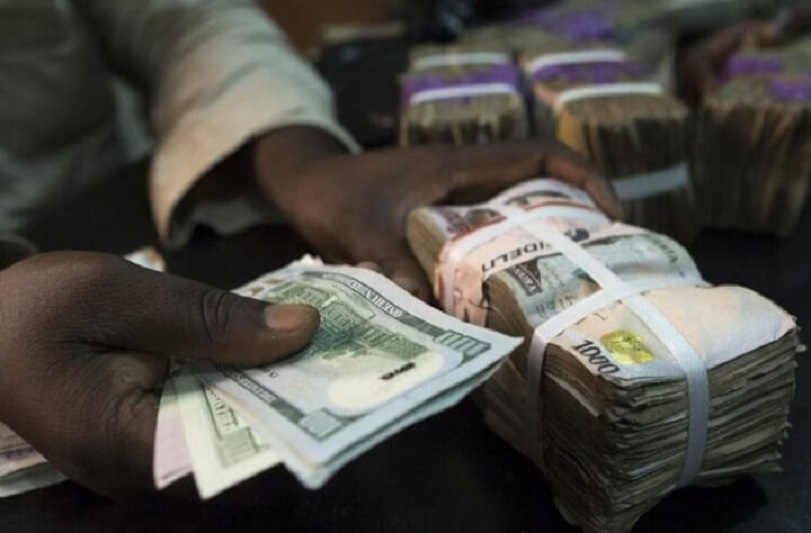
Naira Strengthens to N1,522/$1 at NAFEM, N1,640/$1 at Black Market
By Adedapo Adesanya
The Naira appreciated against the US Dollar at the Nigerian Autonomous Foreign Exchange Market (NAFEM) on Tuesday amid a continued signal from the Central Bank of Nigeria (CBN) to support the market, with plans to clear all pending foreign exchange backlogs after the completion of a forensic audit on forex claims.
Also, the new FX code sets standards to strengthen and promote the integrity and effective functioning of the wholesale foreign exchange (FX) market in Nigeria holistically.
As a result, the value of the domestic currency improved against the greenback during the session by N10.95 or 0.71 per cent to sell for N1,522.68/$1, in contrast to Monday’s closing price of N1,533.63/$1.
In the same vein, the local currency appreciated against the Pound Sterling at the official market on Tuesday by N17.07 to trade at N1,899.58/£1 versus the preceding day’s N1,916.65/£1, and against the Euro, it gained N19.15 to sell for N1,593.04/€1 compared with the previous session’s N1,916.65/€1.
Equally, in the parallel market, the Nigerian Naira strengthened against the Dollar during the session by N10 to quote at N1,640/$1 compared with Monday’s closing price of N1,650/$1.
Meanwhile, the cryptocurrency market was largely negative as traders continued to face the shivers of DeepSeek AI changing the operations of the industry.
The weekend release of the Chinese startup, which was cheaper, challenged US leadership in AI and technology.
Solana (SOL) slumped by 4.0 per cent to trade at $231.76, Ethereum (ETH) slid by 2.1 per cent to close at $3,142.18, Litecoin (LTC) fell by 2.0 per cent to $113.85, Dogecoin (DOGE) recorded a value depreciation of 1.7 per cent to sell at $0.3302, Cardano (ADA) went down by 1.5 per cent to $0.9447, Binance Coin (BNB) depreciated by 0.5 per cent to $678.20, Bitcoin (BTC) retreated by 0.4 per cent to close at $102,514.80, and Ripple (XRP) declined by 0.1 per cent to $3.11, while the US Dollar Tether (USDT) and the US Dollar Coin (USDC) traded flat at $1.00 each.
Economy
NUPRC Allocates 61.9 million Barrels of Crude Oil to Dangote, Others
By Aduragbemi Omiyale
About 61.9 million barrels of crude oil were allocated to domestic refineries, including Dangote Petroleum Refinery, in the first quarter of 2026.
This information was revealed by the Nigerian Upstream Petroleum Regulatory Commission (NUPRC) in a statement by its Head of Media and Corporate Communication, Mr Eniola Akinkuotu, on Tuesday.
In the statistics on the enforcement of the Domestic Crude Supply Obligation (DCSO) for the quarter under review, it was emphasised that producers collectively offered a higher volume of 68.7 million barrels, but actual supply to local refineries was 28.5 million barrels, translating to a supply conversion rate of 36-46 per cent between January 2026 and March 2026.
A breakdown of the DCSO month by month reveals that in the month of January, following consultations with stakeholders, including crude oil producers, the commission mandated producers to supply 22.6 million barrels to the local refiners.
Producers exceeded expectations, offering 25.3 million barrels, representing a rise of 11.9 per cent, or an additional 2.7 million barrels, in the month. However, 9.2 million barrels were ultimately supplied to local refiners.
In February, the agency, in discharging its DCSO, allocated 20.5 million barrels to local refineries, but producers offered slightly less at 19.8 million barrels, missing the target by 700,000 barrels. Actual supply was down at 9.1 million barrels.
In March, there was a modest improvement in deliveries, which rose to 10.1 million barrels, up from 9.2 million barrels in January and 9.1 million barrels in February. During the same period, DCSO allocations stood at 18.8 million barrels, while producers offered a significantly higher 23.6 million barrels, representing an excess of 4.8 million barrels or 25.5 per cent.
It was stated that the shortfall between volumes offered and actual deliveries was primarily due to pricing gaps between producers and domestic refiners.
According to NUPRC, the current framework operates on a “willing buyer, willing seller” basis, which continues to shape transaction outcomes.
Despite these developments, the commission reaffirmed its commitment to achieving the government’s objective of energy sufficiency.
“Leveraging the framework of the PIA, 2021, the commission aims to sustain recent gains in crude oil production while continuously refining the DCSO methodology to enhance transparency, efficiency, and ensure that local refineries are supplied as committed,” the statement said.
Economy
Nigeria Must Shift From Stabilisation to Growth Acceleration—Wale Edun
Nigeria’s economy is entering a critical phase, moving from stabilisation into what the Federal Government describes as ‘growth acceleration’, according to the former Minister of Finance and Coordinating Minister of the Economy, Wale Edun, during his keynote delivery at the Nigeria Business Summit convened by Stanbic IBTC.
In his keynote address, Edun said recent macroeconomic reforms had begun to stabilise the economy but cautioned that current growth levels remain inadequate to deliver broad‑based prosperity.
“For nearly a decade, our GDP averaged around two per cent,” Edun said. “We have now moved into a new phase where growth is closer to four per cent, supported by macroeconomic reforms. This is an important improvement, but it is still below the level required to move Nigerians out of poverty in their millions.”
Reforms have strengthened resilience
Edun noted that Nigeria is navigating a renewed global economic shock at a sensitive point in its reform journey. However, he argued that the effects have been softened by reforms introduced since May 2023.
“These shocks would have been far more severe without the comprehensive reforms that have been put in place,” he said, citing stronger external reserves, improved non‑oil revenue performance, and returning investor confidence across domestic and foreign markets.
According to the former Minister, Nigeria is now better positioned to absorb shocks “through price adjustments, investment reallocation, and expanded trade opportunities across Africa and globally”, creating a more predictable environment for business planning and capital deployment.
Enterprises across the value chain must drive inclusive growth
The central theme of the address was the role of enterprises across the value chain in driving inclusive growth. While Edun described small and medium‑scale enterprises (SMEs) as the backbone of the economy, accounting for over 90 per cent of businesses and the majority of employment, he also highlighted the importance of large corporates in building productive and resilient ecosystems.
“Their growth is central to inclusive development,” he said of SMEs. “If we want growth that creates jobs and reduces poverty, then SMEs must be supported deliberately.”
He stressed that this support must translate into practical outcomes, including access to appropriate financing, improved processes, and stronger integration into value chains. For large organisations, he noted, scaling productive capacity and strengthening supplier networks is equally critical.
Productivity and trade as growth enablers
Edun highlighted the National Single Window Initiative as a reform focused on execution and productivity. “Government revenue will increase, not because of higher charges, but because of increased volumes through productivity,” he said.
He emphasised that Nigeria’s long‑term growth will depend on its ability to compete beyond its borders, noting that trade will remain a key driver of diversification and foreign exchange earnings.
“Our true potential does not lie only in our large domestic market,” Edun said. “It lies in becoming a leading exporting economy.”
Partnership and shared responsibility
The former Minister was clear that the government cannot deliver transformation alone.
“Government cannot drive transformation alone,” Edun said. “Its role is to maintain stability, implement predictable policies, and remove structural and bureaucratic constraints to investment.”
Achieving Nigeria’s ambition of building a one‑trillion‑Dollar economy, he added, will require collaboration between government, large corporates, financial institutions, and SMEs.
In closing, Edun delivered a clear signal to investors and businesses.
“Nigeria is open for business. Nigeria is ready for investment, and Nigeria is committed to building an economy that works for all and delivers shared prosperity.”
As discussions continue at the summit, the message is clear. The next phase of growth will favour businesses that are well‑structured, productive, and positioned to scale. Stanbic IBTC continues to support SMEs and large corporates across key sectors, providing financing, advisory, transaction banking, and trade solutions aligned to different stages of business growth.
Businesses seeking to scale operations, strengthen value chains, or expand into regional and global markets are encouraged to engage with Stanbic IBTC to explore solutions aligned with their growth ambitions.
Economy
NNPC Remits N2.89trn to Federation Account in Three Months
By Adedapo Adesanya
The Nigerian National Petroleum Company (NNPC) Limited remitted a total of N2.89 trillion to the Federation Account in the first quarter of 2026.
The state-owned oil company also added that its revenue rose to N2.774 trillion (up by 3.51 per cent from the February 2026 report) and that it made a profit after tax of N276 billion (up by approximately 102.94 per cent from February 2026).
These were contained in the company’s latest operational performance summary for March 2026, released on Monday.
According to the report, the country’s official crude oil and condensate output rose to 1.56 million barrels of oil per day while gas production climbed to 7,731 million standard cubic feet per day, representing increases of approximately 3.31 per cent and 3.66 per cent respectively, compared with the February 2026 report.
It added that gas production for the month reached its highest level in the trailing 12-month period covered by the report.
According to the statement, its Upstream pipeline availability was 76 per cent. This measures the readiness as well as operational status of pipelines that transport raw natural gas or crude oil from production sites to terminals or transmission pipelines.
The report read in part: “We also highlight key milestones, including the early completion of the OML 118 Bonga Turnaround Maintenance, delivered 12 days ahead of schedule, as well as the completed welding of the 24″ spur line to the Gwagwalada Independent Power Plant on the Ajaokuta-Kaduna-Kano (AKK) Gas Pipeline, with drilling operations on the Obiafu-Obrikom-Oben (OB3) Gas Pipeline River Niger Crossing continuing as scheduled.”
-
Feature/OPED6 years agoDavos was Different this year
-
Travel/Tourism10 years ago
Lagos Seals Western Lodge Hotel In Ikorodu
-
Showbiz3 years agoEstranged Lover Releases Videos of Empress Njamah Bathing
-
Banking8 years agoSort Codes of GTBank Branches in Nigeria
-
Economy3 years agoSubsidy Removal: CNG at N130 Per Litre Cheaper Than Petrol—IPMAN
-
Banking3 years agoSort Codes of UBA Branches in Nigeria
-
Banking3 years agoFirst Bank Announces Planned Downtime
-
Sports3 years agoHighest Paid Nigerian Footballer – How Much Do Nigerian Footballers Earn