Economy
Naira Suffers Crash Against Dollar Despite Forex Supply
By Modupe Gbadeyanka
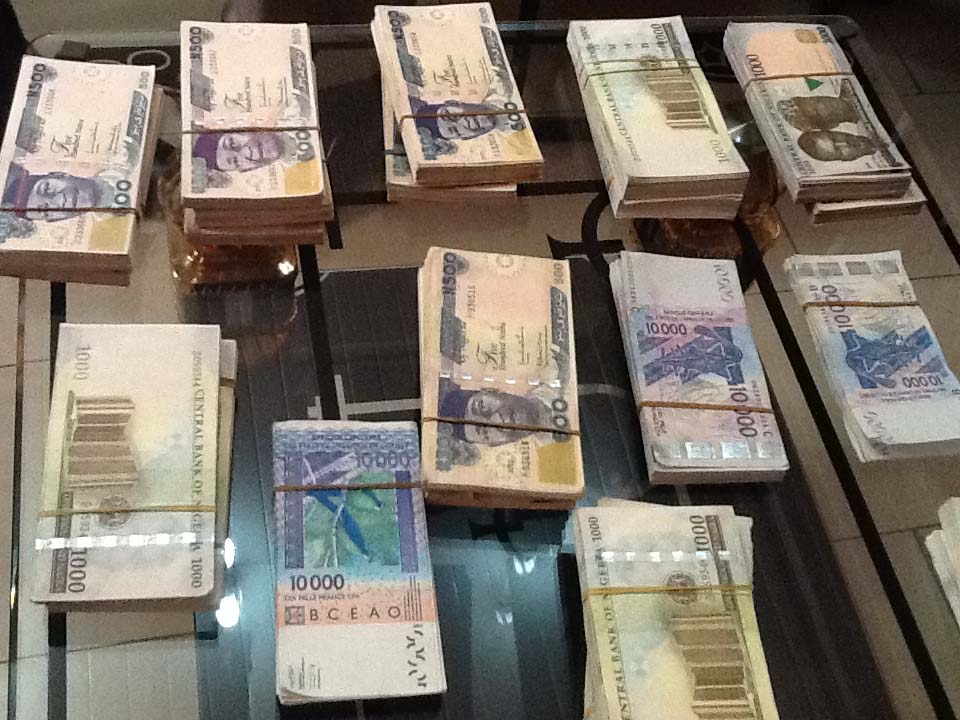
It was very bad day for the Naira yesterday at the parallel market segment of the foreign exchange (forex) market.
This was despite the $210 million injected into the interbank forex market on Monday by the Central Bank of Nigeria (CBN).
The intervention was aimed at sustaining the flow of Dollar at the forex market so as not to pile up more pressure on the Naira.
A total of $100 million wired to the wholesale market by the apex bank yesterday, while $55 million was sent to cater for small businesses, and $55 million was given to the invisibles, which cover school fees, travels, and medical bills.
But despite this intervention by the central bank, the Naira depreciated at the close of business yesterday at the black market.
Business Post reports that the Dollar opened at N363 on Monday morning, the same rate it closed last Friday, but lost N1 in the afternoon, closing in the evening at N364.
Also, the local currency started the day on a bad note against the Pound Sterling, opening at N486 in the morning in contrast to N485 it traded last Friday. By the close of business for the day, it was transacted at N486 per Pound.
In the same vein, the Nigerian currency lost a total of N2 against the Euro on Monday, trading at N432 in the morning against N431 it was sold last Friday and by afternoon, it was exchanged at N433 to the Euro, eventually closing at the same rate it was sold in the afternoon.
Economy
Freight Forwarders Seek Wider Sensitisation on Green Tax, Others
By Modupe Gbadeyanka
The Africa Association of Professional Freight Forwarders and Logistics of Nigeria (APFFLON) has appealed to the Nigeria Customs Service (NCS) to deepen its sensitisation on the newly introduced Green Tax Surcharge Policy.
The chairman of APFFLON, Mr Akeem Ayobiojo, made this plea on behalf of his colleagues on Tuesday, July 14, 2026, at the Customs House in Abuja, during a stakeholders’ engagement with the agency.
He also called for improvements in the administration of Pre-Arrival Assessment Reports and Post Clearance Audit and the African Continental Free Trade Area (AfCFTA).
Mr Ayobiojo stated that freight forwarders were happy to work with the customs, commending the organisation for implementing Chapter 99, describing it as a major relief for manufacturers.
He, however, emphasised that a deeper understanding of the new tax was necessary for his members, saying more predictable procedures would reduce delays and unexpected costs for importers and freight forwarders.
In his remarks, the Comptroller-General of Customs, Mr Adewale Adeniyi, assured manufacturers, freight forwarders and other players in the nation’s trade sector that the NCS would continue to engage them on fiscal policies affecting their businesses, saying sustained dialogue remains key to resolving implementation challenges and improving the country’s trading environment.
He also promised them the service’s resolve to enhance and facilitate trade, acknowledging that, “Your feedback is important because it helps us understand what is happening in the field, and where necessary, we will take your concerns to the Federal Ministry of Finance and other relevant government institutions.”
Speaking about Authorised Economic Operator (AEO), Mr Adeniyi further explained that Nigeria would not lower the standards required under the Authorised Economic Operator Programme as the initiative is guided by global benchmarks established by the World Customs Organisation (WCO).
On her part, the Deputy Comptroller-General of Customs for Tariff and Trade, Ms Caroline Niagwan, clarified that electric vehicles can be imported without payment of duty only by holders of Import Duty Exemption Certificate (IDEC) issued by the Federal Ministry of Finance.
She also urged importers facing classification disputes to take advantage of the Advance Ruling system, noting, “Once an Advance Ruling is issued based on genuine documentation, importers have certainty on classification, valuation or origin before the goods arrive, thereby reducing unnecessary disputes during clearance.”
Economy
Naira Firms to N1,380/$ as FX Market Rally Continues
By Adedapo Adesanya
The Naira appreciated against the US Dollar in the Nigerian Autonomous Foreign Exchange Market (NAFEX) on Friday, July 17, by N1.35 or 0.07 per cent to N1,380.18/$1 from N1,381.53/$1.
It also improved its value against the Pound Sterling in the same market segment during the session by N11.75 to trade at N1,854.42/£1 compared with the previous day’s N1,866.17/£1, and gained N5.69 against the Euro to sell at N1,576.99/€1 versus Thursday’s closing price of N1,582.68/€1.
In the same vein, the Naira chalked up N1 against the United States currency yesterday at the GTBank forex desk to quote at N1,388/$1, in contrast to the preceding day’s N1,389/$1, but closed flat at the black market at N1,405/$1.
The appreciation of the Nigerian currency on Friday came amid fresh signals that Nigeria is building its external reserves for protection against shocks and excessive currency volatility.
The Governor of the Central Bank of Nigeria (CBN), Mr Yemi Cardoso, said the country’s gross reserves had risen above approximately $52 billion by 15 July, while net reserves had increased from about $3 billion when the current CBN leadership took office to more than $40 billion.
Mr Cardoso linked the increase in reserves to reforms that had restored greater confidence in the foreign exchange system. He also pointed to efforts to diversify foreign currency inflows, including policies designed to increase remittances through official channels.
He noted that monthly diaspora remittances had risen above $600 million and the CBN expected them to reach approximately $1 billion by the end of 2026. The target is part of a broader effort to grow reserves through recurring inflows rather than temporary measures.
The improvement, he argued, had strengthened Nigeria’s capacity to respond when unexpected events threatened market stability.
The apex bank has also launched a new digital platform that will track every foreign exchange transaction involving Bureau De Change (BDC) operators, marking a major step in its efforts to improve transparency and strengthen oversight of Nigeria’s retail forex market.
As for the crypto market, prices were up as markets overlooked geopolitical developments and macro forces weighing on the whole market ecosystem rather than anything crypto-specific, with Cardano (ADA) up by 4.6 per cent to $0.1661.
Bitcoin (BTC) jumped by 1.8 per cent to $63,968.32, Ethereum (ETH) improved by 0.9 per cent to $1,843.88, Dogecoin (DOGE) also rose by 0.9 per cent to $0.0723, Solana (SOL) soared by 0.6 per cent to $74.90, Ripple (XRP) also appreciated by 0.6 per cent to $1.08, and Binance Coin (BNB) advanced by 0.1 per cent to $567.32.
However, TRON (TRX) depreciated by 0.2 per cent to close at $0.3218, while the US Dollar Tether (USDT) and the US Dollar Coin (USDC) remained unchanged at $1.00 each.
Economy
Brent Climbs to $88 as Middle East Conflict Fuels Supply Fears
By Adedapo Adesanya
The prices of the crude oil grades rose Friday, as fighting between the US and Iran continued in the Middle East, leading to further attacks in Bahrain, Jordan, Kuwait, Oman, Qatar and Syria.
Brent crude futures advanced by about 4.6 per cent to $88.10 per barrel, while the US West Texas Intermediate (WTI) futures gained about 4.5 per cent to settle at $82.49 per barrel.
US forces stepped up attacks on Iranian sites, reportedly striking key bridges, railways, and an airport, prompting retaliatory action by Iran.
US Central Command said that it had completed its sixth consecutive night of strikes against Iran, hitting dozens of military targets such as military logistics infrastructure and maritime capabilities.
Centcom said more than 50,000 service members were operating across the Middle East, adding that they “remain vigilant, lethal, and ready.”
Iran said it attacked the US targets in Bahrain, Jordan, Kuwait, Oman, Qatar and Syria in retaliation for the latest round of strikes by the Americans.
Kuwait said Iran attacked a power and water desalination plant as fighting escalated in the Persian Gulf, saying that the attack damaged the facility that sparked a fire that affected a large number of its electricity-generating units, according to The Kuwait Times.
Kuwait is heavily dependent on desalination plants for potable water. Analysts have long feared that Iran would strike infrastructure that is critical to supporting civilian life in the Middle East.
A tanker was hit by a projectile off the coast of Oman, causing minor damage, the United Kingdom Maritime Trade Operations Centre said in an incident report Friday. Iran has repeatedly attacked tankers over the past week as it tries to force civilian ships to transit the Strait of Hormuz through its waters.
The escalating fighting comes as the fragile truce reached last month has collapsed, once again disrupting energy flows through the strategically vital Strait of Hormuz, which typically handles around 20% of the world’s oil traffic.
Earlier in the week, President Donald Trump said American forces would target Iran’s infrastructure next week unless the two sides reached a diplomatic breakthrough.
Iran has asked Yemen’s Houthis to close the Red Sea oil route if the US targets Iranian power infrastructure.
Market analysts noted that Iran and the US still have strong economic incentives to avoid a complete breakdown in talks, with the US seeking lower oil prices ahead of the November midterm elections and Iran reluctant to forgo economic incentives.