Economy
NGX Suspends Royal Exchange, Three Others
By Dipo Olowookere
Four public companies trading their shares on the nation’s main stock exchange have been suspended by the management of the Nigerian Exchange (NGX) Limited.
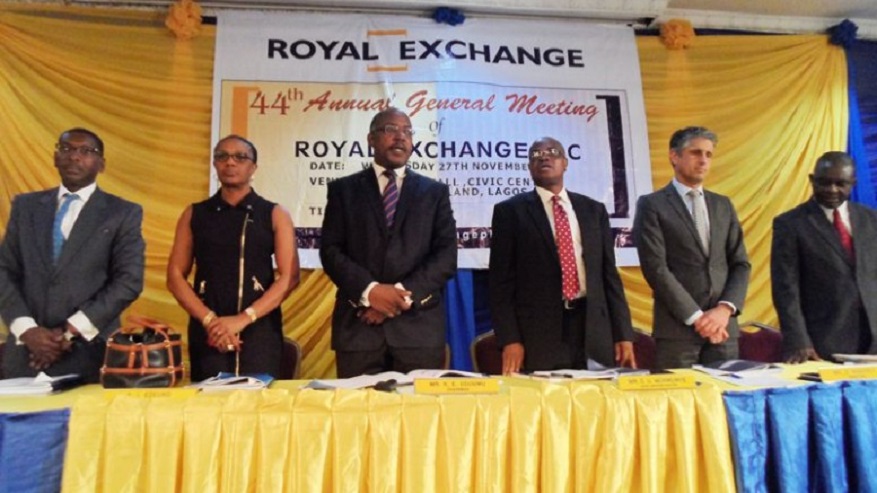
The affected firms are Royal Exchange Plc, African Alliance Insurance Plc, Niger Insurance Plc and Tourist Company of Nigeria Plc.
They were stopped from trading their equities on the exchange for the time being for failing to adhere to one of the listing rules.
A notice from the exchange said the four organisations were specifically punished for refusing to submit their audited financial statements for the year ended December 31, 2020, adding that the suspension became effective Friday, July 2, 2021.
“Trading license holders and the investing public are hereby notified that pursuant to Rule 3.1, Rules for Filing of Accounts and Treatment of Default Filing, (Default Filing Rules), which provides that, ‘If an issuer fails to file the relevant accounts by the expiration of the cure period, the exchange will: a) send to the issuer a second filing deficiency notification within two business days after the end of the cure period; b) suspend trading in the issuer’s securities; and c) notify the Securities and Exchange Commission (SEC) and the market within 24 hours of the suspension,’ trading in the shares of the four companies has been suspended from the facilities of the Nigerian Exchange Limited effective Friday, July 2, 2021, having failed to file their audited financial statements for the year ended December 31, 2020.
“In accordance with the Default Filing Rules set forth above, the suspension of trading in the shares of the above-mentioned companies will only be lifted upon the submission of the relevant accounts, provided NGX Regulation Limited is satisfied that the accounts comply with all applicable rules of the exchange,” the disclosure read.
Business Post reports that before the suspension, African Alliance Insurance share price was 20 kobo, Niger Insurance was also 20 kobo, Royal Exchange was 55 kobo, while Tourist Company of Nigeria was N2.84.
Economy
SEC Okays Migration to T+1 Settlement Cycle for Capital Market Transactions
By Aduragbemi Omiyale
The Securities and Exchange Commission (SEC) has approved the transition to the T+1 settlement cycle for capital market transactions from June 1, 2026.
This is coming some months after Nigeria moved from the T+3 settlement cycle to the T+2 settlement cycle.
The T+ settlement cycle is the number of working days required to complete a capital market transaction, such as the trading of securities, shares, and others, from the first day the trade was executed by an investor.
In a notice on Monday, the SEC, which is the apex capital market regulator in Nigeria, said it was authorising the new system to “promote an efficient, fair, and transparent capital market.”
Under the new arrangement, equities and commodities traded by investors at the market would be cleared and settled by the Central Securities Clearing System (CSCS) within one day.
The agency noted that the migration to a T+1 settlement cycle forms part of its ongoing market modernisation initiatives aimed at enhancing market efficiency and strengthening risk management. reducing counterparty exposure, improving liquidity, and aligning the Nigerian capital market with international standards and global best practices.
“Accordingly, all eligible trades executed in the Nigerian capital market shall settle one business day after the trade date (T+1),” a part of the statement noted.
It was stressed that “Friday, May 29, 2026, shall be the final trading day under the existing T+2 settlement cycle. Trades executed on Friday, May 29, 2026, and Monday, June 1, 2026, shall both settle on Tuesday, June 2, 2026. All trades executed from Monday, June 1, 2026, onward shall be subject to the T+1 settlement cycle.”
SEC tasked all capital market operators, securities exchanges, clearing and settlement infrastructure providers, custodians, registrars, issuers, and other relevant stakeholders to take all necessary measures to ensure full operational readiness and compliance with the new settlement framework.
“Market participants are expected to review and align their systems, processes, controls, and operational workflows ahead of the implementation date,” it further stated, promising to continue to engage stakeholders and monitor the implementation process to ensure an orderly and seamless transition.
The regulator said it remains committed to strengthening market integrity, enhancing investor confidence, and fostering the development of a modern. resilient and globally competitive Nigerian capital market.
Economy
Budget Office Explains Reason for Quarterly Report Delay
By Adedapo Adesanya
The Budget Office of the Federation has defended the delay in publishing three outstanding Quarterly Budget Implementation Reports, saying the situation arose from the repeal and re-enactment of the 2025 Appropriation Act and the subsequent extension of the budget’s implementation period to June 2026.
The last publication on the budget office’s website is Q3 2025, a development that breaks the Fiscal Responsibility Act amid the country’s rising borrowing costs and mounting fiscal pressure.
In a clarification statement, the DG of the Budget Office, Mr Tanimu Yakubu, said public concerns over the absence of the reports must be understood within the constitutional and fiscal framework governing public finance administration in Nigeria, stressing that a fiscal year is not strictly tied to the January–December calendar, but is instead a legislative construct defined by appropriation laws passed by the National Assembly.
“The fiscal year is not necessarily synonymous with the calendar year. The calendar year is a fixed chronological construct of twelve months running from January to December.
“The fiscal year, however, is a juridical and legislative creation whose duration, commencement, and terminal date are determined by the extant appropriation framework enacted by law,” he said.
Mr Yakubu claimed that the recent reporting delay followed the Repeal and Re-enactment of the 2025 Appropriation Act concluded in December 2025, alongside an extension of the budget’s execution period.
These changes, he said, effectively altered the operational timeline for fiscal reporting and necessitated comprehensive reconciliations before publication of the affected quarterly reports.
“In substance and in law, therefore, the fiscal year becomes not merely a chronological concept, but a legislatively sustained expenditure window,” he explained.
The Budget Office further noted that Nigeria’s fiscal practice has historically accommodated adjustments such as supplementary budgets, rollover provisions, and implementation extensions, particularly for capital projects, to ensure continuity and prevent wastage of public resources.
It added that similar practices exist in other jurisdictions, where fiscal years are defined by law rather than fixed to the calendar year.
Citing constitutional provisions, the office referenced Sections 80 and 81 of the 1999 Constitution (as amended), which require that public expenditure be backed by appropriation laws rather than a rigid annual cycle. It maintained that as long as legislative authority exists, expenditure remains valid within the approved framework.
The DG also pointed to judicial precedents underscoring the supremacy of the National Assembly in public finance matters, noting that executive spending must align with statutory approval.
He also explained that the current reconciliation process involves revenue performance reviews, cash flow adjustments, debt analysis, and inter-agency coordination to ensure accuracy and audit integrity of the outstanding reports.
Mr Yakubu then assured that the missing quarterly reports are being finalised and will be released in phases in the coming weeks, adding that reforms are underway to strengthen digital reporting systems and improve transparency and timeliness in fiscal data publication.
In his words, “Accordingly, the outstanding Quarterly Budget Implementation Reports are being finalised and will be released in phases over the coming weeks.
“In parallel, the Budget Office is strengthening its digital reporting architecture, data harmonisation systems, and institutional coordination mechanisms to support more comprehensive, timely, and analytically robust fiscal reporting in line with evolving international public finance reporting standards.”
Economy
NGX Group Advances Investor Education Drive with Digital Retail Engagement Initiative
Nigerian Exchange Group has intensified its investor education drive through a digital engagement initiative aimed at improving financial literacy and deepening retail participation in the Nigerian capital market.
The Group recently hosted an X Space session themed Follow the Fundamentals: A Beginner’s Guide to the Stock Market, reaching over 5,000 users, largely young Nigerians, first-time investors, and retail market participants seeking to better understand investment opportunities in the capital market.
Featuring social media investment influencer Omiete Inko-Tariah, alongside representatives from Nigerian Exchange Limited and NGX Regulation Limited, the session demystified key concepts around market operations, investor protection, and safe participation. Beyond education, it served as an open forum where retail investors engaged directly with market stakeholders on issues of confidence, transparency, and accessibility.
Speaking on the initiative, Clifford Akpolo, Head, Group Communications and Partnerships at NGX Group, said: “Deepening retail participation is critical to building a more resilient, inclusive, and sustainable capital market. At NGX Group, we believe financial literacy is not just an educational responsibility; it is a strategic imperative for strengthening investor confidence, improving market accessibility, and expanding long-term wealth creation opportunities for Nigerians. Through digital platforms like this, we are leveraging innovation to connect with the next generation of investors and democratize access to market knowledge.”
The initiative forms part of NGX Group’s broader sustainability agenda under its Community pillar, which focuses on advancing financial literacy, inclusion, and economic empowerment through education-driven and stakeholder-focused programmes.
Following the success of this edition, NGX Group plans to sustain similar engagements as part of its ongoing commitment to strengthening investor confidence, deepening retail participation, and building a more resilient and inclusive investment ecosystem.
-
Feature/OPED6 years agoDavos was Different this year
-
Travel/Tourism10 years ago
Lagos Seals Western Lodge Hotel In Ikorodu
-
Showbiz3 years agoEstranged Lover Releases Videos of Empress Njamah Bathing
-
Banking8 years agoSort Codes of GTBank Branches in Nigeria
-
Economy3 years agoSubsidy Removal: CNG at N130 Per Litre Cheaper Than Petrol—IPMAN
-
Banking3 years agoSort Codes of UBA Branches in Nigeria
-
Banking3 years agoFirst Bank Announces Planned Downtime
-
Sports3 years agoHighest Paid Nigerian Footballer – How Much Do Nigerian Footballers Earn