Connect with us

Economy

Nigeria Needs Policies that Prioritize Economic Recovery—Peter Obi

Published

on

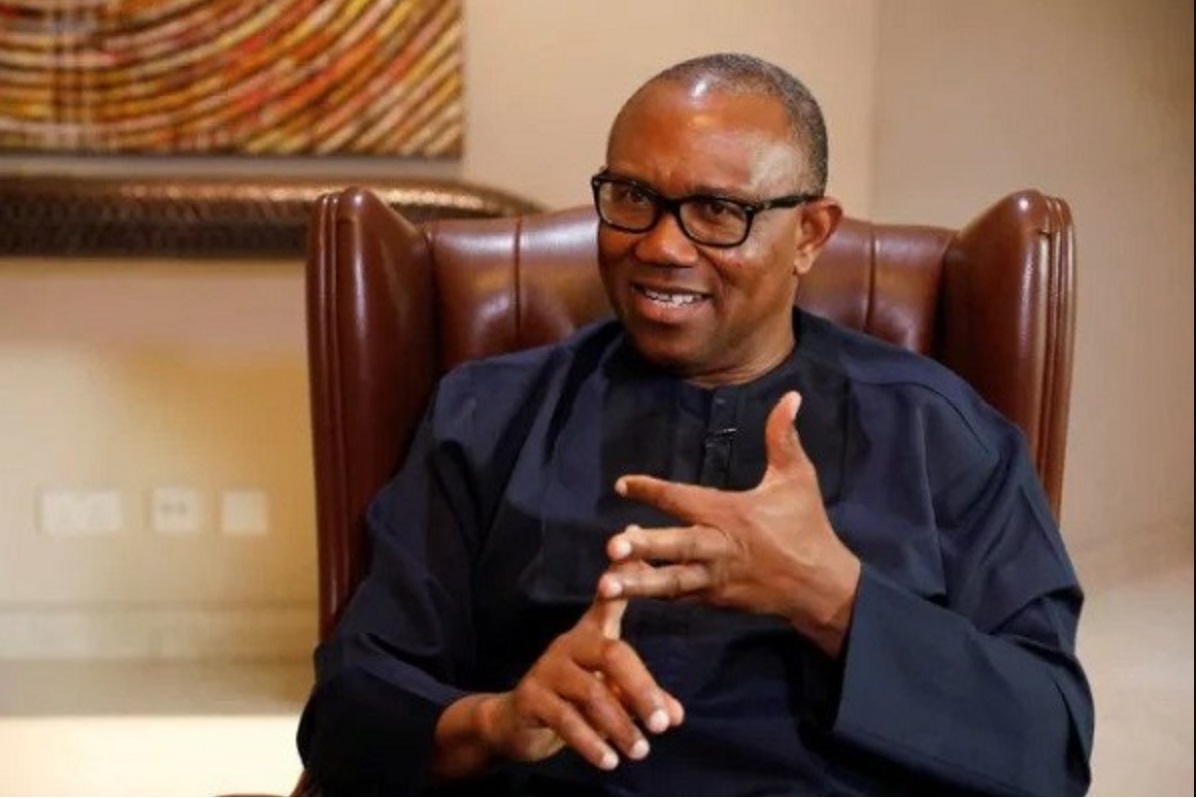
Peter Obi Prioritize Economic Recovery

By Adedapo Adesanya

The presidential candidate of the Labour Party in the 2023 general elections, Mr Peter Obi, has raised concerns over the recent decision of the Monetary Policy Committee (MPC) of the Central Bank of Nigeria (CBN) to increase the Monetary Policy Rate (MPR) to 22.5 per cent and the Cash Reserve Ratio (CRR) to 45 per cent.

Mr Obi warned that this move is likely to worsen the ongoing economic challenges faced by many Nigerian households, and emphasized the need for policies that prioritize economic recovery.

In a statement issued via X (formerly Twitter), the businessman and former Governor of Anambra State expressed his strong opinion that the MPC’s decision would have adverse effects on the economy amid rising inflation and unemployment rates.

He called on the present government to address the root causes of the crisis one of which he says is insecurity.

Mr Obi further urged policymakers to consider alternative measures that would stimulate growth and alleviate the financial burden on Nigerian households.

He called for a more holistic approach to economic management, taking into account the long-term welfare of the populace.

He noted that, “With my vast trading knowledge and my involvement in the real sector, I am of the strong opinion that the recent decision of the Monetary Policy Committee to increase the Monetary Policy Rate, MPR, to 22.5% and the Cash Reserve Ratio, CRR, to 45% will further worsen the economic situation of most Nigerian households as it is bound to cause more job losses in the productive sector, especially manufacturing and other sectors that rely on bank loans and credit facilities for their funding needs.

“Tightening liquidity in the financial system does not improve productivity, i.e food production, which is the major cause of inflation in Nigeria. Moreover, only about 12% of N3.6 trillion of the total money in circulation is in the banking system which means that 88%, about N3.2 trillion is outside the banking system.

“So, this measure would rather be counterproductive as it would not address the intended purpose of managing the money supply. These new measures will worsen the fragile economy as the supply of funds would dry up for the real sector, and the new MPR rate hike will push the interest rate on loans to above 30%, which would be very difficult for the real sector operators especially manufacturers and SMEs to repay; resulting, obviously, in increased bad loans, and worsening the nation’s economic situation.

“The most critical way to manage our high rate of inflation and decline in production is for the government to address the issue of insecurity in the country, which will allow for increased food, and crude oil production, and an overall increase in production, which will make products, especially food, cheaper. This way we would increase our productivity as well as restore the confidence of FDIs and FPIs to come back to the country.

“I must caution that what the Nigerian economy needs now is hard-headed practical originality and results. Tinkering with classical economic theories can only deepen our crisis.”


Adedapo Adesanya is a journalist, polymath, and connoisseur of everything art. When he is not writing, he has his nose buried in one of the many books or articles he has bookmarked or simply listening to good music with a bottle of beer or wine. He supports the greatest club in the world, Manchester United F.C.

Advertisement
Click to comment

Leave a Reply

Your email address will not be published. Required fields are marked *

Economy

NASD Investors Lose N16.25bn

Published

on

NASD Investors' Portfolios

By Adedapo Adesanya

The NASD Over-the-Counter (OTC) Securities Exchange faced south on Tuesday, March 10, by 0.64 per cent, with the market capitalisation dropping N16.25 billion to close at N2.540 trillion versus the preceding session’s N2.556 trillion, and the NASD Unlisted Security Index (NSI) shrinking by 27.15 points to 4,245.97 points from 4,273.12 points.

The red team had more members than the green team yesterday, with the former comprising four and the latter three.

Central Securities Clearing System (CSCS) Plc depreciated by N2.43 to sell at N80.00 per share versus N83.78 per share, Afriland Properties Plc lost N1.90 to trade at N17.60 per unit versus N19.50 per unit, Geo-Fluids Plc declined by 30 Kobo to N3.00 per share from N3.30 per share, and Acorn Petroleum Plc declined by 2 Kobo to N1.33 per unit from N1.35 per unit.

Conversely, FrieslandCampina Wamco Nigeria Plc appreciated by N2.85 to N136.70 per share from N133.85 per share, Lagos Building Investment Company (LBIC) Plc added 25 Kobo to sell at N4.00 per unit compared with Monday’s price of N3.75 per unit, and First Trust Mortgage Bank Plc gained 1 Kobo to settle at N1.91 per share versus N1.90 per share.

The volume of securities surged during the session by 1,253.2 per cent to 14.9 million units from 1.1 million units, the value of securities jumped 180.7 per cent to N132.7 million from N47.3 million, and the number of deals increased by 61.1 per cent to 58 deals from 36 deals.

The most active stock by value (year-to-date) was CSCS Plc with 38.1 million units exchanged for N2.4 billion, Okitipupa Plc occupied the second spot with 6.3 million units worth N1.1 billion, and the third place was taken by MRS Oil Plc with 3.4 million units valued at N507.8 million.

The most traded stock by volume (year-to-date) was Resourcery Plc with 1.05 billion units sold for N408.7 million, followed by Geo-Fluids Plc with 130.6 million units transacted for N503.8 million, and CSCS Plc with 38.1 million units worth N2.4 billion.

Continue Reading

Economy

Naira Weakens to N1,401/$ at Official Market

Published

on

Official FX Market

By Adedapo Adesanya

The Naira further weakened against the United States Dollar in the Nigerian Autonomous Foreign Exchange Market (NAFEX) on Tuesday, March 10.

Yesterday, the local currency depreciated against the greenback by N8.14 or 0.58 per cent to sell at N1,401.40/$1 compared with the previous day’s N1,393.26/$1.

In the same vein, the domestic currency tumbled against the Pound Sterling in the official market by N22.67 to trade at N1,885.73/£1 versus Monday’s closing price of N1,863.06/£1, and lost N19.37 against the Euro to settle at N1,631.51/€1, in contrast to the preceding day’s N1,612.14/€1.

Similarly, the Naira crashed against the US Dollar in the black market during the trading day by N5 to close at N1,420/$1 compared with the previous day’s N1,415/$1, but gained N3 at the GTBank forex counter to end at N1,416/$1 versus N1,419/$1.

With the latest level, the Naira hit a two-month low despite improvements in externalities that could offer enough backing for the local currency, including a stabilisation of oil prices to levels that could strengthen the current account balance and improve FX liquidity.

The last time the exchange rate hit the N1,400/$1 region was January 27, when the local currency traded at N1,401.2 against the American currency.

Inflows into the FX market have strengthened in recent weeks, but likewise, the US Dollar has strengthened at the international market due to recent upheaval involving the United States, Israel and Iran.

Meanwhile, in the cryptocurrency market, the price of the top 1o coins rallied as easing fears of an oil supply shock, helped by the move toward a possible release of emergency reserves, lifted risk sentiment across global markets.

The gainers were led by Dogecoin (DOGE) which chalked up 1.7 per cent to trade at $0.0926, Cardano (ADA) jumped 0.5 per cent to $0.2599, TRON (TRX) added 0.3 per cent to sell at $0.2867, Bitcoin (BTC) appreciated by 0.2 per cent to $69,619.49, and Ripple (XRP) grew by 0.1 per cent to $1.38.

On the flip side, Ethereum (ETH) crashed by 0.3 per cent to $2,022.42, Solana (SOL) slid 0.2 per cent to $86.57, and Binance Coin (BNB) lost 0.1 per cent to finish at $640.29, while the US Dollar Tether (USDT) and the US Dollar Coin (USDC) traded flat at $1.00 apiece.

Continue Reading

Economy

Customs Street Dips 0.57% as Equity Investors Book Profit

Published

on

Lagos Customs Street stock exchange

By Dipo Olowookere

The bears took control of Customs Street on Tuesday after equity investors embarked on profit-taking, resulting in the market closing lower by 0.57 per cent.

Sell-offs were witnessed in almost all the key sectors of the Nigerian Exchange (NGX) Limited yesterday, as the only riser was the insurance index, which gained 0.04 per cent.

The industrial goods space shrank by 0.71 per cent, the banking counter depreciated by 0.48 per cent, the energy counter fell by 0.29 per cent, and the consumer goods sector also slipped by 0.29 per cent.

Consequently, the All-Share Index (ASI) moderated by 1,130.86 points to 196,066.11 points from 197,196.97 points, and the market capitalisation contracted by N726 billion to N125.858 trillion from N126.584 trillion.

Mutual Benefits lost 10.00 per cent to trade at N4.59, NASCON also gave up 10.00 per cent to sell for N147.60, Red Star Express dropped 9.94 per cent to N28.55, Austin Laz slumped 9.88 per cent to N3.74, and SCOA Nigeria depreciated by 9.85 per cent to N27.90.

On the flip side, Premier Paints gained 9.97 per cent to close at N17.65, Sunu Assurances appreciated by 9.95 per cent to N4.75, Conoil improved by 9.95 per cent to N204.40, DAAR Communications expanded by 9.84 per cent to N2.01, and Eterna grew by 9.56 per cent to N51.00.

Business Post observed that there was a stronger selling pressure yesterday after a fall in the global crude oil market. The bourse ended with 26 price gainers and 44 price losers, reflecting a negative market breadth index and weak investor sentiment.

A total of 746.9 million equities valued at N27.9 billion exchanged hands in 65,275 deals during the session versus the 762.5 million equities worth N31.2 billion traded in 86,488 deals in the preceding day, showing a decline in the trading volume, value and number of deals by 2.05 per cent, 10.58 per cent, and 24.53 per cent, respectively.

Leading the activity chart for the session was Access Holdings with 80.3 million shares valued at N2.0 billion, Mutual Benefits sold 52.7 million stocks worth N254.7 million, Fortis Global Insurance transacted 41.4 million equities for N57.7 million, Zenith Bank traded 35.4 million shares worth N3.3 billion, and Jaiz Bank exchanged 31.5 million stocks valued at N343.4 million.

Continue Reading

Trending