Connect with us

Economy

Nigeria Ranks Low in Implementation of World Bank-Funded Projects—Ahmed

Published

on

zainab ahmed economic model

By Aduragbemi Omiyale

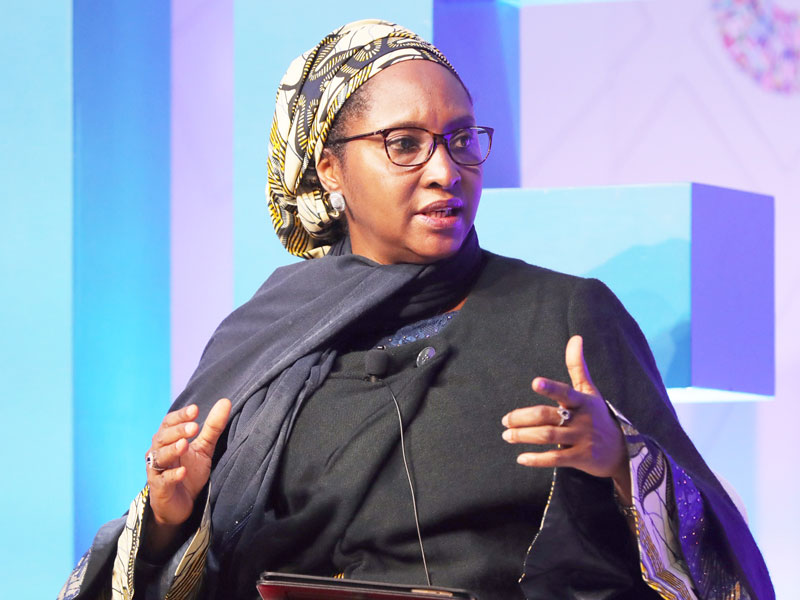
The Minister of Finance, Budget and National, Mrs Zainab Ahmed, has submitted that Nigeria performs poorly in implementing projects funded by the World Bank Group.

Mrs Ahmed said this when she spoke recently at a retreat organised for members of the National Assembly on Process Optimisation in Donor-Financed Projects in Nigeria.

At the event organised by the Ministry, she said it was because of this she created a task force on disbursement in donor-funded projects in Nigeria to evaluate, review and chart a fresh course to significantly increase disbursement levels in donor-financed projects in the country.

Mrs Ahmed informed the lawmakers that much still remains to be streamlined, notwithstanding the efforts and resources committed to procuring development financing for critical sectors of the Nigerian economy.

According to her, Nigeria appears not to have made the desired progress to boost human capital development, improve infrastructure and service delivery as well as strengthening governance and institutions.

“The need to organise this important retreat is predicated on our desire and strong conviction as a Ministry saddled with the responsibility of managing the country’s financial inflows and outflows to deliver planned projects for sustained growth and national development,” she stated.

Mrs Ahmed mentioned the fact that when borrowed funds fail to be properly utilised and to deliver on planned development objectives, growth is impaired and economic development is distorted.

In her words: “An in-depth review of the level of implementation of the entire development projects reveals that delays in the execution of donor-funded projects stem from factors including bureaucratic bottlenecks, capacity challenges, political interference and challenges associated with obtaining varied and misaligned approvals processes between our local authorities and development partners.

“Accordingly, Nigeria ranks low compared to other nations of the world in terms of the level of implementation of World Bank-funded projects. It is public knowledge that there have been increased public agitations against rising foreign debts levels.

“This has put immense pressure on the government to ensure prudent management of resources, and improve transparency and accountability in the utilisation of funds from donor agencies for maximum positive impact on the economy.

“It is, therefore, against this backdrop, that I constituted a task force on disbursement in donor-funded projects in Nigeria. The term of reference (ToR) of the Taskforce is to evaluate, review and chart a fresh course to significantly increase disbursement levels in donor-financed projects in the country.

“It is to also work with relevant stakeholders to facilitate various approval processes for donor-assisted projects before final approval from the National Assembly.”

The retreat organised by the ministry for the chairmen and members of the two relevant committees of the National Assembly is, according to the Minister, in furtherance of the federal government’s efforts towards unravelling the challenges associated with the implementation of donor-financed projects with a view to evolving ways to improve execution levels for national growth and development.

“It is also a clear demonstration of our firm belief in the critical role and importance of the National Assembly to Nigeria’s development drive. As critical stakeholders, it is our hope that this retreat would provide a veritable platform for all to ex-ray the issues and resolve to tackle them headlong,” the Minister said.

She expressed her expectation that the outcome of this meeting would ultimately facilitate the elimination of avoidable delays in the implementation of donor-financed projects, increase levels of execution, improve effectiveness and efficiency in project implementation management and contribute to meeting Nigeria’s development objectives.

At the retreat were the chairmen and members of the Senate Committee on Local and Foreign Debts and the House Committee on Aids, Loans and Debt Management.


Aduragbemi Omiyale is a journalist with Business Post Nigeria, who has passion for news writing. In her leisure time, she loves to read.

Click to comment

Leave a Reply

Your email address will not be published. Required fields are marked *

Economy

NASD Exchange Falls 0.22% After Investors Lose N4.8bn

Published

on

NASD securities exchange

By Adedapo Adesanya

The NASD Over-the-Counter (OTC) Securities Exchange weakened by 0.22 per cent on Tuesday, April 28, with the market capitalisation down by N4.8 billion to N2.420 trillion from N2.425 trillion, and the NASD Unlisted Security Index (NSI) down by 9.01 points to 4,044.96 points from 4,053.97 points.

During the session, the price of Central Securities Clearing System (CSCS) Plc went down by N1.82 to N767.05 per share from N78.87 per share, while FrieslandCampina Wamco Nigeria Plc appreciated by N1.90 to N100.00 per unit from N98.10 per unit.

According to data, the value of trades increased by 265.7 per cent to N27.1 million from N7.4 million units, and the volume of transactions surged by 305.2 per cent to 1.3 million units from 319,831 units, while the number of deals decreased by 6.9 per cent to 27 deals from 29 deals.

Great Nigeria Insurance (GNI) Plc remained the most traded stock by value on a year-to-date basis, with the sale of 3.4 billion units valued at N8.4 billion, followed by CSCS Plc with 59.8 million units exchanged for N4.0 billion, and Okitipupa Plc with 27.8 million units traded for N1.9 billion.

GNI Plc also finished as the most traded stock by volume on a year-to-date basis, with a turnover of 3.4 billion units worth N8.4 billion, trailed by Resourcery Plc with 1.1 billion units transacted for N415.7 million, and Infrastructure Guarantee Credit Plc with 400 million units sold for N1.2 billion.

Continue Reading

Economy

Naira Crashes to N1,380/$ at Official Market, N1,390/$1 at Black Market

Published

on

forex black market

By Adedapo Adesanya

Pressure is beginning to mount on the Nigerian Naira in the different segments of the foreign exchange (FX) market despite an oil windfall triggered by the Middle East crisis.

On Monday, April 27, the domestic currency further weakened against the United States Dollar in the Nigerian Autonomous Foreign Exchange Market (NAFEX) by N16.47 or 1.2 per cent to N1,380.71/$1 from the previous day’s N1,364.24/$1.

It was not different against the Pound Sterling in the same market window, as it lost N16.04 to trade at N1,863.76/£1 versus Monday’s closing rate of N1,847.72/£1, and against the Euro, it slipped by N12.72 to close at N1,615.01/€1 versus N1,602.29/€1.

The Naira also depreciated against the Dollar at the black market yesterday by N5 to quote at N1,390/$1 compared with the previous price of N1,385, and at the GTBank forex counter, it further crashed by N9 to settle at N1,379/$1 compared with the preceding session’s N1,370/$1.

The continued decline of the Naira comes as traders increasingly seek other safe-haven currencies amid continued global disruptions.

The benefit awash in the global market is making foreign portfolio investors stay short in Nigerian markets. Despite this, the daily FX publication released showed that interbank turnover rose to $98.829 million across 78 deals, up from $76.65 million.

Meanwhile, the cryptocurrency market remained cautious, with Bitcoin (BTC) trading at $77,216.66 despite surging oil prices and geopolitical tensions over a potential extended US naval blockade of the Strait of Hormuz.

Analysts say the supply overhang has finally dried up, and the sellers who were spooked by macro shifts or quantum fears have already exited, leaving the market much thinner on the sell-side.

Investors will await decisions made by central banks this week. The US Federal Reserve will announce its rate decision later on Wednesday, while the European Central Bank (ECB) follows on Thursday.

Ethereum (ETH) gained 1.5 per cent to trade at $2,324.59, Dogecoin (DOGE) chalked up 1.4 per cent to sell for $0.1016, Solana (SOL) appreciated by 0.6 per cent to $84.85, Cardano (ADA) grew by 0.5 per cent to $0.2483, and Binance Coin (BNB) advanced by 0.2 per cent to $627.15.

However, TRON (TRX) depreciated by 0.6 per cent to $0.3224, and Ripple (XRP) lost 0.03 per cent to sell at $1.39, while the US Dollar Tether (USDT) and the US Dollar Coin (USDC) were unchanged at $1.00 each.

Continue Reading

Economy

Oil up 3% as Hormuz Disruption Outweighs UAE OPEC Exit

Published

on

Oil Licensing Round

By Adedapo Adesanya

Oil was up by nearly 3 per cent on Tuesday as persistent worries about supply constraints from the closed Strait of Hormuz continued, with Brent futures for June rising by $3.03 or 2.8 per cent to $111.26 a barrel, and the US West Texas Intermediate (WTI) crude futures growing by $3.56 or 3.7 per cent to $99.93 a barrel.

An earlier round of negotiations between the United States and Iran collapsed last week after face-to-face talks failed.

Ship-tracking data showed significant disruptions in the region, with six Iranian oil tankers forced to turn back due to the US blockade, but some traffic is still moving.

Prices trimmed some of the advances after the United Arab Emirates (UAE), the fourth-largest producer in the Organisation of the Petroleum Exporting Countries (OPEC), said on Tuesday it would exit the group on this Friday, May 1, 2026.

This dealt a blow to the oil-exporting group and its de facto leader, Saudi Arabia.

The UAE could quickly ⁠add between 1 million and 1.5 million barrels per day of output. However, with the Strait of Hormuz effectively closed, analysts said that there’s nowhere for that supply to go.

The UAE joined OPEC in 1967, but tension with Saudi Arabia over production quotas has been building for years.

Under the OPEC+ deal, the country has been held to roughly 3 million barrels per day while sitting on capacity above 4 million. It has been pushing toward 5 million barrels per day by 2027, and that target is hard to achieve with quotas built around someone else’s view of the market.

The war in Yemen broke whatever was left of diplomatic patience.

President Donald Trump said he was unhappy with the latest Iranian proposal to end the war. The proposal would avoid addressing the nuclear programme until hostilities cease and Gulf shipping disputes are resolved.

The Idemitsu Maru, ‌a Panama-flagged ⁠tanker carrying 2 million barrels of Saudi oil, and an LNG tanker managed by the Abu Dhabi National Oil Company (ADNOC) crossed the Strait on Tuesday, shipping data showed.

Vortexa data showed that the amount of crude oil held around the world on tankers that have been stationary for at least seven days rose to 153.11 million barrels as of April 24.

The American Petroleum Institute (API) estimated that crude oil inventories in the United States fell by 1.79 million barrels in the week ending April 24. The official data from the US Energy Information Administration (EIA) will be released later on Wednesday.

Continue Reading

Trending