Connect with us

Economy

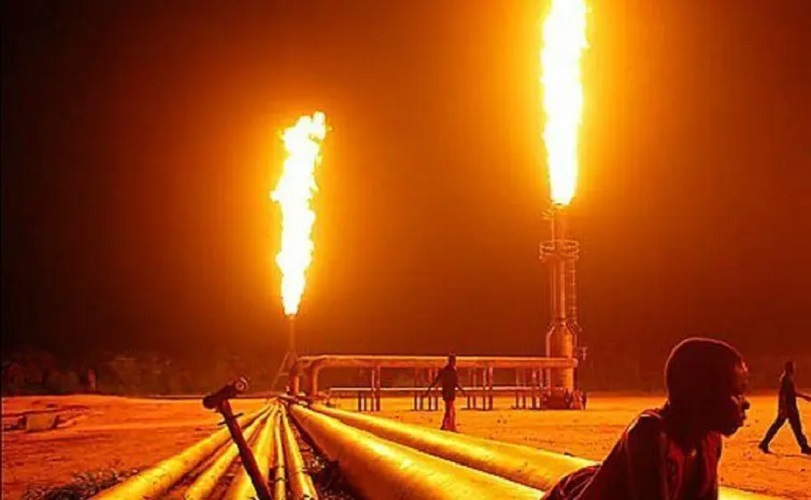
Nigeria Targets 10bscfd Gas Production in Next Four Years

Published

on

Gas Flare Commercialization

By Adedapo Adesanya

The federal government says Nigeria is targeting gas production of 10 billion standard cubic feet per day (bscfd) by 2030, positioning natural gas as a cornerstone of national energy security and economic prosperity.

The Minister of State for Petroleum Resources (Gas), Mr Ekperikpe Ekpo, said this while delivering a ministerial address at the ninth Nigeria International Energy Summit (NIES) 2026 in Abuja.

The Minister said the government’s efforts were yielding tangible results, with Nigeria’s gas production maintaining an upward trajectory in 2025, averaging between 7.5 and 7.6bscfd.

He disclosed that domestic gas supply exceeded two bscfd for the first time, marking a historic milestone for power generation, industrial use and household consumption.

The Minister also said significant progress in environmental performance, with gas flaring reduced to some of the lowest levels recorded in recent years, in line with Nigeria’s commitment to end routine gas flaring by 2030.

He noted that investor confidence in the gas sector had been strengthened, citing Final Investment Decisions (FIDs) in key upstream gas projects supported by improved regulatory clarity under the Petroleum Industry Act (PIA).

“Across the midstream and downstream segments, pipeline infrastructure, processing facilities and gas-to-power projects have expanded, improving connectivity, boosting domestic utilisation and supporting cleaner cooking solutions, job creation and industrial stability.

“Under President Bola Tinubu’s Renewed Hope Agenda, government policy prioritises the expansion of domestic gas infrastructure while strengthening Nigeria’s presence in regional and global gas markets.

“This includes facilitating investments in gas processing, storage and distribution, as well as accelerating gas-to-power projects aimed at addressing energy poverty and enhancing industrial competitiveness,” he said.

The minister emphasised that Nigeria’s energy future was inseparable from peace, partnership and shared responsibility, calling on governments, investors, development partners, host communities and civil society to move from dialogue to decisive action.

“Our collective task is to build an energy system that powers prosperity, strengthens stability and supports regional integration,” he said.

He said Nigeria’s energy strategy is firmly aligned with global energy transition realities while responding to Africa’s unique development challenges, including widespread energy poverty, limited industrial capacity and inadequate access to reliable power.

“While the world moves towards lower-carbon systems, Africa must pursue a transition that is not only green, but also just, inclusive and development-driven.

“Nigeria is leveraging its abundant natural gas resources to balance climate responsibility with economic development, positioning gas as the backbone of industrial growth, job creation and expanded energy access,” he said.


Adedapo Adesanya is a journalist, polymath, and connoisseur of everything art. When he is not writing, he has his nose buried in one of the many books or articles he has bookmarked or simply listening to good music with a bottle of beer or wine. He supports the greatest club in the world, Manchester United F.C.

Advertisement
Click to comment

Leave a Reply

Your email address will not be published. Required fields are marked *

Economy

NASD Market Falls 1.18% to Extend Losing Streak

Published

on

NASD OTC exchange

By Adedapo Adesanya

The NASD Over-the-Counter (OTC) Securities Exchange extended its stay in the south for the fourth consecutive session after it shed 1.18 per cent on Friday, March 13.

The unlisted securities market recorded a loss despite closing without a price decliner, and ending with two price gainers led by Geo Fluids Plc, which gained 1o Kobo to sell at N3.10 per share compared with the previous day’s N3.00 per share. Industrial and General Insurance (IGI) Plc appreciated during the session by 2 Kobo to trade at 54 Kobo per unit versus Thursday’s closing price of 52 Kobo per unit.

When the market closed for the day, the market capitalisation lost N29.83 billion to close at N2.489 trillion compared with the N2.519 trillion it finished a day earlier, and the NASD Unlisted Security Index (NSI) crashed by 49.84 points to 4,160.46 points from 4,210.31 points.

Market activity improved yesterday, as the volume of transactions rose 179.5 per cent to 10.4 million units from 3.7 million units, but the value of trades declined by 68.4 per cent to N29.9 million from N95.0 million, while the number of deals weakened by 11.5 per cent to 46 deals from 52 deals.

Central Securities Clearing Systems (CSCS) Plc remained the most active stock by value on a year-to-date basis with 38.4 million units worth N2.4 billion, Okitipupa Plc followed with 6.4 million units traded at N1.1 billion, and FrieslandCampina Wamco Nigeria Plc transacted 6.3 million units for N584.3 million.

Resourcery Plc ended the trading session as the most traded stock by volume on a year-to-date basis with 1.1 billion units valued at N415.6 million, trailed by Geo-Fluids Plc with 130.8 million units valued at N504.5 million, and CSCS Plc with 38.4 million units worth N2.4 billion.

Continue Reading

Economy

Naira Trades N1,366/$1 at Official Market, N1,400/$1 at Black Market

Published

on

Black Market

By Adedapo Adesanya

The Naira continued to claw back some gains against the Dollar in the different segments of the foreign exchange (FX) market, as its value was strengthened on Friday.

In the black market, it gained N10 against the United States Dollar yesterday to close at N1,400/$1 compared with the preceding day’s rate of N1,410/$1, and at the GTBank forex counter, it chalked up N6 to close at N1,385/$1, in contrast to the N1,391/$1 it was traded a day earlier.

Similarly, in the Nigerian Autonomous Foreign Exchange Market (NAFEX), it appreciated against the greenback during the session by N5.28 or 0.38 per cent to quote at N1,366.23/$1 versus Thursday’s closing price of N1,371.51/$1.

It also improved its value against the Pound Sterling in the official market on Friday by N21.81 to settle at N1,812.99/£1 compared with the previous day’s N1,834.80/£1, and gained N13.86 against the Euro to sell at N1,568.03/€1 versus N1,581.89/€1.

Pressure eased further on the FX market as the Central Bank of Nigeria (CBN) continued interventionist operations this week, selling Dollars to banks to boost liquidity after a $500 million boost last week.

This was complemented by inflows from foreign investors, exporters and non-bank corporates, among others, while Nigeria’s gross external reserves remained above $50 billion, the highest since 2009.

The Governor of the apex bank, Mr Yemi Cardoso, also eased fears of a Naira devaluation, saying the country’s financial system has been strengthened by reforms.

Regardless, external pressure looms as the US Dollar strengthened globally due to its war with Iran, now ongoing for three weeks.

Meanwhile, the cryptocurrency market was largely down as traders and investors continue to align with current realities.

The market is adapting to the conflict in real time. Early in the war, every headline produced an outsized reaction because nobody could price the tail risk. Now, traders have a framework where strikes happen, oil spikes and bitcoin dips only to recover again.

Cardano (ADA) depreciated by 3.8 per cent to $0.2623, Dogecoin (DOGE) lost 1.7 per cent to finish at $0.0948, Ripple (XRP) slumped 1.5 per cent to $1.39, Solana (SOL) dropped 1.4 per cent to sell for $87.33, Binance Coin (BNB) went down by 1.3 per cent to $653.58, Bitcoin (BTC) declined by 1.1 per cent to $70,670.63, and Ethereum (ETH) decreased by 0.9 per cent to $2,078.78.

However, TRON (TRX) appreciated by 1.7 per cent to $0.2941, while the US Dollar Tether (USDT) and the US Dollar Coin (USDC) remained unchanged at $1.00 apiece.

Continue Reading

Economy

Oil Stays Above $100 as Strait of Hormuz Traffic Stalls

Published

on

Oil Prices fall

By Adedapo Adesanya

The price of the major crude oil grade, Brent crude oil, closed above $100 on Friday for the second consecutive session, as the Iran war heads toward its third week, with oil tanker traffic through the Strait of Hormuz still effectively at a standstill.

It gained 2.67 per cent or $2.68 during the trading day to close at $103.14 per barrel, while the US West Texas Intermediate (WTI) crude oil grade appreciated by 3.11 per cent or $2.98 to settle at $98.71 per barrel.

Brent futures were up about 10 per cent for the week following the 27 per cent rise seen last week, which marked the biggest weekly gain in oil prices since the COVID-19 pandemic in 2020. WTI futures, which saw their best week since 1983 last week, ended the week more than 8 per cent higher.

US President Donald Trump said American forces launched a major bombing raid on Iran’s strategic Kharg Island, targeting military facilities on the key Persian Gulf outpost while warning Iran that its vital oil infrastructure could be destroyed if shipping in the Strait of Hormuz is disrupted.

The terminal accounts for roughly 90 per cent of Iranian crude shipments, loading millions of barrels per day onto tankers bound largely for Asian markets.

The US and Israel’s strikes in the conflict have largely targeted Iranian military and nuclear infrastructure. Oil facilities elsewhere in Iran have been hit, but Kharg’s massive storage tanks, jetties, and pipelines had remained untouched until the latest strike.

Iran’s new supreme leader, Mojtaba Khamenei, vowed to keep fighting in a message delivered via state television.

There have been a number of attacks on foreign ships in or near the Strait, feeding into concerns that a prolonged war could translate to a global economic shock.

Prices are rising despite the US and its allies rolling out some measures to keep a lid on energy costs.

The International Energy Agency (IEA) has agreed to release 400 million stockpiled barrels, the largest such action in history.

The US has issued a 30-day waiver for India to purchase sanctioned oil from Russia. President Donald Trump is considering loosening rules under the Jones Act that require American ships to transport goods between domestic ports, including oil and gas, in an effort to lower costs.

Traders are continuing to monitor developments in the Middle East.

Continue Reading

Trending