Connect with us

Economy

Nigerian Exchange All-Share Index Hits 126,000-point Level

Published

on

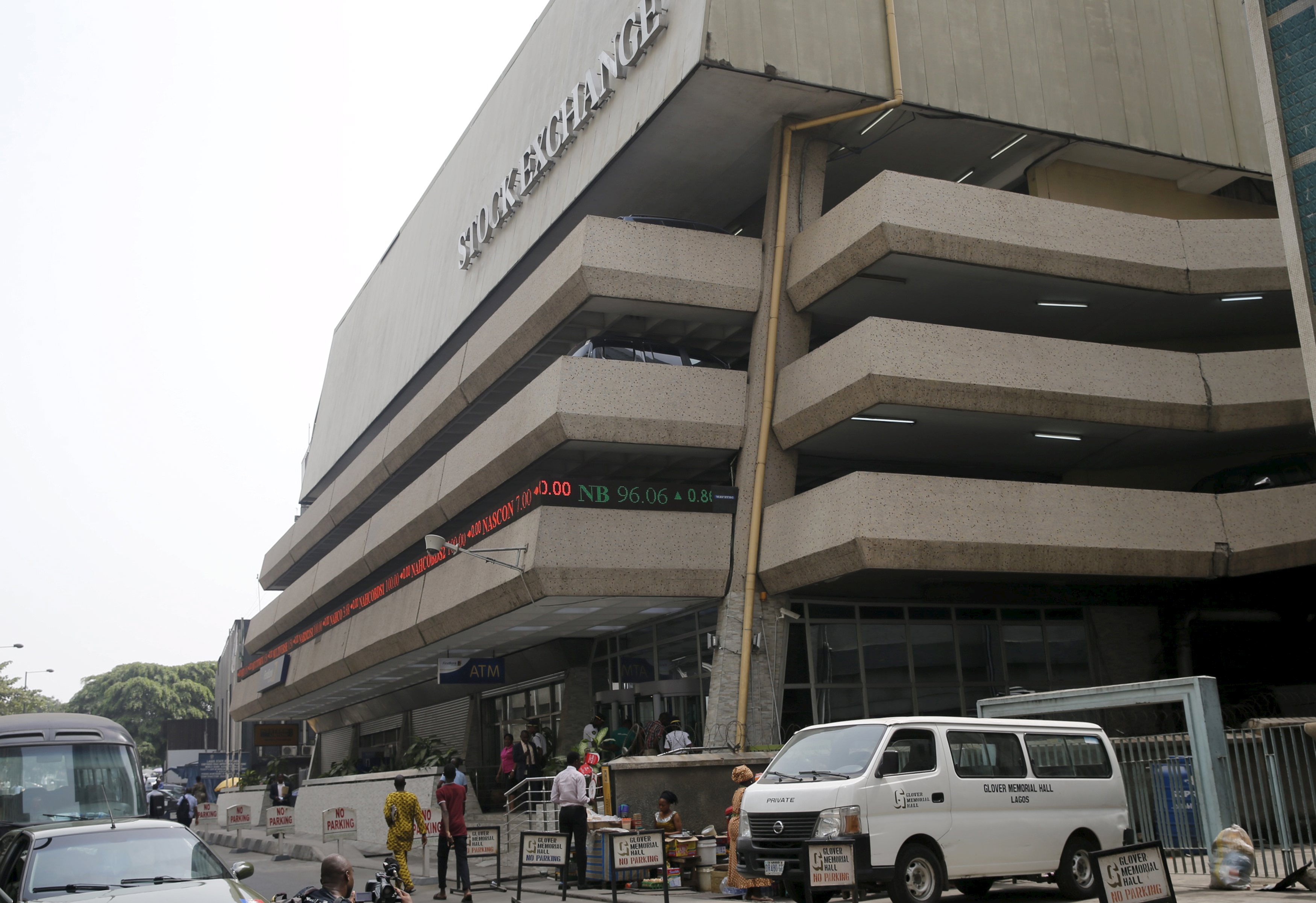
Customs Street Nigerian Stock Exchange

By Dipo Olowookere

A day after crossing the 124,000-point threshold, the All-Share Index (ASI) of the Nigerian Exchange (NGX) Limited hit another milestone on Friday after it closed higher by 1.37 per cent.

Business Post reports that the benchmark index of Customs Street finished at 126,149.59 points after adding 1,702.79 points to the 124,446.80 points it ended a day earlier.

Equally, the market capitalisation of the Nigerian bourse, which measures the total value of stocks on the platform, went up by N1.077 trillion to N79.803 trillion from N78.726 trillion.

At the trading session, 65 equities ended on the gainers’ chart and 25 equities finished on the losers’ table, indicating a positive market breadth index and strong investor sentiment.

Guinness Nigeria, Cadbury Nigeria, Consolidated Hallmark, and NEM Insurance all gained 10.00 per cent each to close at N96.80, N60.50, N3.63, and N22.00 apiece, and Red Star Express improved by 9.98 per cent to N13.44.

Conversely, Learn Africa depreciated by 8.66 per cent to N6.01, Tantalizers shed 6.25 per cent to settle at N3.00, Prestige Assurance slumped by 6.02 per cent to N1.25, Regency Alliance crashed by 5.62 per cent to 84 Kobo, and Oando lost 4.61 per cent to close at N51.70.

The NGX recorded a turnover of 1.4 billion shares traded for N30.6 billion in 33,399 deals on Friday compared with the 1.3 billion shares worth N27.7 billion traded in 27,875 deals on Thursday, implying an increase in the trading volume, value, and number of deals by 7.69 per cent, 10.47 per cent, and 19.82 per cent, respectively.

Access Holdings led the activity chart with 172.9 million units sold for N4.2 billion, Ellah Lakes traded 144.9 million units valued at N1.8 billion, Japaul exchanged 138.7 million units worth N498.8 million, UBA transacted 73.0 million units worth N3.2 billion, and AIICO Insurance traded 60.7 million units worth N135.7 million.

A look at the sectorial performance indicated that the banking index grew by 5.61 per cent, the insurance counter rose by 3.78 per cent, and the industrial goods sector expanded by 1.69 per cent.

However, the energy space depreciated by 0.49 per cent, the consumer goods industry went down by 0.23 per cent, and the commodity sector slipped by 0.02 per cent.


Click to comment

Leave a Reply

Your email address will not be published. Required fields are marked *

Economy

Lagos Illustrates Digital Expansion Plans With $22m FDI Commitments

Published

on

Lagos State government

By Adedapo Adesanya

The Lagos State Government has secured about $22 million in Foreign Direct Investment (FDI) commitments to expand digital infrastructure across the state, in a move aimed at strengthening its position as Nigeria’s leading technology and innovation hub.

The investment was facilitated through the Lagos State Infrastructure Maintenance and Regulatory Agency (LASIMRA) and is expected to accelerate the deployment of fibre optic networks, improve broadband penetration and support smart-city development initiatives.

Speaking recently during the 2026 Ministerial Press Briefing held in Alausa, Ikeja, the Special Adviser to the Governor on Infrastructure, Mr Olufemi Daramola, disclosed that LASIMRA attracted foreign direct investment commitments worth about $22 million targeted at the rollout of high-capacity fibre optic infrastructure across Lagos State.

He said the development aligns with the government’s broader strategy to expand the state’s digital economy and enhance technology-driven growth in Africa’s most populous commercial centre.

Mr Daramola explained that the agency also facilitated additional investments for the deployment of about 30,000 kilometres of 28-way fibre duct infrastructure along strategic corridors across the state, building on the existing 3,000 kilometres of fibre already installed.

He noted that the expansion would significantly improve internet connectivity, boost broadband access and strengthen operations within Lagos’ rapidly growing digital ecosystem.

Beyond foreign investment inflows, he revealed that LASIMRA recorded a 300 per cent increase in revenue generation during the review period, driven by improved permit processing systems, enhanced regulatory compliance and the introduction of digital workflow platforms.

He further disclosed that the agency is advancing the Automated Telecom Infrastructure Registration System (TIRS), a digital platform designed to automate infrastructure registration, improve compliance monitoring and accelerate permit approvals for telecom operators.

“As part of its smart-city agenda, Lagos has deployed Geographic Information System (GIS) technology for mapping and monitoring fibre routes, telecommunications masts and towers, while also advancing the rollout of 5G-enabled smart poles across the state,” he said.

Mr Daramola added that the ongoing initiatives are aimed at building a resilient and future-ready digital infrastructure ecosystem capable of attracting further investments, fostering innovation and supporting long-term economic growth.

This marks the latest government move in tech following its plans to expand the city’s data centre capacity to over 250 megawatts (MW) by 2030 as part of efforts to strengthen the digital infrastructure ecosystem.

Continue Reading

Economy

Nigeria’s Capital Market Leads Africa with Transition to T+1 Settlement Cycle

Published

on

Nigeria capital market T+1 settlement cycle

By Aduragbemi Omiyale

On Monday, June 1, 2026, the Nigerian capital market achieved a historic milestone with the successful transition to a T+1 settlement cycle.

With this feat, it becomes the first market in Africa to implement the shortened settlement framework designed to enhance efficiency, reduce risk, and improve global competitiveness.

This is part of efforts to align the ecosystem with global best practices, where shorter settlement cycles are increasingly being adopted to improve post-trade efficiency, reduce counterparty risk, and strengthen investor confidence, reaffirming regulators’ commitment to continued modernisation of market systems and processes.

The transition follows six months of coordinated industry-wide preparations involving regulators, exchanges, depositories, custodians, registrars, and other market participants, positioning Nigeria among global markets adopting shorter settlement cycles to improve post-trade efficiency and market resilience

At a ceremony to mark this achievement through a symbolic closing gong ceremony yesterday, the Director-General of the Securities and Exchange Commission (SEC), Mr Emomotimi Agama, described the development as a defining moment in the market’s evolution.

“The era of T+1 has begun. In just six months, Nigeria has successfully progressed from T+2 to T+1 settlement, joining a growing group of markets embracing faster and more efficient settlement cycles.

“This achievement signals that Nigeria is prepared to undertake the structural reforms required to compete for global capital,” Mr Agama enthused.

In his goodwill message, the chairman of the Nigerian Exchange (NGX) Group Plc, Mr Umaru Kwairanga, described the transition as a key step in the ongoing transformation of Nigeria’s capital market.

He said the development underscores the shared commitment of stakeholders to strengthening market institutions, deepening investor confidence, and enhancing the market’s role in supporting economic growth and capital formation.

“Milestones such as this reinforce confidence in our institutions and demonstrate our collective determination to build a more efficient and globally competitive capital market,” he stated.

Also speaking at the event, the Chairman of Central Securities Clearing System (CSCS) Plc and chief executive of NGX Group, Mr Temi Popoola, said the transition represents a critical step in the broader evolution of Nigeria’s capital market.

He noted that while the achievement marks a significant milestone, it is part of a longer journey toward building a deeper, more liquid, and more globally competitive market capable of supporting sustained economic growth and capital formation.

“While today is a significant milestone, it is not the destination. It is part of a broader journey toward building a deeper, more liquid, efficient, and globally competitive capital market capable of supporting long-term economic growth and capital formation,” Mr Popoola stated.

On his part, the chief executive of CSCS Plc, Mr Shehu Shantali, said the milestone reflects the strength and operational readiness of Nigeria’s post-trade ecosystem, noting that the new settlement cycle would enhance transaction speed, improve liquidity efficiency, and reduce settlement exposure across the market.

“This transition is far more than a reduction in settlement timelines. It represents a strategic upgrade to market infrastructure and reinforces our commitment to building a more efficient, resilient, and globally competitive capital market,” he disclosed.

Continue Reading

Economy

NASD OTC Market Declines 0.21% as Capitalisation Falls to N2.587tn

Published

on

Nigeria's Unlisted Securities Market Sheds 0.78%, NASD Shares up 8.31%

By Adedapo Adesanya

The NASD Over-the-Counter (OTC) Securities Exchange recorded a loss of 0.21 per cent on Monday, June 1, with the market capitalisation down by N5.44 billion to N2.587 trillion from N2.592 trillion, and the Unlisted Security Index (NSI) falling by 9.10 points to close at 4,324.68 points compared with last Friday’s 4,333.78 points.

The unlisted securities exchange came under selling pressure yesterday, as investors trimmed their exposure to the landscape, with the volume of securities rising by 438.3 per cent to 3.6 million units from 666,853 units. Also, the value of securities increased by 465.9 per cent to N177.4 million from N31.4 million, and the number of deals surged by 37.0 per cent to 37 deals from 27 deals.

Great Nigeria Insurance (GNI) Plc closed the session as the most traded stock by value on a year-to-date basis with 3.4 billion units worth N8.4 billion, followed by Infrastructure Credit Guarantee (Infracredit) Plc with 2.3 billion units sold for N6.5 billion, and Central Securities Clearing System (CSCS) Plc with 61.2 million units exchanged for N4.4 billion.

GNI Plc also closed the day as the most traded stock by volume on a year-to-date basis with 3.4 billion units valued at N8.4 billion, followed by Infracredit Plc with 2.3 billion units transacted for N6.5 billion, and Resourcery Plc with 1.1 billion units traded at N415.7 million.

There were three price gainers and four losers on the first trading day of the new month yesterday, with FrieslandCampina Wamco Nigeria Plc up by N10.60 to N186.68 per share from N176.08 per share. MRS Oil Plc added N1.90 to close at N180.00 per unit versus N178.10 per unit, and Afriland Properties Plc grew by 5 Kobo to sell at N16.0o per share versus N15.90 per share.

On the flip side, CSCS Plc dropped N4.83 to trade at N72.97 per unit compared with the previous session’s N77.80 per unit, IPWA Plc lost 21 Kobo to sell at N2.03 per share versus N2.24 per share, Industrial and General Insurance (IGI) Plc fell by 6 Kobo to 54 Kobo per unit from 60 Kobo per unit, and Food Concepts Plc declined by 2 Kobo to N2.68 per share from N2.70 per share.

The market has commenced the T+1 settlement cycle, meaning securities transactions will be executed within one business day as part of efforts to enhance efficiency and speed in the Nigerian capital market.

Continue Reading

Trending