Economy
Nigerian Exchange Ricochets 0.10% on CBN Rate Decision
By Dipo Olowookere
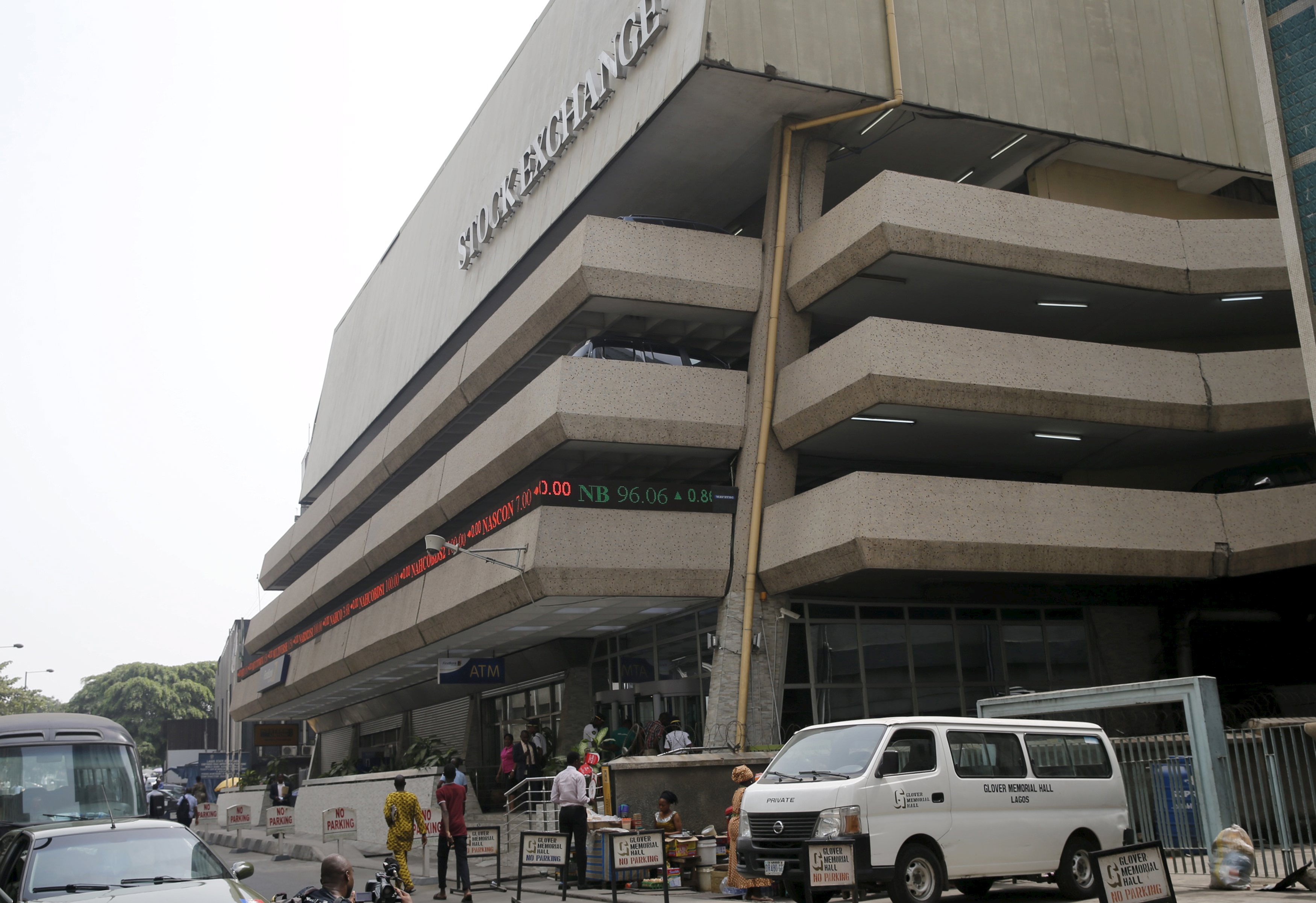
For the first time in seven straight trading sessions, the Nigerian Exchange (NGX) Limited recorded its first closure in green territory.
The local bourse ricocheted by 0.10 per cent on Tuesday after the Central Bank of Nigeria (CBN) retained the Monetary Policy Rate (MPR) at 27 per cent.
Also, Business Post observed that investors had keen interest in some banking equities, which helped to lift Customs Street at the close of business despite profit-taking in other key sectors of the market.
The banking index was up by 0.38 per cent, and the consumer goods counter improved by a marginal 0.01 per cent, while the insurance space lost 0.84 per cent and the energy industry weakened by 0.17 per cent, with the commodity and the industrial goods sectors closing flat.
When the stock market closed for the day, the All-Share Index (ASI) went up by 148.52 points to 143,763.13 points from 143,614.61 points and the market capitalisation grew by N95 billion to N91.441 trillion from N91.346 trillion.
The market breadth index was positive during the second trading day of the week after finishing with 26 price gainers and 20 price losers, indicating strong investor sentiment.
NCR Nigeria gained 9.98 per cent to settle at N45.20, Ikeja Hotel appreciated by 9.86 per cent to N22.85, Prestige Assurance improved by 9.56 per cent to N1.49, Eunisell rose by 9.49 per cent to N86.50, and Sterling Holdings soared by 8.96 per cent to N7.30.
However, Union Dicon slipped by 10.00 per cent to N6.30, Caverton also crashed by 10.00 per cent to N4.95, Sunu Assurance tumbled by 4.78 per cent to N4.38, Lasaco Assurance declined by 4.58 per cent to N2.50, and AXA Mansard lost 4.23 per cent to close at N12.45.
Despite the growth achieved by the NGX yesterday, the level of activity waned as traders transacted 556.2 million stocks for N18.7 billion in 19,500 deals versus the 694.8 million stocks valued at N28.7 billion traded in 24,041 deals a day earlier, implying a shortfall in the trading volume, value, and number of deals by 19.95 per cent, 34.84 per cent and 18.89 per cent apiece.
First Holdco was the most active with 93.7 million shares sold for N2.9 billion, Access Holdings traded 81.8 million stocks for N1.7 billion, Fidelity Bank exchanged 41.8 million equities worth N796.4 million, FCMB transacted 38.0 million shares valued at N386.8 million, and UBA traded 32.0 million stocks worth N1.2 billion.
Economy
We Will Continue to Borrow Responsibly—Tinubu
By Adedapo Adesanya
President Bola Tinubu has said that Nigeria would continue to borrow responsibly amid rising concerns about the country’s swelling debt profile.
According to a statement by presidential spokesperson, Mr Bayo Onanuga, President Tinubu made the remarks on Tuesday while leading Nigeria’s government, diplomatic, and business delegation to the Africa Forward Summit at the Kenyatta Convention Centre in Nairobi.
Mr Tinubu noted that the debt to be repaid in the year is nearly half of the projected revenue, at about $11.6 billion.
“Every single dollar that leaves our treasury to pay punitive interest rates is a Dollar that did not go into our steel sector, our textile mills, our agro-processing plants, or our digital industries. It is a dollar that did not train a young Nigerian engineer or provide affordable power for our factories.
“Our industrial base is being starved of the blood it needs — long-term, affordable finance — while creditors and rating agencies treat African sovereigns as permanent high-risk borrowers, regardless of our fiscal performance.
“So, I ask this gathering: how can an African manufacturer compete with a competitor in Europe, Asia, or North America when the cost of borrowing in our nations is five to ten times higher? How can we build cross-border industrial value chains under the African Continental Free Trade Area when our infrastructure projects face a financing gap deepened by the very institutions meant to bridge it? The answer is plain: we cannot. The international financial architecture, as currently constituted, is an instrument of industrial disarmament for Africa.”
He emphasised that Nigeria is not asking for charity, adding that the country will have to borrow, albeit responsibly.
“We are demanding a financial system that intentionally enables Africa to industrialise — to process its own minerals, refine its own crude oil, manufacture its own pharmaceuticals, and compete fairly in global markets.
“We will continue to borrow responsibly, but we insist that our creditworthiness be measured by our economic fundamentals and our industrial potential, not by outdated stereotypes,” he noted.
He called for deeper economic integration across Africa, stressing the need for policies that prioritise the continent’s industrial growth and prosperity.
Mr Tinubu highlighted Nigeria’s blue economy potential as a key driver of Africa’s development, noting that it had long been underutilised due to insecurity and uncertainty.
“Today, I make an explicit commitment: Nigeria will intensify regional coordination by offering our Deep Blue Project’s maritime intelligence infrastructure as a shared data hub for willing Gulf of Guinea states. Interoperable systems, harmonised laws, and seamless joint enforcement must become the daily reality, not an aspiration on paper.
“Let no one misunderstand: maritime sovereignty does not repel investment — it attracts it. Secure sea lanes, predictable regulation, and functional courts are the preconditions that unlock private capital. Governance has de-risked Nigeria’s maritime proposition. We now invite partners to build on these gains as we advance climate-aligned port modernisation and the digital transformation of our maritime sector.
“As we endorse the Nairobi Declaration, Nigeria affirms that maritime sovereignty and ocean governance are the non-negotiable foundations of Africa’s Blue Economy transformation. We will continue to earn that sovereignty — through institutions, through assets, through law, and through iron-clad regional solidarity that turns our waters from a theatre of risk into a story of shared resilience.
“The oceans have no duplicate as a common heritage of mankind. For Africa, moving from sea blindness to ocean sovereignty is not a choice — it is a generational duty. Nigeria is ready, and we invite all present to join us in that duty,” the President stated.
Economy
Middle East Tensions: Dangote Refinery Exports 1.66 billion Litres of Petroleum Products
By Adedapo Adesanya
An estimated 1.66 billion litres of refined petroleum products were exported by Dangote Petroleum Refinery in April 2026, amid continued tensions in the Middle East and fears of possible disruption to global fuel supply routes following the growing conflict involving the United States and Iran.
According to the latest data from the Nigerian Midstream and Downstream Petroleum Regulatory Authority (NMDPRA), the country exported about 513 million litres of Premium Motor Spirit (PMS), popularly called petrol; 534 million litres of Automotive Gas Oil (AGO), also known as diesel; and 615 million litres of aviation fuel within the month under review.
The Dangote refinery is the only major functional refinery in Nigeria that currently produces enough refined petroleum products for both local consumption and export.
This is the first month the refinery has exported such a high volume of petroleum products, especially jet fuel and diesel, indicating the significance of the 650,000-barrel-per-day plant.
The combined export volume translates to approximately 55.4 million litres daily. The development comes as the international oil market faces fresh uncertainty over the security of the Strait of Hormuz, a critical global oil shipping route, following the failure of the United States and Iran to agree on a peace deal.
The NMDPRA document showed that local refineries operated at an average capacity utilisation of 99.12 per cent in April, with the Dangote refinery accounting for the lion’s share of production.
The downstream regulator stated that the refinery achieved 100 per cent capacity utilisation “for most of the days in April.” The report also indicated that domestic refineries received 18.37 million barrels of crude oil in April, up from 13.11 million barrels recorded in March.
Findings further showed that the refinery maintained strong export momentum despite increased domestic supply obligations.
According to the April fact sheet, average daily petrol production stood at 53.6 million litres, while 40.7 million litres were supplied locally and 17.1 million litres were exported daily.
Similarly, diesel production averaged 23.6 million litres daily, with exports accounting for 17.8 million litres per day, more than double the domestic supply volume of 8 million litres daily. For aviation fuel, exports stood at 20.5 million litres daily, compared to the domestic supply of 2.6 million litres per day.
The strong aviation fuel export performance comes weeks after reports emerged that domestic airline operators threatened to shut down over the rising cost of the fuel.
There are reports that Nigeria has become a net petrol exporter for the first time in decades due to rising output from the Dangote refinery. The refinery had earlier exported about 434 million litres of petrol in March after domestic production exceeded local consumption levels.
The latest figures underscore Nigeria’s gradual transition from a major importer of refined petroleum products to an export hub within Africa. It was observed that jet fuel exports may rise further if instability in the Middle East continues to disrupt traditional supply chains serving Europe and other regions.
The Middle East accounts for a substantial share of global aviation fuel exports, with the Strait of Hormuz serving as a strategic transit corridor for crude oil and refined petroleum products. The prolonged disruption in the region has tightened global fuel supply and pushed up prices internationally.
The NMDPRA report also revealed that Nigerians consumed an average of 51.1 million litres of petrol daily in April, slightly above the 50 million litres benchmark estimated by the regulator. Diesel consumption stood at 17.3 million litres daily, while aviation fuel consumption averaged 2.5 million litres per day.
Economy
Nigeria, Binance Begin Settlement Talks in Tax Evasion Suit
By Adedapo Adesanya
The federal government of Nigeria and Binance are trying to settle a major tax evasion case out of court instead of continuing full trial proceedings immediately.
The Federal High Court in Abuja on Tuesday adjourned the alleged tax evasion case filed by the federal government against Binance Holdings Limited until July 9 for a report of settlement.
Justice Emeka Nwite adjourned the matter after Binance lawyer, Mr Chukwuka Ikwuazom (SAN), and the federal government’s counsel, Mrs Omotola Fatogun, informed the court that parties were still discussing settling the case out of court.
The cryptocurrency company had, on March 24, sought an amicable resolution of the matter.
Another lawyer, Mr Sunday Adaji, who represents Binance, informed the court that discussions were ongoing.
Mr Moses Ideho, a Deputy Director, Legal Department, Federal Inland Revenue Service (now Nigeria Revenue Service), confirmed the development on the federal government’s behalf.
Binance Holdings Limited was, on July 12, 2024, re-arraigned on a four-count charge bordering on tax evasion allegations.
The Nigerian representative of Binance, Mr Ayodele Omotilewa, who was docked, took a plea on behalf of the company before Justice Nwite.
He pleaded not guilty to the four counts.
The re-arraignment before the judge followed the discharge of the cryptocurrency firm’s executive, Mr Tigran Gambaryan, and his fleeing colleague, Mr Nadeem Anjarwalla, from the alleged offence.
Justice Nwite, in a ruling on June 14, 2024, discharged and struck out Gambaryan and Anjarwalla’s names from the charge after Ideho filed an amended charge wherein Binance is listed as the sole defendant.
The amended charge was dated June 13, 2024, but filed June 14, 2024.
The Economic and Financial Crimes Commission (EFCC) is also prosecuting the cryptocurrency company on allegations bordering on money laundering offences before the same judge.
The anti-graft agency had accused Binance of money laundering to the tune of $35.4 million.
Besides, Binance is also facing another civil suit before Justice Mohammed Umar, a brother judge, where the FIRS is demanding about $79.5 billion over economic losses allegedly caused by the company’s operations in Nigeria.
-
Feature/OPED6 years agoDavos was Different this year
-
Travel/Tourism10 years ago
Lagos Seals Western Lodge Hotel In Ikorodu
-
Showbiz3 years agoEstranged Lover Releases Videos of Empress Njamah Bathing
-
Banking8 years agoSort Codes of GTBank Branches in Nigeria
-
Economy3 years agoSubsidy Removal: CNG at N130 Per Litre Cheaper Than Petrol—IPMAN
-
Banking3 years agoSort Codes of UBA Branches in Nigeria
-
Banking3 years agoFirst Bank Announces Planned Downtime
-
Sports3 years agoHighest Paid Nigerian Footballer – How Much Do Nigerian Footballers Earn