

Economy
Nigerian Miners, Geoscientists Question Search for Oil in ‘Boko Haram Territory’

By Modupe Gbadeyanka
Federal Government has been urged to explain to Nigeria why it is desperately searching for crude oil in a “hotly contested land” in the Chad Basin.
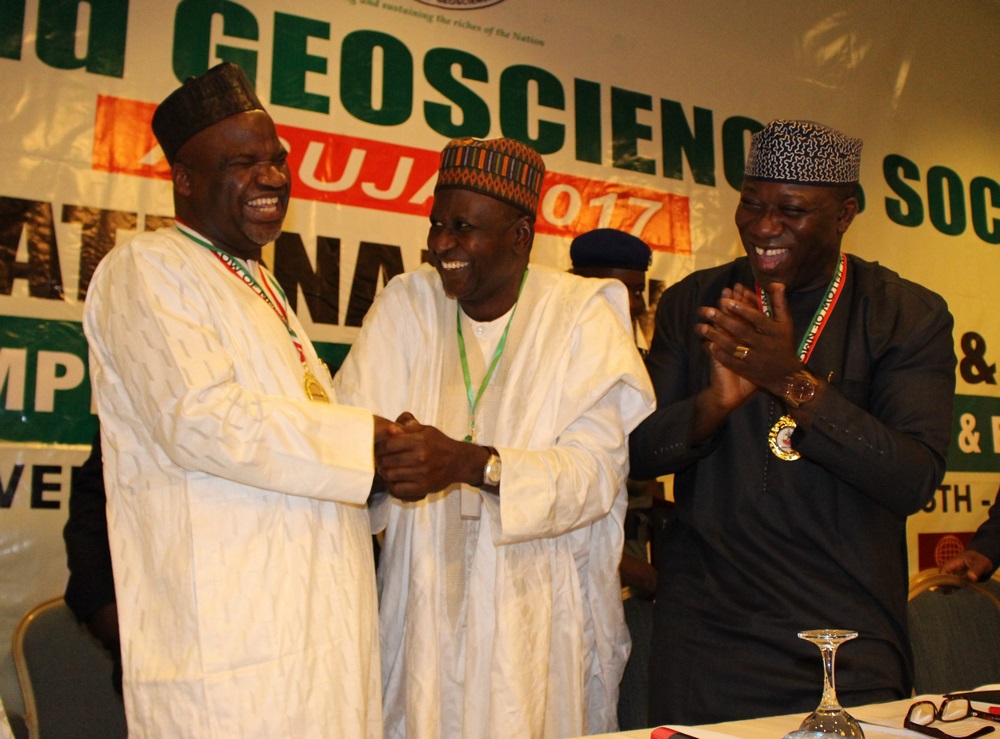
This question was asked by President of the Nigerian Mining and Geosciences Society (NMGS), Prof. Silas Sunday Dada, at a press conference held on Monday, July 31, 2017 to condemn the recent attack by suspected Boko Haram members on oil exploration team.
According to Prof Dada, “Nigerians deserve to know the real reason why NNPC decided to embark on the Maiduguri’s suicide mission of searching for crude oil at Shekau’s background at a time when production level has climbed to 2.2 million barrels per day.”
He said, “The present crude oil exploratory work is centred on a triangle of hotly contested land stretching from Gubio in the west of Borno to Marte in the east, and Kukawa, in the far northeast corner near the shores of Lake Chad.”
“Although it could not be established if the Tuesday attack by the Boko Haram sect is motivated by a desire to control oil in the northeast of Nigeria, but it is undisputable particularly in recent months, that the group has been forced by the superior force of the military’s ‘operation dole’ in the area to rely on guerrilla tactics, particularly suicide bomb attacks, against the security forces and civilian militia.
“This involved the use of women and young girls in particular to detonate improvised bombs against civilian ‘soft’ targets such as mosques, churches as well as the University of Maiduguri, which teaches the ‘western’ education the group despises,” he added.
Read the full transcript of the press conference below;
The growing deadly attacks by the Boko Haram Group in the Northeast of Nigeria – a clarion call for negotiation before the precipice
“Those who would hunt a man should remember that the Jungle also contain those who hunt the hunters”– Malcom X
Preamble
We have been watching with painful indignation, the spate of deadly attacks and wanton destruction of lives and properties being perpetrated by the deadly Boko Haram Group mostly in the northeastern Nigeria especially in Borno State in the last five (5) years. It is indeed an open secret that the deadly group has been holding out in the Maiduguri axis, launching expeditionary raids and dispatching suicide bombers to perpetrate cruelty to a shock. Their inhuman predation in that zone has become the staple news being dished out almost on daily basis to the helpless frustration of Nigerians.
It is apposite to start this short briefing with a plea that no one should misconstrue this press briefing we are holding right now as a ploy to castigate the government for what it ought to have done or ought not to have done on the issue of Boko Haram. Nothing of such is intended. We cannot however look helplessly and refuse to speak when our brothers, friends and professional colleagues were brutally murdered in the course of their national duties to this country last Tuesday by the dreaded Boko Haram sect. We feel indeed very sad and grieved by the untimely death of these patriotic men and only time can heal the wound left in our hearts by their sudden departure.
It is obvious that the recent sustained offensive by the Boko Haram group is to openly challenge and contest the government’s story on their degradation. It is saddening to observe that the celebrated claim by the Nigerian military for about a year now, over the “degradation of Boko Haram” which created the flippant impression that the rebellious group has been demoralized, demobilized, defeated and vanquished, was far from being true after all, as recent happenings have proved otherwise.
To worsen the situation, the same military rained bombs on the IDP camp at Rann, a sanctuary of the helpless refugees which it presumed to be the hideaway of the terrorists. The erroneous bombardment wasted 54 precious lives!
Although the need to grow Nigeria’s crude oil reserves must have motivated the government to intensify efforts on oil exploratory work in the inland Chad basin and Benue Trough areas, Nigerians deserve to know the real reason why NNPC decided to embark on the Maiduguri’s suicide mission of searching for crude oil at Shekau’s background at a time when production level has climbed to 2.2 million barrels per day. Sadly enough, this daredevil stunt has unjustifiably created a new set of widows and fatherless children.
The present crude oil exploratory work is centered on a triangle of hotly contested land stretching from Gubio in the west of Borno to Marte in the east, and Kukawa, in the far northeast corner near the shores of Lake Chad. Although it could not be established if the Tuesday attack by the Boko Haram sect is motivated by a desire to control oil in the northeast of Nigeria, but it is undisputable particularly in recent months, that the group has been forced by the superior force of the military’s “operation dole” in the area to rely on guerilla tactics, particularly suicide bomb attacks, against the security forces and civilian militia. This involved the use of women and young girls in particular to detonate improvised bombs against civilian “soft” targets such as mosques, churches as well as the University of Maiduguri, which teaches the “western” education the group despises.
The Dark Tuesday – Our Agony
It is no longer news that more than 50 people were killed in a Boko Haram ambush on an oil exploration team in northeast Nigeria on Tuesday last week with the possibility that the death toll could rise. What happened last week underscored the persistent threat posed by the jihadists, despite government claims they were a spent force, and also the risks associated with the hunt for crude oil in the volatile Lake Chad basin. It is noteworthy to state that the Tuesday’s attack in the Magumeri area of Borno state on a convoy of specialists from the Nigerian National Petroleum Corporation (NNPC) was the militants’ deadliest in months.
It should be noted that details of the ambush, which we initially thought to be a kidnapping case, have been slow to emerge and an exact death toll is difficult to establish, as the military strictly controls access to rural Borno. Worst still, telecommunications and other infrastructure have been severely damaged or destroyed in that part of the country over the years in the raging Boko Haram bloody escapade, which has left over 20,000 people dead and more than 2.6 million homeless since 2009. One source involved in dealing with the aftermath of the unfortunate event which took place on Tuesday revealed that the death toll has increased to more than 50 with a prospect that more casualties may be recorded.
It is crystal clear that the recent attack was not for abduction but rather to kill and show that the government’s claim of an incapacitated Boko Haram is a fallacy.
An aid agency worker in Magumeri, which is 50 kilometers northwest of Maiduguri revealed that a total of 47 bodies have been recovered from the bush as of Wednesday evening. Information at our disposal shows that “eleven of them were burned alive in their vehicle, which was stuck in a trench, and were buried in Magumeri as they could not be taken to Maiduguri”.
It should be placed on record that out of the nine (9) staff of the University of Maiduguri involved in the unfortunate attack, five (5) are geologists out of which two (2) have been killed, two (2) abducted and one (1) is still missing. Boko Haram insurgents have released a video of the two geologists abducted along with their driver. The video according to reports was recorded on Friday July 28, 2017 and sent to Channels Television. The two (2) geologists are Mr. Yusuf Ibrahim and Dr. Solomon N. Yusuf who are lecturers in the Geology Department of the University along with a driver of the University identified as Mr. Haruna Dashe, were seen in the video fervently appealing to the Federal Government, the University of Maiduguri administration and the NNPC to avoid the use of force and secure their release through a peaceful negotiation with the Abu Musab al-Barnawi’s group of the insurgents who are holding them in captivity
The names of some of the deceased staff of UNIMAID include Dr. Militus Joseph V., Dr Manaja M. Uba of Geology Dept, Idris Abubakar Njodi (Driver)and Dr. Daniel Birma and Mohammed Kamfo of the Soil Science Dept.
The Journey to the Precipice – How did we get to where we are?
The name “Boko Haram” which is usually translated as “Western education is forbidden” was founded in 2002 as a radicalized fundamentalist group in Maiduguri, but also active in Chad, Niger and northern Cameroun. The group came into limelight with increasing radicalization leading to a violent uprising in July 2009 during which its leader, Mohammed Yusuf, was summarily executed.
The group’s unexpected resurgence was marked by a mass prison break in September 2010 which was accompanied by increasingly sophisticated attacks, initially against soft targets, and progressing in 2011 to include suicide bombings of police buildings and the United Nations office in Abuja
Mohammed Yusuf who founded the sect that became known as Boko Haram in Maiduguri, the capital of the north-eastern state of Borno, established a complex group and school that attracted poor individuals and families from across Nigeria and neighboring countries. The center had the political goal of creating a state of anarchy, and became a recruiting ground for terrorists.
By denouncing the police and state corruption, Yusuf attracted followers from unemployed youth and in fact, it has been speculated that the real reason Yusuf founded Boko Haram was to use the opportunity to exploit public outrage at government corruption by linking it to Western influence in governance.
The government’s declaration of a state of emergency at the beginning of 2012, extended in the following year to cover the entire northeast of Nigeria, led to an increase in both security force abuses and militant attacks. In 2014 alone, Boko Haram had killed over 6,600 and in April 2014, the group have carried out mass abductions including the kidnapping of 276 schoolgirls from Chibok in Borno State. By mid-2014, the militants had gained control of some territories in and around their home state of Borno and expand up to about 50,000 square kilometres in January 2015, but failed to capture the state capital, Maiduguri, where the group was originally based.
The group was led by Abubakar Shekau until August 2016, when the group purportedly broke into two (2): one faction led by Abubakar Shekau and the other supposedly led by Abu Musab al-Barnawi.
The group at various times had alleged links to al-Qaeda and in March 2015, it announced its allegiance to the Islamic State of Iraq and the Levant (ISIL). Since the current insurgency started in 2009, the group has killed 20,000 victims, displaced 2.3 million from their homes and was ranked as the world’s deadliest terror group by the Global Terrorism Index in 2015.
Our Position
It is a known fact that man is not a creation of logic but rather, a creation of emotion, love and prejudice. He is bound to be happy at times of peace and grieves at times of adversity; he is receptive to justice/good governance and repulsive towards injustice/maladministration. It is in the light of this that the Nigerian Mining & Geosciences Society (NMGS) as a professional body feel grieved by the recent security challenges being faced at this point in our national life, particularly the ongoing carnage being perpetrated by the dreaded Boko Haram sect, in spite of the seriousness of the current federal government in bringing the dastardly acts to an end.
We owe ourselves, and generations to come, the obligation to commend the efforts of the present Administration of President Muhammadu Buhari over the serious attention given to the issue of Boko Haram since inception of this government. The huge amount of fund and human resources committed to fight the Boko Haram group to a standstill largely underscore the successes recorded so far. It is however sad to note that if the previous administration had handled the Boko Haram saga the way the present administration is doing, the story may have been different today. Those who were saddled with the constitutional obligation of protecting the lives and properties of citizens of the Nigerian State as well as its territorial integrity chose to do otherwise as evident in recent revelation of how the state resources meant to fight the Boko Haram insurgence was diverted for personal use. Corruption in the security services and human rights abuses committed by them during the previous administration have hampered efforts to counter the unrest and nib it in the bud.
While our great Society commends the pragmatic approach of the present administration in putting a stop to this national disgrace called Boko Haram, we want the military to urgently swing into action and adopt negotiation method which has shown to be more effective and life-saving than the use of force as witnessed in the release of substantial number of Chibok school girls, to rescue our colleagues and all others in captivity of the Boko Haram. We also wish to state that the war against Boko Haram insurgency in Nigeria has dragged on for too long and we therefore urge the Federal Government to redouble its efforts in the fight against the insurgency in the Northeast so that the Boko Haram problem is stamped out permanently sooner than later.
Conclusion
On behalf of myself and the entire esteemed members of our Society, we wish to restate our renewed confidence in the ability of the present administration of His Excellency President Muhammadu Buhari and the acting President Prof. Yemi Osinbajo in tackling the Boko Haram issue once and for all. We commend your efforts so far and pledge our sincere prayers towards overcoming this problem.
Once again, we urge the Federal Government to adopt the use of negotiation to secure the release of the Boko Haram captives by doing everything humanly possible to meet the demands of the sect. We also share in the grief being suffered by the families of the deceased professional colleagues and the traumatic agony those in Boko Haram captivity and their families are currently being subjected to. We pray the Almighty God help us all to surmount the barrage of problem being faced in both our national and private lives.
Ladies and Gentlemen of the Press, I sincerely thank you for standing by us at this critical time in the Society’s history. God bless you all.
Prof. Silas Sunday DADA (fnmgs)
President, Nigerian Mining and Geosciences Society


