Connect with us

Economy

Nigerian Oil and Gas Firms Pay N71.6bn as Flaring Penalties

Published

on

gas flaring penalties

By Adedapo Adesanya

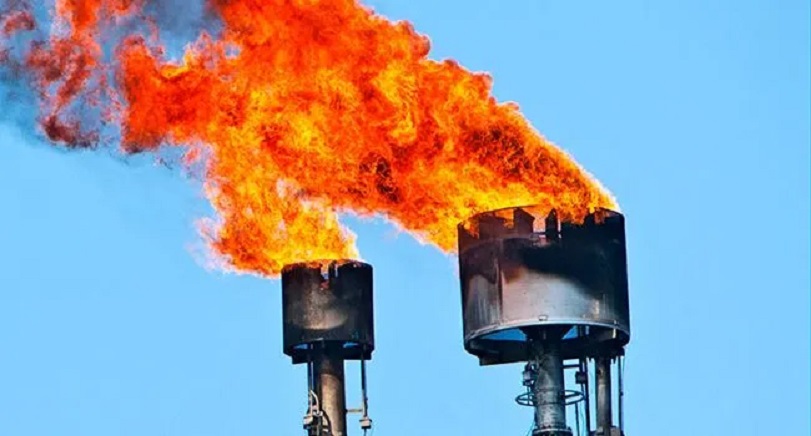
Data from the Central Bank of Nigeria (CBN) has revealed that oil and gas firms operating in the country paid N71.6 billion to the federation account in 2022 as penalties for gas flaring.

The CBN, in its economic report for 2022, disclosed that gas flare penalties accounted for 1.54 per cent of the federation’s gross oil earnings, irrespective of the fact that the country recorded zero revenue from gas sales in 2022.

Giving a breakdown of the revenue from the gas flaring penalties, the CBN stated that in January, February, March, April, May and June 2022, revenue from gas flaring penalties stood at N6.457 billion, N6.565 billion, N6.304 billion, N5.725 billion, N7.778 billion and N4.917 billion, respectively.

Meanwhile, N7.732 billion, N5.24 billion, N3.738 billion, N4.133 billion, N5.972 billion and N7.055 billion were received from the same source in July, August, September, October, November and December 2022, respectively.

In comparison, the CBN reported that the revenue earned from gas flare penalties in 2022 was 25.84 per cent lower than the N96.544 billion recorded in 2021, where in January, February, March, April, May and June 2021, N5.795 billion, N7.254 billion, N5.53 billion, N13.353 billion, N6.501 billion and N6.283 billion, respectively.

In addition, in July, August, September, October, November and December 2021, the financial sector regulator stated that revenue from gas flared penalties stood at N6.167 billion, N12.336 billion, N7.929 billion, N6.379 billion, N8.404 billion and N10.611 billion, respectively.

Furthermore, the central bank stated that banks’ credit to the Nigeria oil and gas industry appreciated by 30.2 per cent from N1.466 trillion as at the end of 2021 to N1.908 trillion at the end of 2022.

The CBN noted that credit to the oil and gas sector accounted for 6.48 per cent of the banks’ total credit to the private sector, valued at N29.446 trillion.

Also, the bank disclosed that banks’ credit to the power and energy sector in 2022 stood at N297.408 billion, dropping by 12.26 per cent compared with N338.945 billion recorded at the end of 2021.

According to the CBN data, credit to the power sector in 2022 accounted for 1.01 per cent of banks’ total credit to the private sector.

As of December 31, 2021, the total credit facilities advanced by the banks to the private sector stood at N24.378 billion, 20.79 per cent lower compared with the N29.446 trillion advanced to the private sector in 2022.


Adedapo Adesanya is a journalist, polymath, and connoisseur of everything art. When he is not writing, he has his nose buried in one of the many books or articles he has bookmarked or simply listening to good music with a bottle of beer or wine. He supports the greatest club in the world, Manchester United F.C.

1 Comment

Leave a Reply

Your email address will not be published. Required fields are marked *

Economy

Corporate Reporting Boosts Market Integrity, Investor Confidence—NGX RegCo CEO

Published

on

Olufemi Shobanjo NGX RegCo

By Aduragbemi Omiyale

The chief executive of the Nigerian Exchange (NGX) Regulation Limited, Mr Femi Shobanjo, has made a strong case for corporate reporting, submitting that it remains critical to enhancing market integrity and boosting investor confidence.

He gave this view at the 3rd edition of the Corporate Reporting Awards organised by his organisation and the Institute of Chartered Accountants of Nigeria (ICAN).

The event recognised listed companies on the local stock exchange for excellence in financial reporting, corporate governance, and sustainability disclosures for the 2024 financial year.

The awards, which cover companies on the NGX 30 Index, assessed performance across three pillars: Financial Reporting (35 per cent), Corporate Governance (30 per cent), and Sustainability Reporting (35 per cent).

Organisers said the 2024 assessment was conducted under strict confidentiality and objectivity, with outcomes based strictly on merit. The exercise builds on earlier editions covering the 2022 and 2023 financial years and continues to serve as a benchmark for corporate disclosure standards in the Nigerian capital market.

Mr Shobanjo highlighted NGX RegCo’s continued adoption of global reporting frameworks, including the International Financial Reporting Standards (IFRS), the Nigerian Code of Corporate Governance, and the IFRS Sustainability Disclosure Standards (IFRS S1 and S2).

According to him, the growing emphasis on environmental, social, and governance (ESG) disclosures reflects an important shift in market expectations, as sustainability considerations are increasingly becoming central to corporate strategy and long-term value creation.

“Strong corporate reporting is fundamental to market integrity and investor confidence. Beyond financial performance, there is now a clear expectation for companies to disclose how environmental, social, and governance considerations are embedded in their strategy.

“Long-term corporate success is increasingly linked to the integration of sustainability into core business decisions,” he said.

He added that the “Most Improved Company” category was introduced to encourage continuous improvement in reporting quality among listed firms.”

On his part, the president of ICAN, Mr Haruna Nma Yahaya, said corporate reporting has evolved significantly beyond compliance, becoming a strategic instrument for communicating purpose, resilience, and direction.

He noted that organisations are now expected not only to report performance but also to demonstrate how they are responding to change and creating sustainable value.

“Corporate reporting has evolved beyond compliance to become a strategic tool that communicates purpose, resilience, and direction.

“In today’s environment, organisations are expected not only to report performance, but also to demonstrate how they are adapting to change and creating sustainable value. Transparency remains central to building trust, strengthening investor confidence, and supporting market stability,” he said.

International Breweries Plc was named Most Improved Company (Overall), while First HoldCo Plc won the Sustainability Reporting Award. Zenith Bank Plc received the Corporate Governance Award, and MTN Nigeria Communications Plc clinched the Financial Reporting Award.

In the top overall category, Access Holdings Plc won Silver, Airtel Africa Plc took Gold, while Seplat Energy Plc emerged Platinum winner.

Continue Reading

Economy

Crude Oil Rises 3% as Iran Hesitates on US Peace Talks

Published

on

crude oil exports

By Adedapo Adesanya

Crude oil climbed about 3 per cent on Tuesday after Iran said it had yet to decide whether to attend peace talks with the United ​States.

With one day left before the ceasefire runs out in the Iran war, US President Donald Trump said he hoped to ‌reach a deal to end the war. However, he said he did not want to extend the ceasefire, adding that the US military was “raring to go” if negotiations were not successful.

This development raised the price of Brent futures by $3 or 3.1 per cent to $98.48 a barrel, and lifted the US West Texas Intermediate (WTI) futures by $2.52 or 2.8 per cent to $92.13 per barrel.

Crude oil prices have spent most of March-April seesawing up and down, reacting to Iran’s closure of the Strait of Hormuz and President Trump’s Truth Social posts.

The lack of progress in US-Iran talks and their continuous postponement are keeping the oil market on edge, with the American President’s latest comments about no extension sending another wave of anxiety across market watchers.

Shipping traffic through the Strait ​of Hormuz, which normally handles about 20 per cent of global oil and liquefied natural gas supplies, remained broadly halted on ⁠Tuesday with only three ships passing the waterway in the past 24 hours. Over 1 billion barrels of crude have been disrupted due to the blockade.

Meanwhile, the Israeli military said Hezbollah fired rockets at Israeli troops in southern Lebanon, accusing the Iran-backed group of violating a ceasefire ahead of US-mediated talks between the government of Israel and Lebanon this week.

The European Union (EU) said it will provide guidance to airlines on how to handle issues such as airport slots, passenger rights ​and public service obligations in the event of jet fuel shortages because of the Iran war.

Countries continued to feel the effects of the war. In Germany, the biggest economy ​in Europe, investor morale declined to its ​lowest level in more than three ⁠years in April, while in the US, retail sales increased more than expected in March as the war in ​Iran boosted gasoline prices.

Ukrainian President Volodymyr Zelenskiy said the Druzhba oil ‌pipeline, which pumps ⁠Russian oil to Europe, is ready to resume operations, signalling that Ukraine now expects an over $106 billion aid package to be unblocked.

The American Petroleum Institute (API) estimated that crude oil inventories in the US fell by 4.4 million barrels in the week ending April 17. In the week prior, US crude oil inventories rose by 6.10 million barrels. Official data from the Energy Information Administration (EIA) will be released later on Wednesday.

Continue Reading

Economy

NASCON, Others Drive Stock Exchange’s 0.06% Rise as Bulls, Bears Fight for Control

Published

on

Local Stock Exchange

By Dipo Olowookere

The local stock exchange recorded a marginal 0.06 per cent surge on Tuesday as the bulls and the bears engaged in a fierce battle for control of the bourse.

Business Post reports that the Nigerian Exchange (NGX) Limited experienced a mix of profit-taking and bargain-hunting, with two of the five key sectors ending in green.

According to data from Customs Street, the banking counter lost 1.30 per cent, the consumer goods sector decreased by 0.39 per cent, and the energy index tumbled by 0.09 per cent.

However, the industrial goods and the insurance indices appreciated by 1.64 per cent and 0.19 per cent, respectively, as a result of buying pressure.

Consequently, the All-Share Index (ASI) went up by 135.97 points to 218,249.81 points from 218,113.84 points, and the market capitalisation soared by N87 billion to N140.523 trillion from N140.436 trillion.

The market breadth index for the session was negative, like the preceding session, with 26 price gainers and 45 price losers, showing bearish investor sentiment.

Again, NASCON led the advancers’ group after it chalked up another 10.00 per cent to close at N171.60. Union Dicon increased by 9.92 per cent to N19.95, Lafarge Africa gained 9.64 per cent to trade at N273.00, Trans-Nationwide Express appreciated by 8.27 per cent to N7.20, and UAC Nigeria rose by 7.84 per cent to N110.00.

On the other side, Legend Internet depreciated by 9.92 per cent to N5.63, Abbey Mortgage Bank shed 9.59 per cent to quote at N6.60, Stanbic IBTC weakened by 8.96 per cent to N154.50, Access Holdings dropped 8.83 per cent to close at N29.95, and Veritas Kapital crashed by 7.50 per cent to N1.85.

On top of the activity chart yesterday was Access Holdings with 110.7 million shares sold for N3.6 billion, FCMB transacted 57.7 million equities valued at N751.5 million, Fidelity Bank exchanged 44.8 million stocks worth N1.0 billion, Zenith Bank traded 44.2 million equities for N5.5 billion, and UBA transacted 43.6 million shares valued at N2.2 billion.

At the close of trades, 842.5 million stocks worth N44.9 billion exchanged hands in 61,617 deals versus the 984.0 million stocks valued at N50.8 billion executed in 76,410 deals on Monday, indicating a shortfall in the trading volume, value, and number of deals by 14.38 per cent, 11.61 per cent, and 19.36 per cent, respectively.

Continue Reading

Trending