Connect with us

Economy

Nigerian Stocks Close Week with 0.78% Growth

Published

on

Nigerian Stocks

By Modupe Gbadeyanka

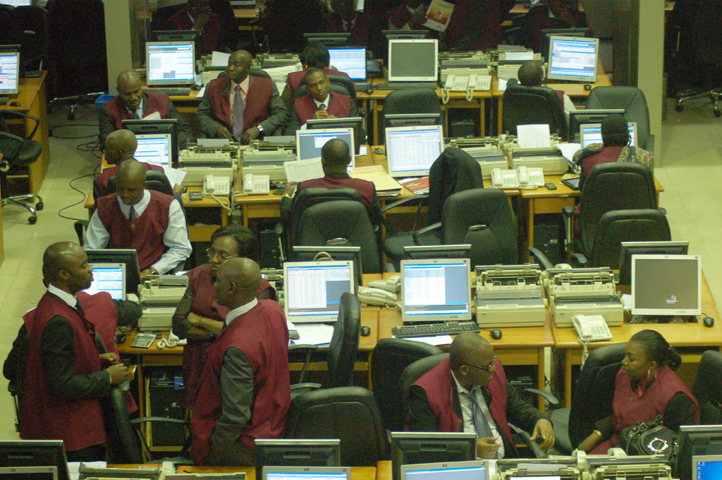
Trading activities on the floor of the Nigerian Stock Exchange (NSE) closed for the week bullish on Friday, stretching gains at the market to the 4th session.

This was influenced by gains recorded by some blue-chip stocks led by Nigerian Breweries and Forte Oil.

Nigerian Breweries chalked up N3.25k to close at N175.65k per share, while Forte Oil gained N2.87k to finish at N60.37k per share.

Dangote Cement went up by N2 to end at N242 per share, Julius Berger rose by N1.79k to settle at N35.99k per share, and 7up advanced by N1.75k to close at N92 per share.

However, it was not so good for Beta Glass and 10 other equities, which depreciated at the close of transactions on Friday.

Beta Glass shed N3.1k to settle at N57.33k per share, while Zenith Bank fell by 20k to finish at N25.20k per share.

UBA declined by 9k to end at N9.81k per share, Stanbic IBTC lost 5k to close at N37.50k per share, and Morison Industries also depreciated by 5k to settle at N1.13k per share.

But a look at the market indices showed the All-Share Index (ASI) rising by 0.78 percent or 289.92 points to close at 37,425.15 points, while the market capitalisation increased by N99.9 billion to finish at N12.9 trillion and the YTD return expanded to 39.26 percent.

Business Post reports that WAPIC was the most active stock at the market today, trading 118.6 million shares for N59.3 million.

It was followed by Zenith Bank, which transacted 80.3 million shares worth N2.03 billion, and Access Bank, which exchanged 78.7 million shares valued at N789.12 million.

Transcorp sold 29.1 million shares at N42.5 million, while GTBank traded 23.8 million shares valued at N962 million.

At the close of transactions on the floor of the NSE on Friday, investors transacted a total of 515.5 million shares worth N6.3 billion executed in 4,132 deals.


Modupe Gbadeyanka is a fast-rising journalist with Business Post Nigeria. Her passion for journalism is amazing. She is willing to learn more with a view to becoming one of the best pen-pushers in Nigeria. Her role models are the duo of CNN's Richard Quest and Christiane Amanpour.

1 Comment

Leave a Reply

Your email address will not be published. Required fields are marked *

Economy

Naira Crashes to N1,383 Per Dollar at NAFEX

Published

on

funds in Naira accounts

By Adedapo Adesanya

The value of the Naira crashed against the United States Dollar by N2.70 0r 0.2 per cent in the Nigerian Autonomous Foreign Exchange Market (NAFEX) on Monday, June 29, to N1,383.63/$1 from last Friday’s exchange rate of N1,380.93/$1.

This was influenced by FX pressure on the domestic currency, which also weakened its exchange rate against the Pound Sterling in the same market segment during the session by N6.06 to N1,831.64/£1 from the previous value of N1,824.90/£1. It also depleted the Nigerian currency against the Euro by 45 Kobo, trading at N1,578.03/€1 versus the preceding session’s N1,577.58/€1.

However, it maintained stability against the greenback at the parallel market and the GTBank forex desk yesterday at N1,395/$1 and N1,387/$1, respectively.

Despite the pressure on the Naira, it is still trading within the expected range, as a result of ongoing FX reforms, stronger market liquidity, and increased transparency in the FX market.

Unlike in previous years, the improved stability is reflected in the relatively narrow spread between the official exchange rate and rates in the Bureau de Change (BDC) segment, suggesting that reforms introduced by the Central Bank of Nigeria (CBN) are helping to improve price discovery and reduce distortions.

Also, Nigeria’s external reserves, which provide the apex bank with the capacity to support the Naira and meet the country’s external obligations, have continued to trend upward. Most recent data published on the apex bank’s website showed that reserves rose to $51.29 billion as of June 26, 2026.

In the cryptocurrency market, Bitcoin (BTC) lost momentum after it dropped below $60,000, remaining under its 200-week moving average as currency markets swung following the Japanese Yen slipping to four-decade lows against the US Dollar.

Strategy, the largest public holder of bitcoin, plans to sell more than $1 billion of BTC as part of a $1.25 billion monetisation program, a sharp break from Michael Saylor’s long-held “never sell” stance. BTC traded at $59,463.89.

Dogecoin (DOGE) went down by 0.9 per cent to $0.0723, TRON (TRX) slipped by 0.8 per cent to $0.3196, Cardano (ADA) dipped 0.2 per cent to $0.1446, and Ripple (XRP) dropped 0.1 per cent to close at $1.04.

On the flip side, Solana (SOL) gained 2.5 per cent to sell at $73.99, Ethereum (ETH) improved by 0.4 per cent to $1,587.51, and Binance Coin (BNB) added 0.01 per cent to sell for $552.58, while the US Dollar Tether (USDT) and the US Dollar Coin (USDC) remained unchanged at $1.00 each.

Continue Reading

Economy

NGX Diarrhoea Persists, Further Loses 1.57% Amid Panic Sell-Offs

Published

on

NGX investors

By Dipo Olowookere

Panic sell-offs by investors have left the Nigerian Exchange (NGX) Limited losing weight very fast, as it further gave up 1.57 per cent on Monday.

Yesterday, only 17 equities ended on the advancers’ log, while 45 equities finished on the laggards’ chart, representing a negative market breadth index and weak investor sentiment.

All the major sectors of the bourse tasted defeat during the session, with the insurance counter down by 1.33 per cent. The banking space lost 1.22 per cent, the consumer goods index depreciated by 0.63 per cent, the industrial goods segment shed 0.39 per cent, and the energy sector tumbled by 0.06 per cent.

Consequently, the All-Share Index (ASI) stumbled by 3,682.70 points to 228,366.32 points from 232,049.02 points, and the market capitalisation slipped by N2.363 trillion to N146.542 trillion from N148.905 trillion.

Learn Africa lost 10.00 per cent to close at N9.00, MTN Nigeria also declined by 10.00 per cent to N747.00, Unilever Nigeria crashed by 10.00 per cent to N126.00, Austin Laz dropped 9.94 per cent to settle at N3.17, and Universal Insurance dipped by 9.90 per cent to quote at N28.12.

Conversely, Sovereign Trust Insurance gained 4.08 per cent to end at N2.04, Cornerstone Insurance chalked up 3.45 per cent to trade at N6.00, Neimeth appreciated by 3.03 per cent to N8.50, Livestock Feeds climbed by 1.92 per cent to N7.95, and C&I Leasing grew by 1.90 per cent to N5.35.

Business Post observed a surge in activity level on the first trading day of this week, with the trading volume, value, and number of deals up by 156.37 per cent, 137.50 per cent, and 38.50 per cent.

This was because market participants transacted 996.5 million stocks worth N43.7 billion in 61,813 deals on Monday compared with the 388.7 million stocks valued at N18.4 billion traded in 44,631 deals last Friday.

Ikeja Hotel exchanged 305.5 million shares for N13.2 billion, Access Holdings sold 289.9 million equities worth N6.6 billion, Dangote Sugar traded 29.4 million stocks valued at N1.9 billion, Chams transacted 22.0 million shares worth N87.9 million, and Zenith Bank traded 21.2 million equities for N2.4 billion.

Continue Reading

Economy

Oil Prices Climb Over 1% as Fragile US-Iran Truce Faces New Concerns

Published

on

Crude Oil Prices

By Adedapo Adesanya

Oil prices settled higher by more than 1 per cent on Monday after attacks by the United States and Iran underscored ‌the fragility of their interim peace deal.

Brent crude futures gained $1.16 or 1.61 per cent to sell at $73.15 a barrel, while the US West ⁠Texas Intermediate (WTI) crude appreciated by $1.52 or 2.2 per cent to $70.75 per barrel.

The latest price movement appears to suggest that the market is concerned about a reduction in tanker traffic through the Strait of Hormuz following attacks on two commercial vessels on Thursday and Friday last week, and a further flare-up over the weekend.

The Thursday attack on the container ship Ever Lovely prompted some shipowners to pull back and wait for additional information about how safe transiting the Strait is. The US military on Friday carried out strikes on Iran in response to the attack on the vessel.

On Saturday, an Iranian attack on a Panama-flagged oil tanker, Kiku, while it was transiting the Strait of Hormuz, prompted additional strikes by the U.S. forces.

After the flare-up this weekend, the US and Iran appear to have agreed to cease attacks ahead of tentatively planned new talks this week.

Iranian and US technical teams working on the implementation of an interim peace deal are expected to meet in Doha ​in the coming days, even after both sides carried out strikes over the weekend that threatened to ​derail the accord.

Iranian Deputy Foreign Minister Kazem Gharibabadi said Iranian and ​Omani experts will start talks on redefining transit paths through the Strait of Hormuz in the coming days, adding that his country will try to obstruct vessels outside of defined paths.

Analysts cautioned that traffic through the strait is far from being fully recovered, helping keep prices somewhat elevated as outbound Persian Gulf ​crude exports are quickly rebounding to at least 75 per cent of pre-war levels.

Middle East producers are pushing ahead with loading oil and Liquefied Natural Gas (LNG) despite ​fresh ship attacks ⁠in the Strait of Hormuz and renewed strikes between the US and Iran in recent days.

Saudi oil giant Aramco resumed crude oil loadings on Friday at its Ras Tanura terminal, west of the Strait of Hormuz, after ⁠they were ​halted for nearly four months. Loadings continued even after a helicopter belonging to ​the company crashed on Sunday at Ras Tanura, killing 14 nationals. The cause of the crash was unknown.

Continue Reading

Trending