Connect with us

Economy

Nigerian Stocks Lose 0.48% as Buhari Receives N40m APC Nomination Form

Published

on

Nigerian Stocks

By Dipo Olowookere

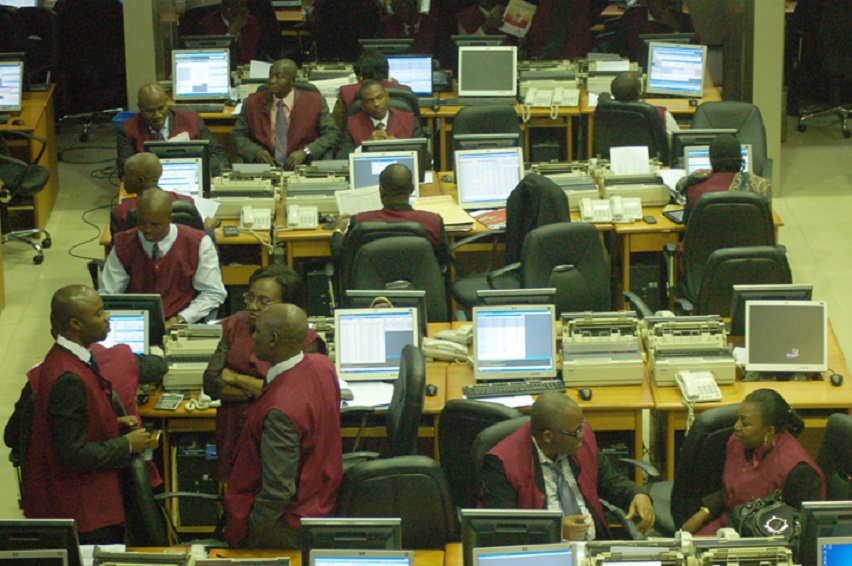
The bearish sentiment at the local stock market continued on Tuesday with a 0.48 percent loss, leaving the year-to-date return to sink deeper to -12.54 percent.

This was as President Muhammadu Buhari received his presidential nomination form worth N40 million and the expression of interest form valued at N5 million from a group, which reportedly purchased the forms for him due to his inability to buy the forms because of its high cost.

With this, President Buhari has set the pace to seek re-election next year on the platform of the ruling All Progressives Congress (APC).

Back to the stock market, investors continued with their profit taking activity, reflecting in the number of price losers and gainers yesterday; 30 losers against 14 gainers.

Nigerian Breweries closed as the highest price loser after shedding N4.50k of its stock value to close at N88 per share.

It was followed by GTBank, which lost N2 to finish at N32.50k per share, and Dangote Sugar, which fell by N1.60k to end at N14.40k per share.

Forte Oil went down by 95 kobo to settle at N18.10k per share, while UAC of Nigeria crashed by 80 kobo to close at N10.20k per share.

At the other end, Nestle Nigeria recovered part of the N145 it lost on Monday, gaining N130 on Tuesday to settle at N1485 per share.

Dangote Flour rose by 55 kobo to finish at N8.40k per share, while Access Bank grew by 10 kobo to end at N9 per share.

Learn Africa increased its share value yesterday by 9 kobo to close at N1.10k per share, while Neimeth Pharmaceuticals appreciated by 6 kobo to end at 72 kobo per share.

Business Post reports that the market capitalisation depreciated on Tuesday by N59 billion to finish at N12.212 trillion, while the All-Share Index (ASI) fell by 162.52 points to close at 33,449.17 points.

Despite the bearish sentiment yesterday, the volume and value of equities traded by investors of the floor of the Nigerian Stock Exchange (NSE) increased by 9.48 percent and 17.74 percent respectively.

A total of 150.7 million shares worth N1.6 billion exchanged hands on Tuesday in contrast to the 137.6 million equities worth N1.4 billion transacted on Monday.

These trades were dominated by stocks in the Financial Services sector, accounting for 123.5 million units valued at N1.2 billion. It was followed by equities in the Oil and Gas sector, which recorded 8.8 million shares sold for N34 million.

A total of 17.5 million units of GTBank shares worth N562.8 million were sold at the market yesterday, leading the activity chart at the close of business.

UBA traded 15.6 million stocks valued at N117.4 million, while Diamond Bank transacted 13.8 million units worth N18.6 million.

Access Bank exchanged 11.9 million shares yesterday valued at N103.3 million, while Zenith Bank sold 11.7 million equities worth N236.1 million.


Dipo Olowookere is a journalist based in Nigeria that has passion for reporting business news stories. At his leisure time, he watches football and supports 3SC of Ibadan. Mr Olowookere can be reached via [email protected]

Economy

Naira Slips to N1,343/$ at NAFEX

Published

on

Naira-Dollar exchange rate gap

By Adedapo Adesanya

The Naira sold at N1,343.64/$1 Nigerian Autonomous Foreign Exchange Market (NAFEX) on Friday, April 17, after shedding N1.34 or 0.10 per cent against the greenback from the previous day’s rate of N1,342.30/$1.

In the same vein, the Nigerian currency depreciated against the Pound Sterling in the same market window during the session by N5.03 to quote at N1,824.39/£1 versus the previous rate of N1,819.36/£1, and lost N10.05 against the Euro to sell at N1,591.14/€1 versus N1,581.09/€1.

At the GTBank FX desk, the exchange rate of the Naira to the Dollar remained unchanged at N1,355/$1, and it also maintained stability in the parallel market at N1,375/$1.

Interbank liquidity increased to N124.34 million from N74.255 million the previous day, data from the Central Bank of Nigeria (CBN) showed.

Meanwhile, external reserves remain at $48.70 billion, down from the 2009 peak of $50 billion amidst uncertainties in the global commodities market.

Global oil prices dropped sharply on Friday after Iran signalled that the Strait of Hormuz would remain open to commercial shipping during a temporary ceasefire in the Middle East.

Crypt assets also gained on the news from Iran’s foreign minister, who declared the Strait of Hormuz open, drawing a positive response from President Donald Trump. The development helped ease worry around risky assets like crypto.

Meanwhile, the cryptocurrency market was bullish, as traders weighed possible scenarios ahead of next week’s US-Iran cease-fire deadline.

Ethereum (ETH) appreciated by 3.2 per cent to $2,410.53, Bitcoin (BTC) jumped by 2.8 per cent to $77,124.22, Ripple (XRP) rose by 2.7 per cent to $1.47, Binance Coin (BNB) expanded by 2.5 per cent to $643.97, Dogecoin (DOGE) added 1.0 per cent to close at $0.0988, Cardano (ADA) improved by 0.9 per cent to $0.2578, Solana (SOL) soared by 0.4 per cent to $88.53, and TRON (TRX) gained 0.4 per cent to sell at $0.3275, while the US Dollar Tether (USDT) and the US Dollar Coin (USDC) traded flat at $1.00 apiece.

Continue Reading

Economy

Brent, WTI Tumble Over 9% on Hormuz Reopening Signal

Published

on

Brent crude futures

By Adedapo Adesanya

Oil prices plunged by 9 per cent on Friday after Iran said passage for all ​commercial vessels through the Strait of Hormuz was open for the remaining ceasefire period.

Brent crude futures lost $9.01 or 9.07 per cent to trade at $90.38 a barrel, while the US West Texas Intermediate (WTI) crude futures depreciated by $10.48 or 11.45 per cent to finish at $83.85 a barrel.

Iran said Friday that the Strait of Hormuz is “completely open” for the remainder of the Israel-Lebanon ceasefire, bolstering hopes of a breakthrough in the weeks-long crisis over the crucial oil route.

Iran had maintained its blockade of the strait despite a two-week ceasefire with the US, which expires on Tuesday, and previously said it would not open the key waterway while Israel continued to strike Lebanon.

Business Post had reported that oil prices weakened to around $88 per barrel after Iranian Foreign Minister Seyed Abbas Araghchi posted on X that “all commercial vessels” would be allowed to pass through the strait throughout the remainder of the ten-day ceasefire in Lebanon.

US President Donald Trump thanked Iran on Truth Social, but stressed that the US naval blockade of the regime’s ports would remain “in full force and effect” until a peace deal was completed. “This process should go very quickly in that most of the points are already negotiated,” he added.

A second round of truce talks between the US and Iran is expected to take place as oil tankers are beginning to test the waters at the Strait of Hormuz.

Despite the fact that all ships can sail through the Strait of Hormuz, this passage needs to be coordinated with Iran’s Islamic Revolutionary Guard Corps (IRGC).

Market analysts noted that if these initial tankers make it through, flows will begin to partially normalise. However, a handful of vessels does not equal restored capacity. The backlog alone will take significant time to clear, and producers across the region are still dealing with disrupted output and logistics.

Prices had already fallen earlier in the Friday session as possible ​further talks between the US and Iran over the weekend and a 10-day ceasefire between Lebanon and Israel raised investors’ hopes that the war in the Middle East could be ‌nearing an ⁠end.

The American President also said on Friday that the US has banned Israel from further bombing in Lebanon, using a harsher tone than usual with the ​longtime US ally.

Continue Reading

Economy

Nigerian Exchange Extends Stock Trading Hours to 4:00 pm

Published

on

exposure to Nigerian stocks

By Dipo Olowookere

The daily stock trading hours on the floor of the Nigerian Exchange (NGX) have been expanded by an hour to 4.00 pm after extensive stakeholder engagement, ensuring alignment and operational readiness ahead of the go-live date.

A statement from the bourse on Friday said the extension was approved by the Securities and Exchange Commission (SEC).

Before now, trading activity on Customs Street resumed from 9.30 am to 2:30 pm, but from Monday, April 27, 2026, the resumption time would be 9.00 am, and the closing gong would be struck by 4.00 pm from Monday to Friday.

It was explained that this action was taken “to deepen market liquidity, enhance price discovery, and broaden investor access.”

The NGX has witnessed renewed investor interest due to increased awareness of equities lately, especially as the nation and the global community await the much-anticipated listing of Dangote Refinery shares later in the year, all things being equal.

The statement also noted that this extended trading window would provide greater flexibility for investors, improve responsiveness to market-moving information, and support broader participation across the market.

The development builds on the momentum of Nigeria’s recent reclassification to Frontier Market status by FTSE Russell, reinforcing NGX’s global positioning and enhancing its attractiveness to a broader pool of domestic and international investors.

It further stated that this reform reflects strong regulatory collaboration and underscores the SEC’s continued commitment to advancing market development initiatives. Alongside Nigeria’s Frontier Market reclassification, it signals a deliberate shift towards a more accessible, liquid, and globally competitive market.

With this development, NGX reinforces its position as a leading multi-asset exchange, deepening liquidity, improving market access, and supporting efficient capital formation within Nigeria’s financial markets.

Continue Reading

Trending