Connect with us

Economy

Nigerian Stocks Suffer First Loss in 23 Trading Sessions, Down 0.43%

Published

on

exposure to Nigerian stocks

By Dipo Olowookere

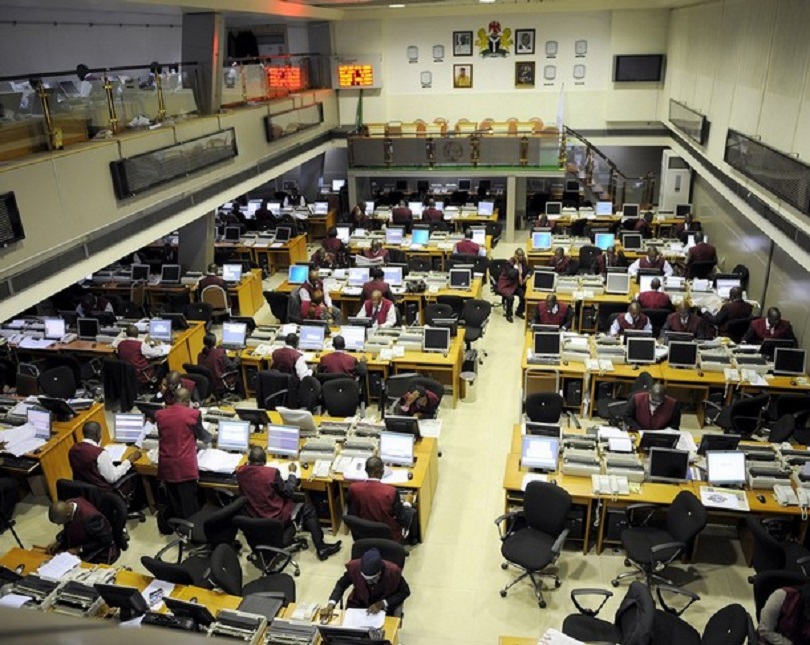
The upward trajectory seen at the Nigerian Exchange (NGX) Limited in the past sessions was halted on Thursday as a result of profit-taking in Aradel Holdings, MTN Nigeria, GTCO, and others.

Nigerian stocks were down by 0.43 per cent because of the selling pressure. It was the first loss in 2026 and also the first in 23 trading session. The last time Customs Street ended in red was December 10, 2025.

The decision of investors to trim their exposure to equities contracted the All-Share Index (ASI) by 714.66 points during the session to 166,057.29 points from 166,771.95 points and brought down the market capitalisation by N458 billion to N106.323 trillion from N106.781 trillion.

A look at the sectorial performance indicated that the energy, commodity, and insurance indices were down by 2.21 per cent, 1.14 per cent, and 0.24 per cent, respectively, while the banking, consumer goods, and industrial goods sectors were up by 0.78 per cent, 0.33 per cent, and 0.01 per cent apiece.

Yesterday, investor sentiment was weak after the bourse ended with 26 price gainers and 41 price losers, showing a negative market breadth index.

McNichols declined by 9.99 per cent to trade at N6.58, Caverton crashed by 9.47 per cent to N7.65, Ikeja Hotel collapsed by 9.43 per cent to N35.05, FTN Cocoa dropped 9.38 per cent to sell for N7.05, and Neimeth went down by 8.91 per cent to N9.20.

On the flip side, Nestle Nigeria gained 10.00 per cent to quote at N2,153.80, NCR Nigeria appreciated by 9.97 per cent to N116.90, Jaiz Bank improved by 9.92 per cent to N8.20, Morison Industries rose by 9.90 per cent to N5.66, and Mecure Industries grew by 9.84 per cent to N97.70.

During the session, market participants traded 1.0 billion stocks worth N31.6 billion in 51,227 deals compared with the 761.9 million stocks valued at N29.9 billion transacted in 55,751 deals at midweek, representing a drop in the number of deals by 8.12 per cent, and a surge in the trading volume and value by 31.25 per cent, and 5.69 per cent, respectively.

Sovereign Trust Insurance returned on top of the activity chart with 245.2 million units sold for N798.5 million, Access Holdings traded 78.4 million units worth N1.8 billion, Zenith Bank transacted 72.4 million units for N5.0 billion, Jaiz Bank exchanged 53.7 million units valued at N433.9 million, and Lasaco Assurance traded 53.4 million units worth N135.1 million.


Dipo Olowookere is a journalist based in Nigeria that has passion for reporting business news stories. At his leisure time, he watches football and supports 3SC of Ibadan. Mr Olowookere can be reached via [email protected]

Economy

El-Rufai Gets Bail in Ongoing ICPC Corruption Proceedings

Published

on

icpc el rufai

By Adedapo Adesanya

Former Kaduna Governor Nasir Ahmad El-Rufai has been granted bail in the ongoing corruption case filed by the Independent Corrupt Practices and Other Related Offences Commission (ICPC).

However, Mr El-Rufai will remain in ICPC custody until he fulfils all the bail conditions set by the court.

The development was confirmed by his son, Mr Bello El-Rufai, shortly after the ruling.

This comes amid separate proceedings at the Kaduna State High Court, where the ICPC recently amended its charges against the former governor. Mr El-Rufai has pleaded not guilty to the allegations.

The chieftain of the opposition African Democratic Congress (ADC) was arraigned by the ICPC over charges related to alleged corruption and abuse of office during his tenure in the North-Western state from 2015 to 2023. Allegations ranging from abuse of office and fraud to intent to commit fraud and conferring undue advantage were levied against the politician.

The commission disclosed that both charges were instituted on March 18, 2026, as part of its ongoing efforts to enforce accountability and combat corruption.

The scrutiny of Mr El-Rufai by the ICPC follows the report of the Kaduna State House of Assembly’s ad hoc committee constituted in 2024 to investigate finances, loans and contracts awarded between 2015 and 2023 under his eight-year administration of the state.

Presenting the committee’s report during plenary last year, the committee chairman, Mr Henry Zacharia, alleged that most of the loans obtained by the El-Rufai administration within the eight years were not utilised for the purposes for which they were secured.

While receiving the report, the Speaker of the House, Mr Yusuf Dahiru Leman, alleged that about N423 billion was siphoned under the El-Rufai administration, leaving Kaduna State with heavy financial liabilities and a rising debt profile.

The committee recommended the investigation and prosecution of the former governor and several members of his cabinet over alleged abuse of office, award of contracts without due process, diversion of public funds, money laundering and reckless borrowing.

The Assembly subsequently endorsed a petition to the EFCC and the ICPC, urging them to take up the matter.

The embattled former FCT Minister is equally embroiled in a case with the federal government over alleged unlawful interception of the phone communications of the National Security Adviser, Mr Nuhu Ribadu.

Continue Reading

Economy

Nigeria Retains ‘B’ Rating as Fitch Foresees Naira Depreciation

Published

on

Fitch Ratings

By Adedapo Adesanya

Credit rating agency, Fitch, has affirmed Nigeria’s Long-Term Foreign Currency Issuer Default Rating at ‘B’ with a stable outlook, while projecting depreciation for the Naira in the near term.

The decision underscores the country’s large economy, relatively developed and liquid domestic debt market, substantial oil and gas reserves, and ongoing improvements in monetary and exchange-rate policies.

This comes as the firm expects the country’s external reserves to decline marginally to $47 billion by the end of this year, while inflation is projected to hover around an average of 16 per cent.

The rating agency in its latest report on Nigeria said the rating is constrained by weak governance indicators, high hydrocarbon dependence, high inflation, security challenges and structurally low revenue relative to peers.

Fitch while stating that expects disinflation trend to continue said the risks however remain, “Inflation has moderated since April 2025 supported by policy reforms, but remains structurally high, at 15 per cent year-on-year in February 2026,” adding that, “We expect inflation to average about 16 per cent in 2026, from 23 per cent in 2024, but to remain well above the ‘B’ median of 5.5 per cent.”

Fitch also said that recent measures by the Central Bank of Nigeria (CBN), including the removal of forex restrictions on the repatriation of oil export proceeds by international oil companies, should support further forex market normalisation, improve confidence and support relative naira stability after a 40 per cent depreciation in 2024.

It also noted that it expects “modest depreciation in the near term amid rising fiscal pressures and heightened external risks, while data quality concerns continue to weigh on policy credibility.”

“The CBN began easing monetary policy in September 2025, cutting the policy rate twice by a total of 100bp to 26.5 per cent after an extended tightening cycle. However, a looser fiscal stance ahead of the general election scheduled in January 2027 or further fuel price increases could reverse disinflation and prompt renewed monetary tightening.”

Noting that external reserves are expected to remain strong, it said gross reserves rose to $49.4 billion at end-March 2026, from $32 billion in mid-April 2024, and “we forecast a marginal decline to $47 billion at end-2026, reflecting higher spending pressures and external risks.

“However, we expect reserves to cover seven months of current external payments (CXP), well above the ‘B’ median of 4.3 months,” it said.

“Official disclosure on the composition of the CBN foreign-currency balance sheet remains limited, but the CBN has made substantial progress in unwinding foreign exchange swaps with local banks.

It estimates net reserves at $35 billion at end-2025 (5.5 months of CXP), up from about $4 billion at end-2023.

Continue Reading

Economy

Nigeria Targets Gas Delivery Through AKK Pipeline by July

Published

on

AKK Gas Project

By Adedapo Adesanya

Nigeria hopes to begin delivering natural gas to Abuja by July through its long-delayed Ajaokuta-Kaduna-Kano (AKK) gas pipeline.

According to the Nigerian Upstream Petroleum Regulatory Commission (NUPRC), this marks a key milestone for the country’s gas development plans.

“We’re hoping that by July, gas will be delivered to Abuja through the AKK gas pipeline,” a spokesperson for the commission told the regulator’s in-house magazine.

The 614-kilometre (382-mile) pipeline is designed to deliver more than 2.2 billion cubic feet of gas per day and is a core part of Nigeria’s strategy to shift its energy mix towards gas, supply power plants and industries in the north, and reduce reliance on diesel and fuel oil.

Nigeria holds Africa’s largest gas reserves, estimated at over 210 trillion cubic feet, but much of the country’s gas infrastructure remains underdeveloped, making the AKK pipeline a critical test of its gas-led growth ambitions.

The $2.8 billion project, first conceived in 2008, has missed several delivery targets, including earlier deadlines of 2023 and the final quarter of 2025.

Construction began in 2020 but was slowed by funding pressures and engineering challenges, most notably the crossing of the River Niger.

That section, widely regarded as the project’s most technically demanding, required drilling beneath the riverbed using horizontal directional drilling, often compared to a scaled-down version of the Eurotunnel.

Reuters reported that work on the project is moving at an advanced pace, with the critical pipeline more than 90% complete.

Gas transported through the AKK pipeline will be sourced from Nigeria’s southern producing areas largely through its interconnection with the East-West Obiafu-Obrikom-Oben (OB3) gas pipeline, according to industry officials.

Continue Reading

Trending