Connect with us

Economy

Nigeria’s Stock Exchange Gives up 0.39% on Weak Investor Sentiment

Published

on

exposure to Nigerian stocks

By Dipo Olowookere

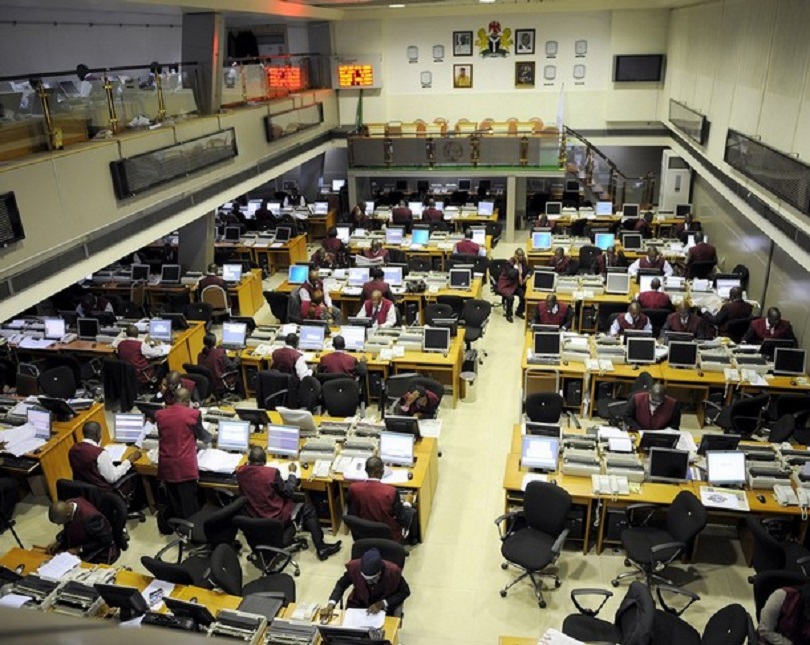
Weak investor sentiment further crumbled Nigeria’s stock exchange by 0.39 per cent on Thursday, as sell-offs persisted.

Data showed that all the major sectors of the Nigerian Exchange (NGX) Limited ended in the red, with the consumer goods index down by 1.22 per cent. The industrial goods space retreated by 0.75 per cent, the insurance segment depreciated by 0.55 per cent, the banking sector tumbled by 0.27 per cent, and the energy counter receded by 0.07 per cent.

At the close of business, the All-Share Index (ASI) went down by 949.71 points to 243,017.38 points from 243,967.09 points, and the market capitalisation dipped by N613 billion to N156.881 trillion from N157.494 trillion.

Unilever Nigeria led the losers’ chart after it depleted by 9.97 per cent to N118.30, Chellarams dropped 9.66 per cent to close at N10.75, NDIF slumped by 9.55 per cent to N147.70, DAAR Communications crashed by 9.25 per cent to N1.57, and Cornerstone Insurance slipped by 9.09 per cent to N5.00.

On the flip side, International Energy Insurance topped the gainers’ log after it grew by 10.00 per cent to N4.84, John Holt expanded by 9.89 per cent to N10.00, Trans-Nationwide Express rose by 9.75 per cent to N2.59, SUNU Assurances gained 8.48 per cent to settle at N3.58, and NEM Insurance appreciated by 6.25 per cent to N34.00.

Business Post reports that there were 16 appreciating stocks and 41 depreciating stocks, representing a negative market breadth index.

Yesterday, 4.2 billion equities worth N50.7 billion were transacted in 41,454 deals versus the 1.5 billion equities valued at N20.9 billion that exchanged hands in 39,085 deals at midweek.

This indicated that the trading volume, value, and number of deals surged by 180.00 per cent, 142.58 per cent, and 6.06 per cent, respectively.

Cornerstone Insurance was the busiest equity on Thursday, with a turnover of 3.6 billion units valued at N18.4 billion, VFD Group exchanged 151.8 million units worth N1.9 billion, Chams sold 33.8 million units for N153.7 million, First Holdco transacted 28.3 million units worth N3.9 billion, and CMFC traded 24.6 million units valued at N78.2 million.


Dipo Olowookere is a journalist based in Nigeria that has passion for reporting business news stories. At his leisure time, he watches football and supports 3SC of Ibadan. Mr Olowookere can be reached via [email protected]

Click to comment

Leave a Reply

Your email address will not be published. Required fields are marked *

Economy

Crude Oil Slips 2% on Weak Demand, Rising US Stockpiles

Published

on

crude oil supply disruption

By Adedapo Adesanya

Crude oil declined by more than ​2 per cent on Thursday as investors focused on signs of weaker global demand and a sharp build ‌in inventories in the United States.

Brent futures finished $1.91 or 2.15 per cent lower to $87.07 a barrel, while the US West Texas Intermediate (WTI) crude lost $2.02 or 2.4 per cent to close at $81.25 a barrel.

Investors weighed data from the US Energy Information Administration on Wednesday that showed commercial crude oil inventories in the world’s largest oil producer made their largest weekly gain since January 2023 ​as exports slumped. Crude inventories rose by 17.4 million barrels to 424.4 million in the week ended August 7, their highest ⁠since June 5, the EIA said.

This comes as the Organisation of the Petroleum Exporting Countries (OPEC) lowered its world oil demand growth forecast for 2026 to 580,000 barrels per day in its monthly oil market report.

The International Energy ​Agency (IEA) also said it expected a contraction of 1.6 million barrels per day in consumption this year, versus a drop of 1 million barrels per day forecast last month, with demand curtailed by higher prices and restricted ​supply due to the US-Israeli war with Iran.

Pressure came after a report that Yemen’s Houthi militant group attacked an Aramco refinery in Saudi Arabia’s Jazan with two drones on Thursday. News of the attacks sent diesel cracks to an all-time high as the Jazan refinery has the capacity to produce 250,000 barrels per day of ultra-low sulfur diesel.

Despite the recent decline, supply disruptions in the Middle East and the Black Sea region continued to support oil prices, with the US and ‌Iran making competing ⁠claims over the Strait of Hormuz, through which about 20 per cent of global oil supply passed before the start of the Iran war.

Iran said once again that the strait is under its control on Thursday, a day after President Donald Trump said the US had “total control” of the waterway.

Prices have spiked and crashed so many times due to negotiations, threats, Iranian attacks on tankers, American blockades on Iran’s oil exports, and numerous pledges of “strong responses” from both sides.

Adding to market tightness, Russia’s seaborne oil product exports fell sharply in ⁠July after Ukrainian ​drone attacks led to unplanned maintenance at key domestic refineries. In ​the Russian city of Orsk, an oil refinery that was hit by a Ukrainian drone strike two days ago has been forced to shut down, and repairs could take up to six months.

Continue Reading

Economy

NNPC Sees Deep Offshore Incentive Order Accelerating Investment, Production Growth

Published

on

NNPC Crude Cargoes pricing

By Aduragbemi Omiyale

The Deep Offshore Oil and Gas Projects Incentives (Tax Remission) Order, 2026, approved recently by President Bola Tinubu, has been described as a landmark reform that significantly enhances Nigeria’s competitiveness for deep offshore investment and strengthens the nation’s pathway towards achieving its 3 million barrels of oil per day (MMbopd) production ambition by 2030.

The chief executive of the Nigerian National Petroleum Company (NNPC) Limited, Mr Bayo Ojulari, in a statement signed by the Chief Corporate Communications Officer of NNPC, Mr Andy Odeh, said the development is one of the most significant policy interventions for the upstream sector in recent years.

He thanked Mr Tinubu for his relentless leadership and unwavering commitment to creating an enabling environment for investment and sustainable growth in Nigeria’s energy sector through several Presidential Executive Orders which have strengthened the nation’s oil and gas sector.

“This is a transformative reform that sends a strong signal to global investors that Nigeria is committed to providing a stable, competitive and investment-friendly environment for deep offshore development. Fiscal certainty is a critical driver of investment decisions, and this framework provides the additional clarity the industry has long sought,” he said.

“For NNPC, the order aligns directly with our strategy of protecting our existing production base, accelerating near-term growth, and attracting new investment into high-value assets. It strengthens our confidence in achieving our strategic production ambition of 3 MMbopd while creating greater value for our shareholders and the Nigerian economy,” the NNPC chief added.

Mr Ojulari noted that recent reforms across the petroleum sector have already stimulated more than $34 billion in new investment commitments, stating that the Deep Offshore Incentives Order is expected to build on that momentum by enabling timely FIDs on strategic offshore developments.

The new order establishes a transparent, predictable and globally competitive fiscal framework for qualifying greenfield deep offshore developments. It provides the certainty required to unlock long-term capital, accelerate Final Investment Decisions (FIDs), and maximise value from Nigeria’s offshore resources.

The framework, which reinforces Nigeria’s position as one of the world’s attractive destinations for deep offshore oil and gas development, is expected to unlock over $50 billion in new investments, including major projects starting with Bonga South-West, which was approved in March 2026, and the Zabazaba and Owowo Deep Offshore projects. Bonga South West is expected to be the first FID on a Nigeria deepwater Production Sharing Contract asset since 2008.

Continue Reading

Economy

Geregu Acknowledges Concerns Over N40bn Bond Repayment Default

Published

on

Geregu Power

By Aduragbemi Omiyale

The board of Geregu Power Plc has acknowledged the concerns raised by shareholders, stakeholders, as well as regulators over the inability of the company to pay bondholders for their investment in its N40 billion bond sale.

There were reports that the power-generating organisation defaulted in repaying investors who bought its debt instrument.

In 2022, the company issued a seven-year paper to investors at a coupon of 14.5 per cent to be paid semi-annually. The note is expected to mature in July 2029. But data from the FMDQ Securities Exchange showed that there have been defaults in the 8th coupon payment and the 4th bullet principal repayment.

Reacting to the issue on Thursday, Geregu said it is actively having talks with advisers and others on ways to iron things out.

“Geregu remains actively engaged with relevant stakeholders and advisers regarding the resolution of the various challenges and is committed to achieving an orderly and mutually beneficial outcome.

“Discussions and engagements are ongoing, and the Company will continue to act in good faith in fulfilling its responsibilities,” part of the statement signed by its scribe, The Structure HQ, stated.

The firm explained that since assuming responsibility for its affairs, the current board and management have undertaken a comprehensive review and reconciliation of its transactions, liabilities, operational commitments, financing arrangements, financial obligations and related corporate documentation.

It stressed that this action was to ensure transparency, accuracy and prudent financial management, adding that it remains committed to transparency, responsible corporate governance and constructive engagement with all stakeholders.

The majority stake of Geregu Power was controlled by Mr Femi Otedola. He divested his stake in the energy firm in 2025, with the sale of 95 per cent of his shares in Amperion to MA”AM Energy.

Earlier in 2023, he sold N399 million shares of Geregu to another investor. Before then, he sold his stake in Forte Oil to invest in Geregu Power, which now has the former Governor of Zamfara State, Mr Abdulaziz Yari, as its chairman.

Continue Reading