Economy
NNPC Confirms Explosion at Escravos–Lagos Pipeline in Delta
By Aduragbemi Omiyale
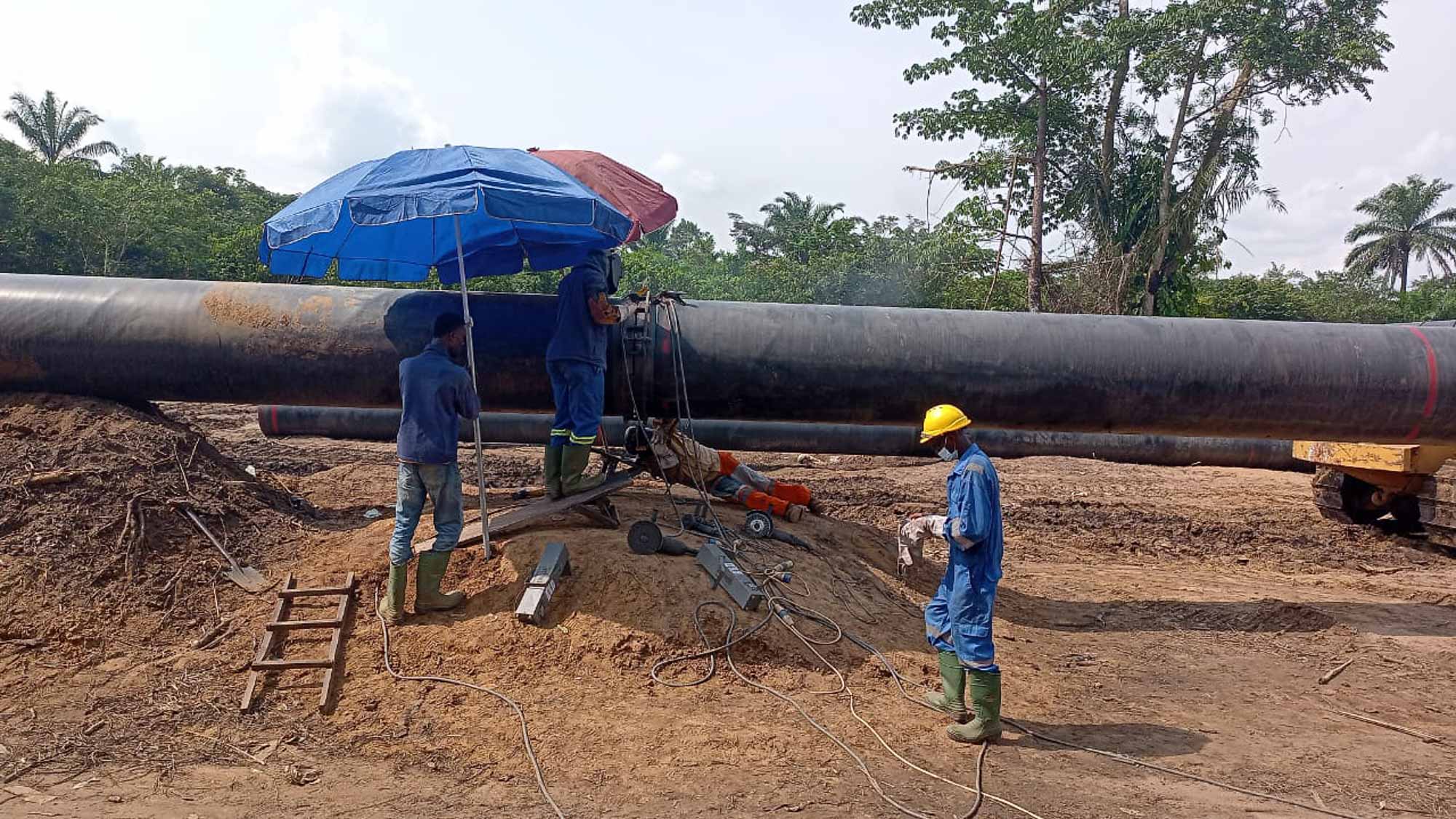
The Nigerian National Petroleum Company (NNPC) Limited has confirmed that the Escravos–Lagos pipeline experienced an explosion on Wednesday evening.
It was gathered that an explosion happened on the oil facility at a few minutes before 6pm on Wednesday, December 10, 2025.
It precisely occurred near Tebijor, Okpele, and Ikpopo communities in Gbaramatu Kingdom, Delta State.
The Chief Corporate Communications Officer of the NNPC, Mr Andy Odeh, in a statement on Thursday, disclosed that, “Initial observations indicate a pressure drop consistent with a loss of containment on an NNPC Gas Infrastructure Company (NGIC) pipeline.
“The cause of the explosion is still unknown but would be confirmed after a detailed investigation has been concluded. Our priority at this time is the safety of nearby communities and the protection of the environment.”
He noted that, “Emergency response procedures have been activated, and we are working closely with relevant authorities and community leaders to ensure a coordinated approach to mitigate impact.”
“NNPC Limited remains committed to the highest safety and environmental standards.
“Further updates will be provided as more confirmed information becomes available,” he added.
Economy
Nigerian Equities Regain 0.30% on Renewed Buying Pressure
By Dipo Olowookere
Renewed buying pressure revived the Nigerian Exchange (NGX) Limited by 0.50 per cent on Tuesday, reversing the previous day’s loss.
Interest in Nigerian equities slightly rose during the trading day, with the volume of transactions up by 6.10 per cent to 676.9 million units from the preceding session’s 638.0 million units.
However, the value of trades slumped by 36.36 per cent to N36.4 billion from N57.2 billion, and the number of deals decreased by 22.22 per cent to 55,412 deals from Monday’s 71,240 deals.
Access Holdings led the activity chart yesterday, with a turnover of 87.5 million shares worth N2.4 billion. FCMB traded 68.7 million stocks valued at N810.6 million, Chams sold 31.0 million equities for N148.8 million, United Capital transacted 29.7 million shares valued at N537.5 million, and Zenith Bank traded 26.5 million stocks worth N3.4 billion.
On Tuesday, there were 36 price gainers and 23 price losers, indicating a positive market breadth index and strong investor sentiment.
Lasaco Assurance led the advancers’ chart after it chalked up 10.00 per cent to trade at N2.20, Linkage Assurance appreciated by 9.93 per cent to N1.66, Trans-Nationwide Express also gained 9.93 per cent to quote at N3.10, Sunu Assurances rose by 9.88 per cent to N3.56, and CMFC grew by 9.86 per cent to N3.79.
The laggards’ group was led by Meyer, which shrank by 9.97 per cent to N16.70. Mecure slipped by 9.94 per cent to N56.20, ABC Transport crumbled by 9.93 per cent to N6.35, C&I Leasing crashed by 8.66 per cent to N5.80, and Haldane McCall dipped by 8.21 per cent to N3.02.
Business Post reports that the All-Share Index (ASI) went up by 745.81 points to 247,984.55 points from 247,238.74 points, and the market capitalisation increased by N482 billion to N159.993 trillion from N159.511 trillion.
Economy
Oil Prices Plunge 5% as US-Iran Ceasefire Fuels Peace Hopes
By Adedapo Adesanya
Oil prices dropped about 5 per cent on Tuesday as hopes increased that the pause in fighting between the United States and Iran will lead to talks to end the war.
Brent futures fell by $4.27 or 5.3 per cent to $83.70 a barrel, while the US West Texas Intermediate (WTI) crude declined by $3.35 or 4.4 per cent to $79.26 per barrel.
After dropping about 16 per cent over three days, Brent closed at its lowest since July 13 and WTI at its lowest since July 16.
Although both sides have stopped attacking each other, they remain far from resolving the differences that led to the effective closure of the Strait of Hormuz, which, before the war, handled the transit of about one-fifth of global oil supplies.
Iran has also denied seeking to resume talks with the US, contradicting claims by US President Donald Trump that “good talks” are underway. Trump has made similar assertions on several occasions, often alongside threats to launch fresh strikes, but Iranian officials have remained firm in rejecting those claims.
According to Reuters, Oman presented Iran with a Gulf-backed proposal to manage the Strait of Hormuz, including the introduction of voluntary transit fees for vessels using the strategic waterway. The proposal was intended to provide a framework for restoring trade through the strait, which was severely disrupted by the conflict.
Iran, however, rejected the Omani plan and proposed to Oman a temporary arrangement to reopen the Strait of Hormuz under which one direction of traffic would pass through Iranian waters and part of the opposite route would also be in Iranian waters.
Meanwhile, Saudi Aramco shut down its 400,000-barrel-per-day Jizan oil refinery in Saudi Arabia on July 27 following an attack by the Houthis on Saturday.
The Houthis have disrupted shipping through the Bab el-Mandeb Strait linking the Red Sea to the Gulf of Aden, creating a second chokepoint for oil flows.
The Organisation of the Petroleum Exporting Countries and its allies (OPEC+) is preparing to approve one more production increase for September and then put the monthly quota parade on hold through the end of the year
Saudi Arabia, Russia, Iraq, Kuwait, Algeria, Kazakhstan, and Oman are expected to raise their combined September target by about 188,000 barrels per day when they meet on August 2, sources told Reuters.
That would match the increases announced for June, July, and August and complete the return of a 1.65-million-bpd voluntary cut agreed in 2023, adjusted for the UAE’s departure from OPEC in May. Then OPEC+ appears ready to stop.
Economy
Reps Extol SEC on Fiscal Sustainability, Revenue Growth
By Aduragbemi Omiyale
The Securities and Exchange Commission (SEC) has been praised by the House of Representatives Committee on Finance for improving its fiscal sustainability through cost-cutting measures and enhanced revenue generation.
The Deputy Chairman of the panel, Mr Saeed Musa Abdullahi, speaking on Tuesday during the 2026 Revenue Monitoring Exercise with the commission in Abuja, however, challenged the organisation to exceed its 2026 revenue target.
He commended the regulator’s efforts to strengthen its finances and urged it to sustain the momentum.
“You have done significantly well. We have followed the progress of the SEC over the years and urge you to keep the flag flying. We will continue to celebrate you when you do well.
“This exercise is not to witch-hunt any agency; it is aimed at ensuring better performance, especially at a time when the country is facing serious fiscal challenges,” the lawmaker said.
“You have told us your revenue projection for 2026, but we believe you can do more. We urge you to surpass your projection by at least 20 per cent, or even more,” Mr Abdullahi stated.
Earlier, the Director-General of the SEC, Mr Emomotimi Agama, told the committee that, in line with the principles of the International Organisation of Securities Commissions (IOSCO), securities regulators are expected to operate independently, with governments providing financial support where necessary.
According to him, his organisation currently receives no budgetary allocation from the federal government, relying instead on income generated from the capital market while still remitting funds to the government.
“Going by IOSCO principles, the SEC is expected to be financially independent. The government is supposed to provide support for the running of the Commission.
“However, due to the paucity of funds, all the money used to fund the commission comes from the market. The SEC does not receive any funding from the government; rather, it pays money to the government,” he said.
The DG explained that once the commission’s revenues are paid into its account with the Central Bank of Nigeria (CBN), statutory deductions are made automatically before the SEC can access the funds.
“When these funds hit our account with the CBN, deductions are made directly by the government. We do not have access to the funds before the deductions are effected,” he added.
Mr Agama noted that as a regulator, the SEC is careful not to overburden market operators with additional charges to fund its operations. To ease financial pressure, he said the agency secured approval from the Minister of Finance for a waiver allowing it to retain 20 per cent of its income.
“We are regulators and are not expected to ask the market for money. With the kind permission of the Minister of Finance, we obtained a 20 per cent waiver on deductions to ensure our operations are not hindered,” he said.
The SEC boss also disclosed that the commission had secured a grant from the African Development Bank (AfDB) to acquire a modern market surveillance system, which is expected to be deployed this year to strengthen oversight of Nigeria’s capital market and align it with international standards.