
Economy
NNPC Rakes $53m Monthly From Direct Oil Sales


By Ebitonye Akpodigha
The Direct Sale, Direct Purchase (DSDP) initiative introduced by the Nigerian National Petroleum Corporation (NNPC) is already yielding fruits, the Corporation has disclosed.
In its latest report, the NNPC revealed that since it introduced the concept in April 2016, it has recorded an average monthly savings of $53 million.
This, the report said, is despite the renewed activities of Niger Delta militants in oil producing regions, which have reduced crude oil and gas production in Nigeria as well as a sharp slump in the prices of oil.
It would be recalled that the DSDP was initiated to ensure full recovery of crude oil sales value and delivery of 100 per cent federation revenue from domestic crude allocation which is 445,000 barrels per day in place of the previous offshore processing and crude swap arrangements which resulted in huge losses.
NNPC noted that between February and July 2016, it saved about $336,379,854.98 from the DSDP scheme.
According to the report, the Kaduna, Warri and Port Harcourt refineries had a surplus posting of N0.78 billion in July.
“The combined value of output by the three refineries (at import parity price) for the month of July 2016 amounted to N20.09 billion while the associated crude plus freight cost was N19.31 billion, giving a surplus of N0.78 billion after considering overhead of N7.38 billion.
“Despite these challenges (irregular crude supply and impact of pipeline vandalism) the domestic refineries have a consolidated positive cash flow for the month under review due to favourable products price variance and ongoing restoration of the refineries,” the report said.
“For the month of July 2016, the three refineries produced 139,2841MT of finished petroleum products out of 126,756MT of crude processed and intermediate of 40,640MT at a combined capacity utilisation of 6.74 per cent compared to 12.40 per cent combined capacity utilisation achieved in the month of June 2016,” it added.
NNPC, however, disclosed that militancy in the Niger Delta caused a loss worth N24.18 billion.
“The degree of turbulence in the nation’s oil and gas sector due to renewed militancy has grossly impacted on oil and gas production with its attendant consequences for the economy. In July 2016, operations, about 311 vandalised points were recorded.
“This 12th publication of NNPC monthly financial and operations report indicates a trading deficit of N24.18 billion in July 2016 as against N26.51 billion deficit reported in June, 2016, the net cash flow improved by 8.77 per cent or N2.32 billion in July 2016,” which it explained “was largely due to increase in revenue stream from NPDC and PPMC, despite the upsurge in upstream and downstream vandalised points.”



By Adedapo Adesanya
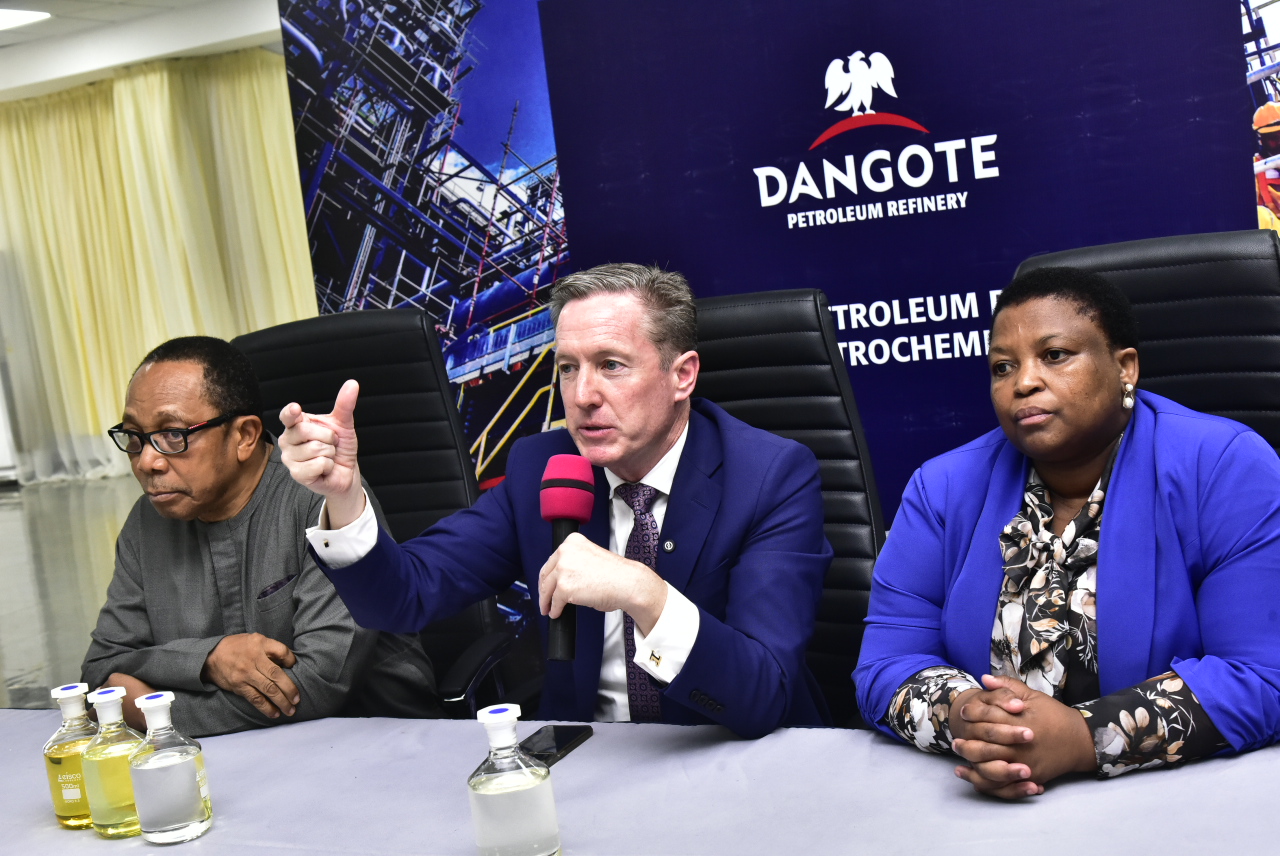
Dangote Petroleum Refinery imported a total of $3.74 billion) worth of crude oil in 2025, to make up for shortfalls that threatened the plant’s 650,000-barrel-a-day operational capacity.
The data disclosed in the Central Bank of Nigeria’s Balance of Payments report noted that “Crude oil imports of $3.74 billion by Dangote Refinery” contributed to movements in the country’s current account position, as Nigeria imported crude oil worth N5.734 trillion between January and December 2025.
Last year, as the Nigerian National Petroleum Company (NNPC), which is the refinery’s main trade partner and minority stakeholder, faced its challenges, the company had to forge alternative supply links. This led to the importation of crude from Brazil, Equatorial Guinea, Angola, Algeria, and the US, among others.
For instance, in March 2025, the company said it now counts Brazil and Equatorial Guinea among its global oil suppliers, receiving up to 1 million barrels of the medium-sweet grade Tupi crude at the refinery on March 26 from Brazil’s Petrobras.
Meanwhile, crude oil exports dropped from $36.85 billion in 2024 to $31.54 billion in 2025, representing a 14.41 per cent decline, further shaping the external balance.
The report added that the refinery’s operations also reduced Nigeria’s reliance on imported fuel, noting that “availability of refined petroleum products from Dangote Refinery also led to a substantial decline in fuel imports.”
Specifically, refined petroleum product imports fell sharply to $10.00 billion in 2025 from $14.06 billion in 2024, representing a 28.9 per cent decline, while total oil-related imports also eased.
However, this was offset by a rise in non-oil imports, which increased from $25.74 billion to $29.24 billion, up 13.6 per cent year-on-year, reflecting sustained demand for foreign goods.
At the same time, the goods account remained in surplus at $14.51 billion in 2025, rising from $13.17 billion in 2024, supported largely by activities linked to the Dangote refinery and improved export performance in other segments.
The CBN stated that the stronger goods balance was driven by “significant export of refined petroleum products worth $5.85bn by Dangote Refinery,” alongside increased gas exports to other economies.
Nigeria posted a current account surplus of $14.04 billion in 2025, lower than the $19.03 billion recorded in 2024 but significantly higher than $6.42 billion in 2023. The decline from 2024 was driven partly by structural changes in oil trade flows, including crude imports for domestic refining, according to the report.
Pressure on the current account came from higher external payments. Net outflows for services rose from $13.36 billion in 2024 to $14.58 billion in 2025, driven by increased spending on transport, travel, insurance, and other services.
Similarly, net outflows in the primary income account surged by 60.88 per cent to $9.09 billion, largely due to higher dividend and interest payments to foreign investors.
In contrast, secondary income inflows declined slightly from $24.88 billion in 2024 to $23.20 billion in 2025, as official development assistance and personal transfers weakened, although remittances remained a key source of inflow, as domestic refineries grappled with persistent feedstock shortages, exposing a deepening supply paradox in the country’s oil sector.
This comes despite the Federal Government’s much-publicised naira-for-crude policy designed to prioritise local supply.


By Aduragbemi Omiyale
An application has been submitted by Sovereign Trust Insurance Plc for its proposed N5.0 billion rights issue.
The application was sent to the Nigerian Exchange (NGX) Limited, and it is for approval to list shares from the exercise when issued to qualifying shareholders.
A notice signed by the Head of Issuer Regulation Department of the exchange, Mr Godstime Iwenekhai, disclosed that the request was filed on behalf of the underwriting firm by its stockbrokers, Cordros Securities Limited, Dynamic Portfolio Limited and Cedar of Lebanon Securities.
The company intends to raise about N5.022 billion from the rights issue to boost its capital base, as demanded by the National Insurance Commission (NAICOM) for insurers in the country.
Sovereign Trust Insurance plans to issue 2,510,848,144 ordinary shares of 50 Kobo each at N2.00 per share on the basis of three new ordinary shares for every 17 existing ordinary shares held as of the close of business on Tuesday, March 17, 2026.
“Trading license holders are hereby notified that Sovereign Trust Insurance has through its stockbrokers, Cordros Securities Limited, Dynamic Portfolio Limited and Cedar of Lebanon Securities, submitted an application to Nigerian Exchange Limited for the approval and listing of a rights issue of 2,510,848,144 ordinary shares of 50 Kobo each at N2.00 per share on the basis of three new ordinary shares for every 17 existing ordinary shares held as of the close of business on Tuesday, March 17, 2026,” the notification read.

By Adedapo Adesanya
Food Concepts Plc, the parent company of fast food brands like Chicken Republic and PieXpress, has disclosed plans to pay 10 Kobo in interim dividend to new and existing shareholders for the 2026 financial year.
This was disclosed by the company in a notice to the NASD Over-the-Counter (OTC) Securities Exchange, where it trades its securities.
The notice indicated that the proposed interim dividend, which comes with no bonus, will be paid to those who hold the stocks of the company as of the qualification date for the dividend, which was Tuesday, March 24.
This means only those who hold the company’s shares as of the closing session will be eligible to receive the stipulated dividend payment.
The shareholders of the company will be credited with the 10 Kobo dividend on Tuesday, March 31.
The notice noted that the closure of the company’s register will be on Wednesday, March 25, through Friday, March 27, 2026, both days inclusive.













-
 Feature/OPED6 years ago
Davos was Different this year
-
Travel/Tourism10 years ago
Lagos Seals Western Lodge Hotel In Ikorodu
-

 Showbiz3 years ago
Estranged Lover Releases Videos of Empress Njamah Bathing
-
 Banking8 years ago
Sort Codes of GTBank Branches in Nigeria
-

 Economy3 years ago
Subsidy Removal: CNG at N130 Per Litre Cheaper Than Petrol—IPMAN
-

 Banking3 years ago
Sort Codes of UBA Branches in Nigeria
-

 Banking3 years ago
First Bank Announces Planned Downtime
-

 Sports3 years ago
Highest Paid Nigerian Footballer – How Much Do Nigerian Footballers Earn