Connect with us

Economy

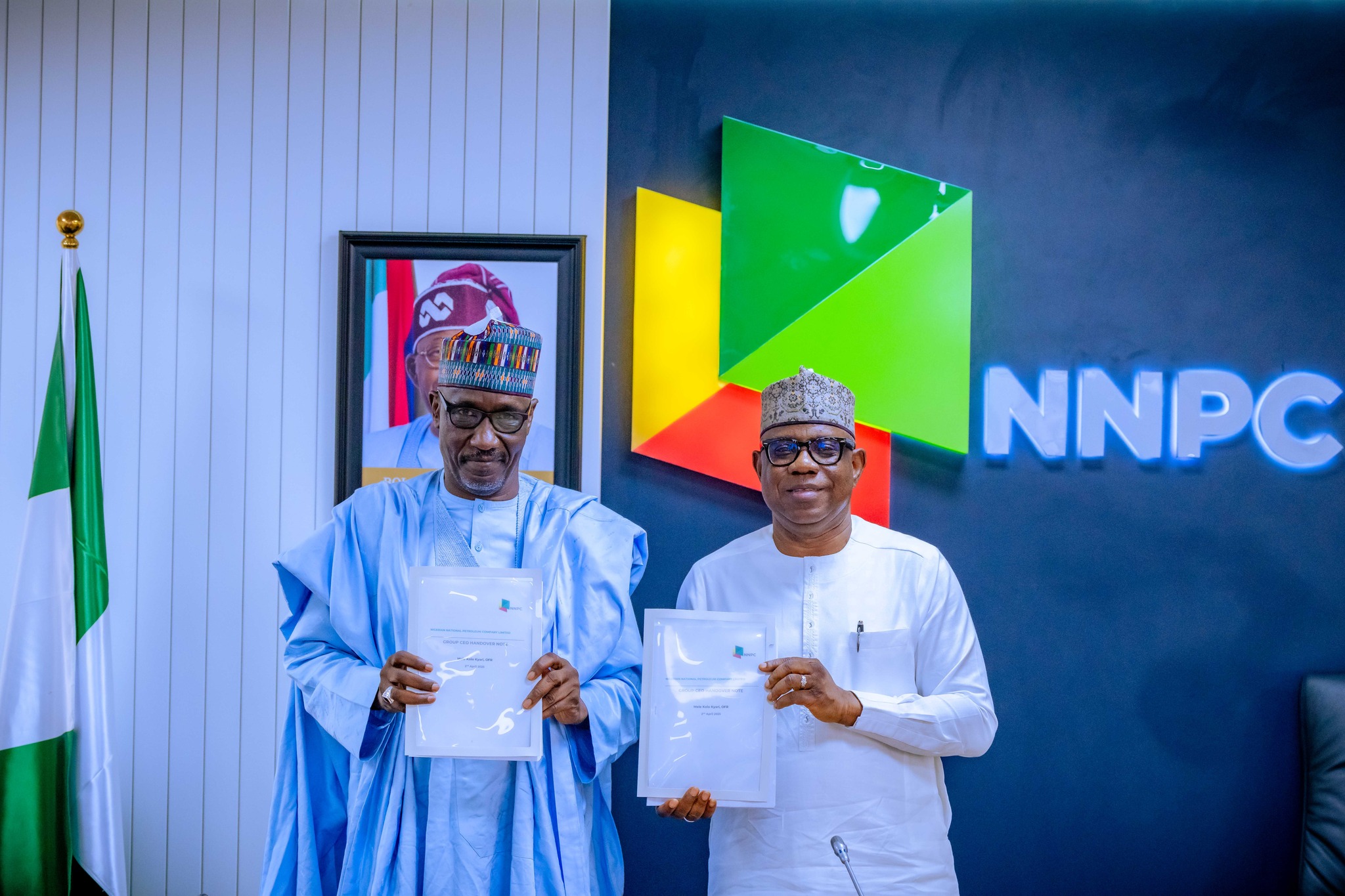
NNPC Sacks Kyari Loyalists, Others Ahead of NGX Listing

Published

on

Bayo Ojulari Mele Kyari NNPC

By Adedapo Adesanya

The Nigerian National Petroleum Company (NNPC) Limited has sacked some executives and employees in the first major shake-up since the exit of its former chief executive, Mr Mele Kyari.

Earlier in the month, President Bola Tinubu removed Mr Kyari from office, replacing him with Mr Bayo Ojulari, a former chief executive of Shell.

He also dissolved the NNPC board and appointed a new 11-man board led by Mr Ahmadu Kida as non-executive chairman.

Now, more top officials, believed to be loyal to the erstwhile chief executive, have been axed from the state-owned oil firm as part of a reorganisation carried out ahead of a planned Initial Public Offering (IPO) by year end.

Some of the individuals shown the door are the Chief Upstream Investment Officer, NNPC Upstream Investment Services (NUIMS), Mr Bala Wunti.

NUIMS is the investment management arm of the NNPC and oversees the Nigerian Petroleum Exchange (NipeX), an electronic platform for contracting in the upstream sector.

It manages the Nigerian government’s investments in the upstream sector of the oil and gas industry, plus its equity holdings in Joint Venture (JV), Production Sharing Contract (PSC), and Service Contract (SC) companies.

Also leaving are the Managing Director of the Kaduna Refinery, Mr Ibrahim Onoja as well the Chief Compliance Officer and former Managing Director of NNPC Trading, Mrs Sade Lawal.

According to reports, several other lower and middle class staff were also affected by the restructuring drive.

The total headcount reduction was put at around 200.

The exit of some of the executives has seen others step up, including Mrs Maryam Idrisu, who will now take over as Managing Director of NNPC Trading, the unit responsible for all crude oil transactions, while Mr Obioma Abangwu is now Chief Liaison Officer for board matters.

This is the latest round of layoffs in the state oil firm after it sacked a number of staff back in September 2023, which it said was due to reorganisation.

The company, in a statement then, said the reorganisation was in line with its commitment to scale up its capabilities “through targeted talent management and equal opportunity for all Nigerians”, noting that only staff members with less than 15 months to retirement will be affected.

This development comes as the NNPC continues to finalise its IPO plans to drive sufficiency without reliance on state funding, years after it was announced.

It is currently engaging with prospective stakeholders including investment banks and investors to comply with capital market regulations.

The company is chasing a dual listing on the Nigerian Exchange (NGX) as well as the London Stock Exchange (LSE) by the end of 2025.


Adedapo Adesanya is a journalist, polymath, and connoisseur of everything art. When he is not writing, he has his nose buried in one of the many books or articles he has bookmarked or simply listening to good music with a bottle of beer or wine. He supports the greatest club in the world, Manchester United F.C.

Economy

Trade Facilitation: Customs Okays Lagos Free Zone Green Channel

Published

on

Lagos Free Zone Green Channel

By Modupe Gbadeyanka

The Nigeria Customs Service (NCS) has approved the activation of the Lagos Free Zone Green Channel to enable the seamless and controlled movement of Free Zone cargo directly from the Lekki Deep Sea Port to the Lagos Free Zone (LFZ).

This development makes LFZ the first and only zone in the country to operate a sanctioned green channel, reflecting globally recognised port-to-free-zone logistics and customs integration models successfully implemented in leading trade hubs in the Middle East and Asia.

With this, businesses in the Lagos Free Zone can now scale their industrial output with total peace of mind, as every consignment is protected by an unbroken chain of 24/7 CCTV surveillance, telemetry, and tamper-evident digital logs that ensure absolute cargo integrity.

This integration not only secures the supply chain but also builds unrivalled investor confidence by establishing a transparent, high-compliance trade environment monitored directly by the customs.

For manufacturers and distributors, the outcome is a predictable, ultra-fast logistics flow that solidifies LFZ as the most efficient regional hub for Nigerian and West African operations.

“This approval is a testament to our commitment to trade modernisation. The Lagos Free Zone Green Channel will enhance Customs visibility while significantly improving investor confidence in Nigeria’s Special Economic Zones,” the Comptroller-General of Customs, Mr Bashir Adeniyi,” stated.

On her part, the chief executive of LFZ, Mrs Adesuwa Ladoja, said, “The activation of the Lagos Free Zone Green Channel is the latest testament to our customer-centricity and our commitment to continually deliver enhanced ease of doing business for our tenants.

“The Green Channel solidifies the advantages of Lekki Deep Sea Port being physically and digitally integrated into our zone. We have effectively removed the ‘last mile’ uncertainty that has historically challenged Nigerian logistics.

“Our tenants no longer need to navigate the complexities of traditional port exits; instead, they benefit from a high-velocity, customs-integrated corridor that moves cargo with precision and speed.

“This is a game-changer for manufacturing and regional distribution, reinforcing Lagos Free Zone as the premier gateway for those looking to dominate the West African market.”

Continue Reading

Economy

Dangote Refinery Finally Hits Full 650,000-Barrel Per Day Capacity

Published

on

dangote refinery 1.5 billion litres

By Adedapo Adesanya

Dangote Refinery has reached its full capacity of 650,000 barrels per day following the successful optimisation of critical processing units, marking a turning point for Africa’s largest refinery, located in Lagos.

The $20 billion facility is now operating at full capacity, a world-record milestone for a single-train refinery.

This achievement comes after the completion of an intensive performance testing on the refinery’s Crude Distillation Unit and Motor Spirit production block.

According to the chief executive of Dangote Refinery, Mr David Bird, the refinery is now positioned to supply up to 75 million litres of petrol daily to the domestic market, a dramatic increase from the 45 million – 50 million litres delivered during the recent festive period.

The development can reshape Nigeria’s energy landscape and reduce the country’s longstanding dependence on imported refined products.

“Our teams have demonstrated exceptional precision and expertise in stabilising both the CDU and MS Block,” Mr Bird said. “This milestone underscores the strength, reliability, and engineering quality that define our operations.”

The refinery has completed a 72-hour series of performance test runs in collaboration with technology licensor UOP, a Honeywell company, to validate operational efficiency and confirm that all critical parameters meet international standards.

The tests covered the naphtha hydrotreater, isomerisation unit, and reformer unit, which together form the backbone of the facility’s gasoline production capability.

The milestone marks another achievement for the businessman and majority stake owner at the facility in his ambition to transform Nigeria from Africa’s largest crude oil producer into a refining powerhouse.

Since the commencement of the facility in 2016, it has faced numerous setbacks, including pandemic-related delays, foreign exchange challenges, and technical complications.

It was finally commissioned in May 2023 to help wean Nigeria off imported petroleum products, due to the chronic underperformance of its state-owned refineries.

Despite being Africa’s largest crude producer, the country has not been able to self-produce, even with four state-owned refineries with a combined capacity of 445,000 barrels per day. This has led to decades of high dependency on importation.

The Dangote refinery’s emergence at full capacity has the potential to eliminate this import dependence while positioning Nigeria as a net exporter to West African markets.

Yet, the refinery faces difficulty securing adequate crude oil supplies from Nigerian producers, forcing it to import feedstock from the US, Brazil, Angola, and other countries.

Mr Bird also confirmed that Phase 2 performance test runs for the remaining processing units are scheduled to commence next week, suggesting further capacity optimisation ahead.

The official emphasised the refinery’s commitment to “enhancing Nigeria’s energy security while supporting industrial development, job creation, and economic diversification.”

Continue Reading

Economy

NASD OTC Exchange Rallies 0.74%

Published

on

NASD OTC stock exchange

By Adedapo Adesanya

For the third consecutive session, the NASD Over-the-Counter (OTC) Securities Exchange closed in positive territory after it gained 0.74 per cent on Wednesday, February 11, amid a flat market breadth index.

The bourse recorded five appreciating securities as well as five depreciating securities during the midweek session.

On the gainers’ side of the market was Central Securities Clearing System (CSCS), which added N5.80 to sell at N70.53 per share versus Tuesday’s closing price of N64.73 per share.

Further, Air Liquide Plc appreciated by N2.02 to N22.34 per unit from N20.32 per unit, Afriland Properties Plc improved by 25 Kobo to N16.20 per share from N15.95 per share, First Trust Mortgage Bank Plc expanded by 6 Kobo to 75 Kobo per unit from 69 Kobo per unit, and Food Concepts Plc grew by 2 Kobo to N2.91 per share from N2.89 per share.

On the flip side, Okitipupa Plc lost N17.00 to sell at N220.00 per unit compared with the previous day’s N237.00 per unit, NASD Plc dropped N5.14 to trade at N46.26 per share versus N51.40 per share, Geo-Fluids Plc depreciated by 39 Kobo to close at N4.02 per unit versus N4.41 per unit, Acorn Petroleum Plc went down by 6 Kobo to N1.31 per share from N1.37 per share, and Industrial and General Insurance (IGI) Plc slipped by 5 Kobo to 54 Kobo per unit from 59 Kobo per unit.

At the close of trading activities, the market capitalisation increased by N17.05 billion to N2.308 trillion from N2.291 trillion, while the NASD Unlisted Security Index (NSI) advanced by 29.50 points to 3,858.81 points from 3,830.31 points.

Yesterday, the volume of securities jumped 15,181.4 per cent to 1.06 billion units from 6.9 million units, the value of securities surged 10.4 per cent to N465.7 million from N89.1 million, and the number of deals rose by 21.8 per cent to 56 deals from 46 deals.

The most active stock by value on a year-to-date basis was CSCS Plc with 18.2 million units worth N790.9 million, trailed by Resourcery Plc with 1.04 billion units valued at N408.6 million, and Geo-Fluids Plc with 29.2 million units sold for N150.8 million.

As for the most active stock by volume on a year-to-date basis, the position was taken over by Resourcery Plc with a turnover of 1.04 billion units valued at N408.6 million, while Geo-Fluids Plc moved to second place with 29.2 million units exchanged for N150.8 million, and the third place was occupied by Mass Telecom Innovation Plc with 20.1 million units worth N8.1 million.

Continue Reading

Trending