Economy
NSE: Customs Street Sinks 0.07% as Profit-Taking Persists
By Dipo Olowookere
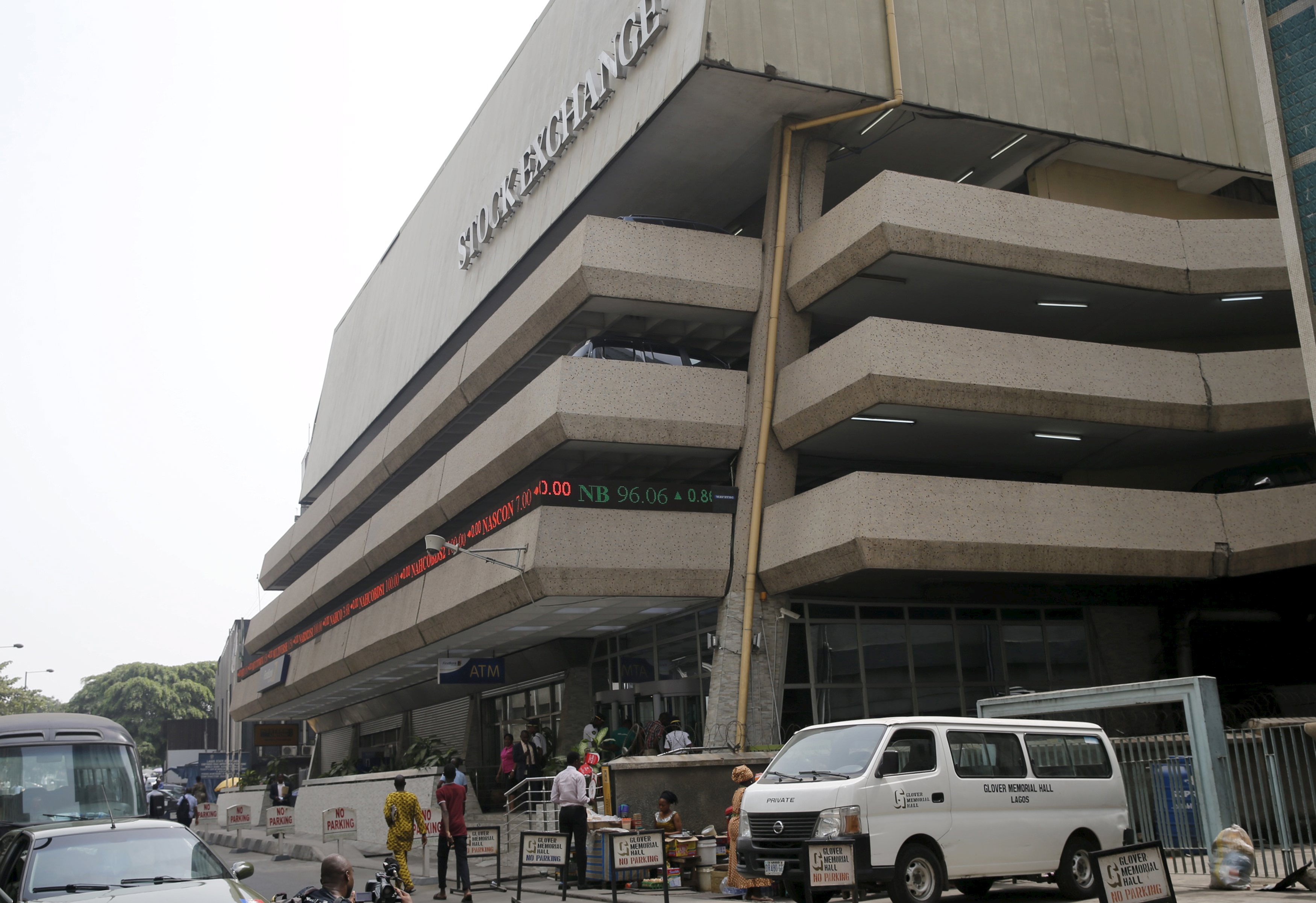
Transactions on the floor of the Nigerian Stock Exchange (NSE) tucked in Customs Street, Lagos closed bearish on Wednesday.
It was observed that the market closed marginally lower at the midweek trading session by 0.07 per cent on the back of sustained profit-taking.
Business Post reports that the losses printed by industrial goods (-0.80 per cent), banking (-0.24 per cent) and consumer goods (-0.07 per cent) sectors outweighed the 1.92 per cent growth by the insurance and the 0.20 per cent increase by the energy counters.
When trading activities were rounded up for the day, the All-Share Index (ASI) further went down by 29.03 points to 40,465.32 points from 40,494.35 points, while the market capitalisation reduced by N15 billion to N21.169 trillion from N21.184 trillion.
The negative investor sentiment seen at the market lately continued yesterday as a total of 22 stocks closed in red as against the 18 stocks that finished in the green zone.
Beta Glass ended the session as the worst-performing stock with a price depreciation of 9.75 per cent to settle at N50 per unit and was trailed by Japaul, which dropped 8.86 per cent to finish at 72 kobo per share.
Fidson declined by 8.55 per cent to trade at N5.35 per share, Consolidated Hallmark Insurance (CHI) reduced by 7.89 per cent to quote at 35 kobo per unit, while Vitafoam lost 7.56 per cent to settle at N7.95 per unit.
Conversely, it was a good day for Julius Berger as its share price moved up by 9.73 per cent to N20.30 per unit and was closely followed by LivingTrust Mortgage Bank, which gained 9.68 per cent to sell for 68 kobo per share.
Honeywell Flour grew by 9.60 per cent to quote at N1.37 per unit, Cornerstone Insurance appreciated by 9.26 per cent to settle at 59 kobo per share, while UPDC REIT rose by 7.41 per cent to trade at N5.80 per unit.
A look at the activity chart on Wednesday indicated that the trading volume reduced by 31.49 per cent to 244.2 million shares from the previous day’s 356.4 million shares.
Also, the trading value went down by 53.95 per cent to N2.7 billion from N5.8 billion, while the number of deals decreased by 18.99 per cent to 4,083 deals from 5,040 deals recorded on Tuesday.
Unlike the preceding session, FBN Holdings was the active equity by volume yesterday with the sale of 52.3 million units of its shares worth N381.5 million.
Transcorp sold 24.8 million units for N23.8 million, GTBank exchanged 16.5 million stocks valued at N512.5 million, Zenith Bank transacted 14.0 million equities for N349.3 million, while Vitafoam traded 12.1 million stocks worth N94.5 million.
Economy
Senate Seeks Stronger Financial Sector Collaboration for Economic Stability
By Adedapo Adesanya
The Senate Committee on Banking, Insurance and Other Financial Institutions has called for stronger collaboration among financial sector regulators and other stakeholders to strengthen Nigeria’s financial system and support sustainable economic growth.
The committee made the call during an expanded stakeholders’ engagement in Lagos, attended by the leadership of the Central Bank of Nigeria (CBN), Nigeria Deposit Insurance Corporation (NDIC), Asset Management Corporation of Nigeria (AMCON), National Insurance Commission (NAICOM) and Nigeria Export-Import Bank (NEXIM), among other industry stakeholders and financial experts.
Chairman of the committee, Mr Adetokunbo Abiru (Lagos East), who was represented by Mr Osita Izunaso (Imo West), said stronger legislative reforms and regulatory collaboration were necessary to reposition Nigeria’s financial architecture for long-term economic prosperity.
Mr Abiru said the financial sector remained critical to investment, job creation, business expansion and macroeconomic stability, stressing that its ability to mobilise savings, channel credit to productive sectors, facilitate investment and manage risks was fundamental to sustainable economic growth.
He said the current economic realities required closer collaboration between the legislature and financial regulators, noting that challenges confronting the sector were interconnected and could not be effectively addressed through isolated interventions.
The lawmaker identified inflationary pressures, global economic uncertainties, cybersecurity threats, low insurance penetration and the need to diversify Nigeria’s export base as some of the challenges requiring coordinated policy responses.
He said the engagement was aimed at generating practical solutions to strengthen the country’s financial architecture and support sustainable economic growth.
According to him, monetary policy, financial safety nets, banking institutions, the insurance industry and export finance were interdependent components of a stable financial system and must therefore be strengthened collectively.
The Commissioner for Insurance and Chief Executive Officer of the National Insurance Commission (NAICOM), Mr Olusegun Ayo Omosehin, said the Nigeria Insurance Industry Reform Act (NIIRA) 2025 had contributed significantly to stabilising and repositioning the insurance sector.
Mr Omosehin disclosed that 43 insurance companies had successfully recapitalised, describing the development as a major milestone for the industry.
He commended Abiru and members of the committee for their role in advancing insurance sector reforms and urged the House of Representatives to expedite action on the relevant insurance reform bill to enable it to receive presidential assent and become operational.
Representatives of the CBN Governor and the Managing Directors of AMCON, NEXIM and NDIC also commended the Senate committee for its oversight and legislative support, saying its interventions had strengthened the agencies’ capacity to discharge their statutory mandates.
The engagement, held under the theme, Strengthening Financial System Architecture for Sustainable Economic Growth and Stability in Nigeria, also featured presentations by Professor Uche Uwaleke, President of Capital Market Academics of Nigeria (CMAN); Professor Biodun Adedipe, Chief Consultant, B. Adedipe Associates Limited; and Dr Tilewa Adebajo, Chief Executive Officer of CFG Advisory.
The experts presented policy recommendations on key issues affecting Nigeria’s financial system, with emphasis on financial stability, investment and sustainable economic growth.
Mr Abiru said the Senate would continue to engage financial regulators and other stakeholders to deepen financial inclusion, strengthen public confidence in financial institutions and improve regulatory effectiveness.
He said the broader objective was to position Nigeria’s financial system to compete more effectively in the global economy while remaining resilient and responsive to the country’s economic transformation agenda.
Economy
Caverton Declares N8.7bn Half-Year Loss Amid 10.9% Shrink in Revenue
By Aduragbemi Omiyale
The first six months of 2026 were not too good for Caverton Offshore Support Group Plc, as it suffered an N8.7 billion loss compared with the N2.1 billion net profit it recorded in the same period of 2025.
This occurred as the company posted a 10.91 per cent decline in earnings between January and June 2026, according to its financial statements for the period ended June 30, 2026.
Analysis of the results showed that the revenue generated in the period under review stood at N14.7 billion versus the N16.5 billion printed in the corresponding period of last year.
Business Post observed that the revenue was negatively impacted by a decline in earnings from helicopter charter and helicopter/airplane contract.
Further analysis of the financial results indicated that operating profit went down by 22.34 per cent to N7.3 billion from N9.4 billion, with administrative expenses jumping to N7.9 billion from N4.7 billion.
But Caverton believes things will get better, noting that the clearest driver of the recovery is Caverton Marine.
Through its relationship with Stena Bulk, one of the world’s leading tanker operators, the organisation now participates in three Suezmax tankers trading a rare source of foreign-currency revenue for a Nigerian-listed company.
It noted that the relationship is being deepened through Unity Shipping Worldwide, a joint venture with the Nigerian National Petroleum Company (NNPC) Limited and Stena Bulk that pairs the state-owned oil firm’s national position and Stena Bulk’s fleet with Caverton’s indigenous operating platform
Closer to home, the firm’s OMIBUS platform, developed with Shanghai-based electric-propulsion OEM Explomar, is bringing battery-electric passenger ferries to Lagos waterways. A prototype is already in service, and Caverton holds a firm order from Lagos State for ten vessels, an early-mover position in clean inland-water transport that the group believes can be replicated across other states as the fleet enters service and ferry operations mature into steady, recurring revenue.
In aviation, the institution said the recovery is anchored on its partnership with NHV, a Belgium-based international helicopter operator, with the restructuring of charter operations targeted for the second half of 2026.
“The first half of the year tested us, but the direction of travel is now visible in the numbers.
“Quarter on quarter, we are working to build up our revenue to narrow losses. Our marine business units, from international tankers to electric ferries, are scaling.
“Meanwhile, our aviation relaunch is on track for the second half, and our cost base is tighter than it has been in years. There is distance still to travel, but Caverton is moving from stabilisation to recovery, and we intend to finish 2026 with that momentum intact,” the chief executive of Caverton, Mr Olabode Makanjuola, stated.
Economy
NRS, JRB Issue Guidelines for Taxation of Virtual Assets
By Adedapo Adesanya
The Nigeria Revenue Service (NRS) and the Joint Revenue Board (JRB) have issued new guidelines clarifying the taxation of virtual assets in Nigeria.
The guidelines provide an administrative framework for the taxation of virtual assets and specify the tax obligations of individuals and businesses operating in the sector.
According to a public notice issued by the two agencies, the framework covers registration, reporting and record-keeping requirements, valuation principles and the tax treatment of virtual asset transactions.
It applies to taxpayers, Virtual Asset Service Providers (VASPs), peer-to-peer (P2P) marketplace operators, tax practitioners and other persons engaged in virtual asset-related activities.
The NRS and JRB said the guidelines were developed in line with the provisions of the Nigeria Tax Act 2025 and the Nigeria Tax Administration Act 2025.
The two bodies said the release was aimed at providing clarity, certainty and consistency in the administration of Nigeria’s tax laws as the country’s virtual asset ecosystem continues to evolve.
The agencies added that the framework would promote voluntary compliance, enhance transparency and support the development of a fair and efficient tax system for digital asset transactions.
They urged all affected taxpayers and stakeholders to familiarise themselves with the guidelines and ensure compliance with the applicable tax obligations.
The guidelines are available on the official websites of the two agencies.