Connect with us

Economy

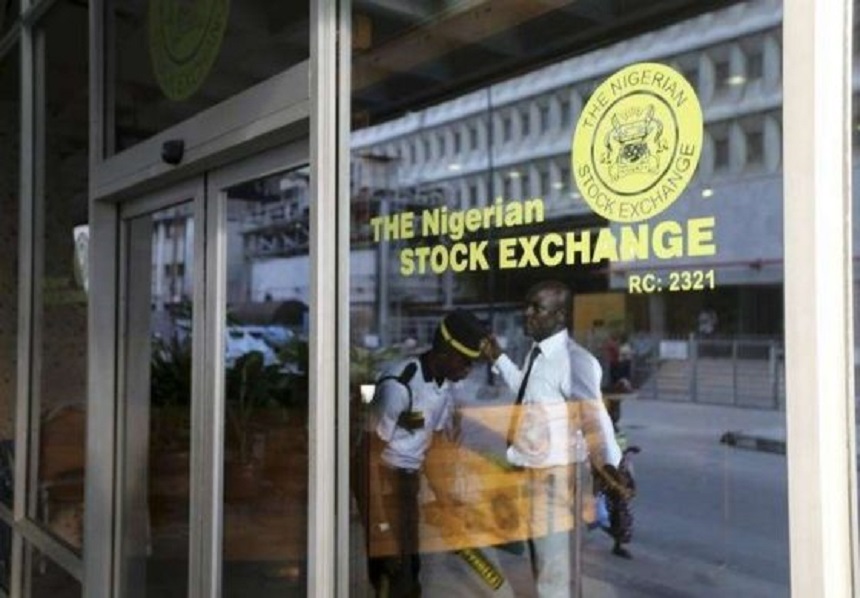
NSE Index Sheds 1.25% as Nestle Loses N145 Per Share

Published

on

NSE All-Share Index

By Modupe Gbadeyanka

Activities on the floor of the Nigerian Stock Exchange (NSE) opened bearish on Monday with the major market indicators finishing in the negative territory.

The equities market closed 1.25 percent lower yesterday with the Year-to-Date (YtD) returns ending at -12.11 percent as the prices of stocks continue to fall.

While the All-Share Index (ASI) depreciated by 426.22 points to close at 33,611.69 points, the market capitalisation reduced by N155 billion to settle at N12.271 trillion.

Business Post reports that the market breadth closed negative on Monday with 21 price losers and 11 price gainers.

The heaviest price loser yesterday was Nestle Nigeria. The company’s shares went down by N145 to close at N1355 per share.

It was followed by Forte Oil, which went down by N1.95k to finish at N19.05k per share, and Global Spectrum Energy Services, which depreciated by 60 kobo to end at N5.75k per share.

GTBank decreased by 50 kobo to settle at N34.50k per share, while Nigerian Breweries reduced by 40 kobo to end at N92.50k per share.

On the flip side, Flour Mills led the gainers’ chart after appreciating by 50 kobo to close at N22 per share.

Custodian Investment rose by 10 kobo to end at N5.50k per share, while Honeywell Flour increased by 8 kobo to settle at N1.52k per share.

UPL also grew by 8 kobo to end at N2 per share, while NPF Microfinance Bank went up by 5 kobo to settle at N1.65k per share.

The volume of stocks transacted at the market on Monday decreased by 11.75 percent from 156 million to 137.6 million, while the value went down by 35.53 percent from N2.1 billion to N1.4 billion.

A breakdown indicated that the Financial Services sector led the activity chart with 121.4 million shares worth N882 million, while the Oil and Gas industry followed with 4.1 million equities valued at N52 million.

Diamond Bank was the most traded stock yesterday, accounting for 30.1 million units exchanged for N40.4 million.

It was followed by UBA, which traded 16.7 million equities worth N130.9 million, and GTBank, which sold 11.3 million shares valued at N390.9 million.

Fidelity Bank traded 10.1 million shares worth N17.2 million, while FBN Holdings transacted 6.6 million equities worth N59.8 million.


Modupe Gbadeyanka is a fast-rising journalist with Business Post Nigeria. Her passion for journalism is amazing. She is willing to learn more with a view to becoming one of the best pen-pushers in Nigeria. Her role models are the duo of CNN's Richard Quest and Christiane Amanpour.

Click to comment

Leave a Reply

Your email address will not be published. Required fields are marked *

Economy

Oil Prices Slip Despite Rising Tensions in Strait of Hormuz

Published

on

oil prices fall

By Adedapo Adesanya

Oil prices fell on Wednesday after the United States’ attacks against Iranian military installations that aimed to limit its ability to strike shipping in the ‌Strait of Hormuz.

Brent futures declined by $1.11 or 1.31 per cent to $83.62 a barrel, while the US West Texas Intermediate (WTI) futures lost 81 cents or 1.02 per cent to close at $78.53 a barrel.

Attacks ​worsened a supply disruption in the Strait of Hormuz, through which about a fifth of the world’s oil and liquefied natural gas passed prior to the war’s outbreak.

The US military said it ​had hit dozens of military targets near the strategic waterway and Iranian coastal areas in strikes lasting seven hours. In response, Iran’s Islamic Revolutionary ​Guard Corps (IRGC) said on Wednesday it had struck American military targets in the region, including in Bahrain, Kuwait and Jordan.

The US military said its fresh strikes on ‌Wednesday against ⁠Iran’s coastal defence systems and cruise missile storage and launch sites were “designed to further degrade military capabilities Iranian forces have used to attack commercial shipping in the Strait of Hormuz.”

The US alleged that said Iran had “intentionally” targeted civilians and attacked seven commercial vessels over the previous week, leaving roughly a dozen crew members dead, missing or injured.

The hostilities between Iran and the US reignited last week, breaking an already fragile truce reached in June after several months of fighting. The collapsed ceasefire precipitated a new crisis in the waterway, and Iran threatened to close all other export corridors that benefit the US and its allies.

The US Energy Information Administration reported a 1.7 million-barrel drop in US crude inventory last week. The American Petroleum Institute (API) had estimated that crude oil inventories in the US fell by 564,000 barrels in the week ending July 10.

Goldman Sachs estimated in a note that Gulf exports recovered to more than ​80 per cent of pre-war levels after the US-Iran memorandum of understanding in June but slipped back below 50 per cent, or ​about 11 million ⁠barrels per day, over the last week.

The bank said Brent could exceed $110 in the fourth quarter this year if the Gulf export recovery continues to stall.

Continue Reading

Economy

NUPRC to Reveal Successful Bidders for 50 Oil, Gas Assets July 21

Published

on

NUPRC

By Adedapo Adesanya

The Nigerian Upstream Petroleum Regulatory Commission (NUPRC) will, at the Commercial Bid Conference, announce the successful bidders for 50 oil and gas blocks in the 2025 Licensing Round on July 21, 2026.

The regulator said the conference would conclude an eight-month licence round that began on December 1, 2025, after President Bola Tinubu approved the exercise under the Petroleum Industry Act (PIA) 2021.

The commission said the 50 blocks include 15 onshore, 19 shallow-water, 15 frontier and one deep-offshore block, covering basins such as the Niger Delta, Chad Basin, Benue Trough, Anambra and Bida.

It said the round aims to attract about $10 billion in fresh investment and to unlock discovered but undeveloped fields, fallow assets and gas resources. NUPRC described the 2025 round as the third licensing exercise under the PIA framework and stressed it is designed to prioritise natural gas development.

NUPRC outlined a five-stage process for the round — registration and pre-qualification, data acquisition, technical bid submission and evaluation, and the commercial bid conference — followed by ministerial approval and contracting. The Commission said it notified pre-qualified applicants on March 16, 2026, and closed technical and commercial bids on June 12, 2026.

NUPRC chief executive, Mrs Oritsemeyiwa Eyesan, had said the selection would be merit-based and would exclude weaker applicants.

She said only candidates with strong technical and financial credentials, professionalism and credible development plans would advance, and that winners would be chosen on a weighted combination of technical and commercial scores.

To widen participation, the federal government fixed signature bonuses for the round in a prescribed range of $3 million to $7 million per block, the Commission said, adding that bids outside that range would be non-compliant and excluded.

NUPRC said it would resolve the tied highest bids within the range by conducting a sealed rebid for the signature bonus, adding that successful bidders will receive Petroleum Prospecting Licences (PPLs) and may elect either a Concession or a Production Sharing Contract (PSC) framework, noting that the choice of framework will determine fiscal terms for up to two decades.

The agency noted that bidders were required to present host community development plans and to commit to remit 3 per cent of operating expenditure to Host Community Development Trusts. It said decarbonisation objectives and broader environmental, social and governance (ESG) requirements were mandatory parts of submissions.

It warned that applicants with government debts, those that had previously failed to develop licences “vigorously and in a business-like manner,” or those found non-compliant with applicable laws could be disqualified at any stage.

The regulator said it expects ministerial approval and formal contracting between July and October 2026, after which awardees must execute concession contracts before licences take legal effect.

Recall that during the 25th Nigeria Oil and Gas (NOG) Energy Week in Abuja, the NUPRC issued PPLs to 12 companies across 19 blocks from the 2024 round. The Commission named recipients, including Boron Energy Limited, Energy Marketing and Supply Limited, Sahara Deepwater Resources Limited, Tulkan Energy E&P Company Limited and said that the exercise showed the licensing pipeline was functioning.

Continue Reading

Economy

Nigeria Needs $38.3bn to Meet 2030 Oil, Gas Production Targets—Verheijen

Published

on

Olu Verheijen

By Adedapo Adesanya

The Special Adviser to the President on Energy, Mrs Olu Verheijen, has said Nigeria requires about $38.3 billion in fresh investment to sustain current oil and gas production and achieve its 2030 output targets.

Speaking at the recently concluded 25th NOG Energy Week Conference and Exhibition in Abuja, Mrs Verheijen said global investors are now prioritising countries with predictable policies, competitive fiscal terms and credible regulatory systems.

“For Africa, that question is urgent. And for Nigeria, the scale of the task is equally clear: to sustain the current base and grow toward our 2030 production target, analysis shows a financing gap of about $38.3 billion,” she said.

According to her, the era when countries relied solely on resource endowment to attract capital has ended.

“Capital has no passport. It is rational. It prices risk. It follows credibility. It asks one question: can this country turn resources into bankable projects, and bankable projects into reliable returns?”

She said Nigeria had deliberately repositioned itself through reforms aimed at improving investor confidence and accelerating project execution.

“We recalibrated fiscal terms, clarified regulation and streamlined oversight. We introduced targeted incentives and cut contracting timelines by more than half. We made a clear statement to the world: Nigeria is no longer asking to be trusted; Nigeria is working to be bankable.”

Highlighting progress recorded under the reforms, Verheijen said Nigeria now has more than $50 billion worth of upstream projects in its visible investment pipeline.

“We now have more than 50 billion dollars of upstream projects in the visible pipeline. In the last three years, more than 10 billion dollars of long-awaited final investment decisions have come through.”

She added that crude oil and condensate production has increased by about 400,000 barrels per day since 2023, while onshore production is at its highest level in two decades.

“Crude oil and condensate production has risen by about 400,000 barrels per day since 2023. Onshore production is at its strongest level in twenty years.”

Mrs Verheijen said the Federal Government remains committed to achieving its target of producing three million barrels of oil per day and 10 billion standard cubic feet of gas daily by 2030, while strengthening Nigeria’s competitiveness in the global energy market.

She also highlighted ongoing reforms in the power sector, including the N4 trillion Presidential Power Sector Financial Reforms Programme, which she described as critical to restoring confidence across Nigeria’s electricity value chain.

On gas development, she said the government was expanding domestic LPG supply, improving affordability and supporting investments through tax and import duty incentives.

“A gas-rich nation cannot be comfortable when families are priced back to firewood, charcoal or kerosene,” she said.

Mrs Verheijen stressed that Nigeria’s ambition extends beyond exporting crude oil to building an industrial economy anchored on value addition.

“We have chosen not merely to produce molecules, but to convert molecules into megawatts, fertiliser, petrochemicals, mobility, manufacturing, jobs and exports.”

She concluded that the country’s reforms were laying the foundation for long-term growth despite lingering challenges.

“The age of Nigerian hesitation is ending. The age of Nigerian ambition has begun. Our task now is to turn reform into relief, capital into projects, projects into jobs, and energy into national greatness.”

Continue Reading